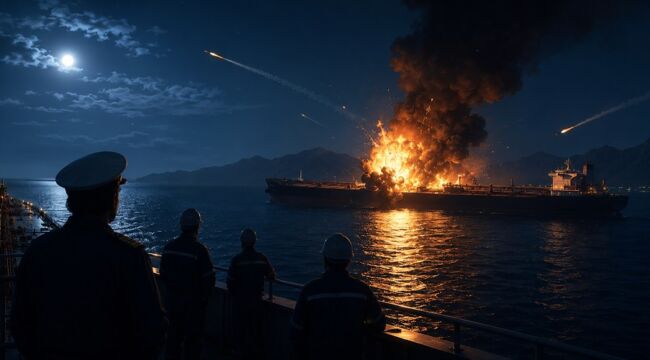

Battle of the Straits
On Monday, Yemen announced a blockade on Saudi oil exports.
At the time we wondered, “Does Yemen have the firepower to shut down Saudi oil exports? We’re about to find out.”
It looks like we have an answer. Yesterday Yemen’s Houthi forces struck 2 full Saudi oil tankers with anti-ship missiles and drones.
The result was catastrophic for both ships:
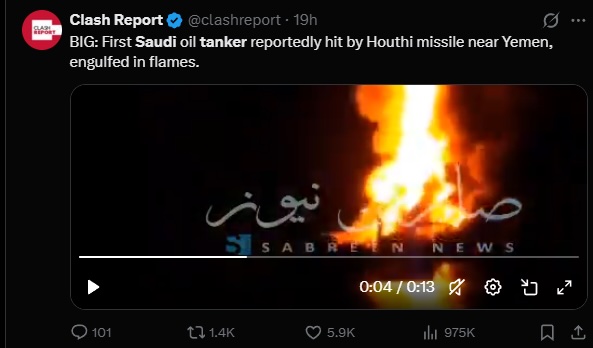
Source: X
This is an ugly development. These VLCC oil tankers are massive. They carry 2 million barrels of oil each, worth about $200 million dollars at current prices. The ship itself is worth another ~$100 million. So two Yemeni strikes caused about $600 million in direct damage, and far more indirectly.
Brent crude oil has since spiked above $100 a barrel.
President Trump responded to Yemen’s strikes this morning on Truth Social:
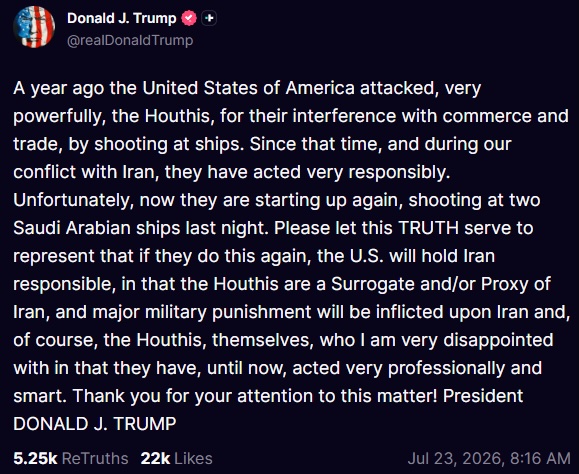
Source: Truth Social
Clearly the President isn’t happy about this development. Saudi Arabia normally exports more than 6 million barrels of oil per day, 6% of the global total. Yemen’s actions have the potential to shut down their exports, plus another key Strait in the area, Bab al-Mandab.
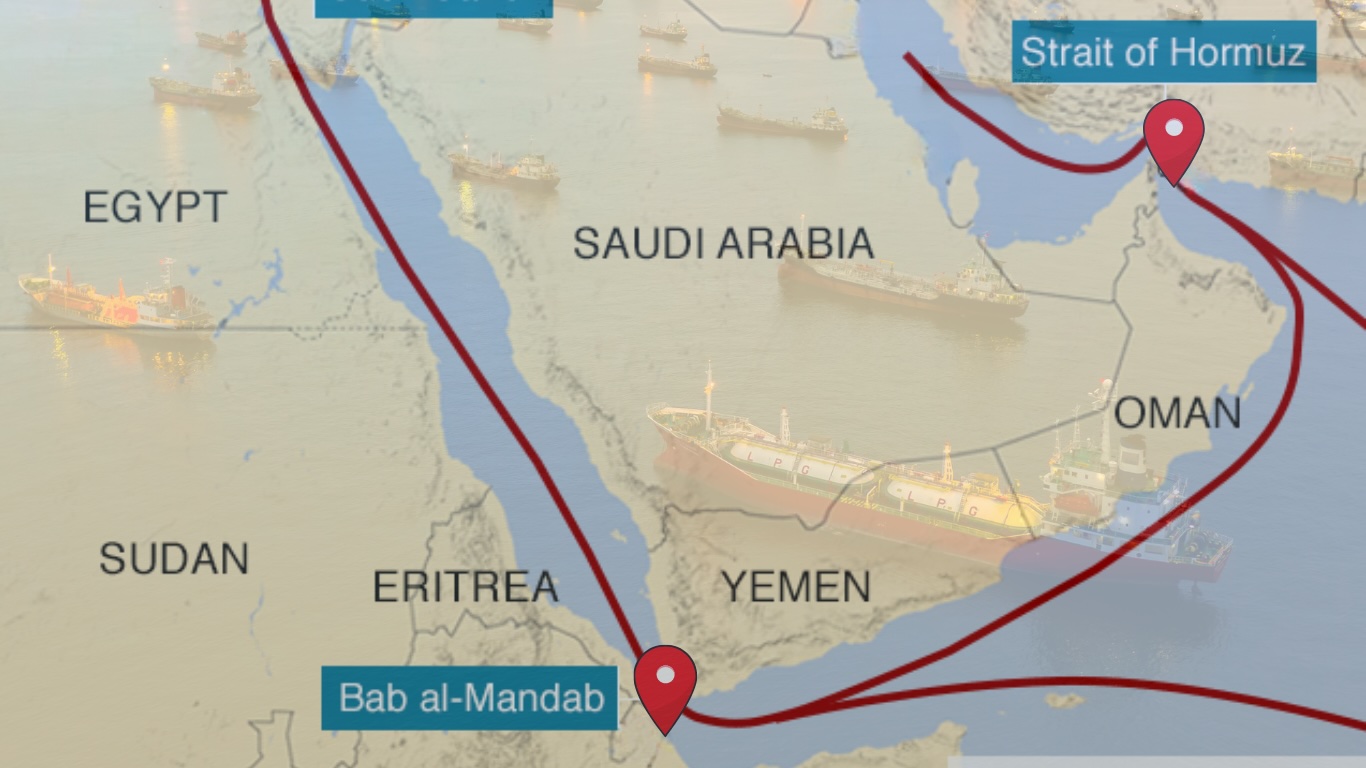
Source: GFSIS
On Monday, we wrote the following about oil, “If the Strait of Hormuz remains closed, and Yemen is able to prevent Saudi exports, we’re going a lot higher.”
Since then, crude is up another ~$14 a barrel. But we could be heading a lot higher. $150+ oil is entirely possible if we don’t get a resolution soon. As we discussed Monday, the world’s oil inventories and strategic reserves are already significantly depleted.
Hormuz Updates
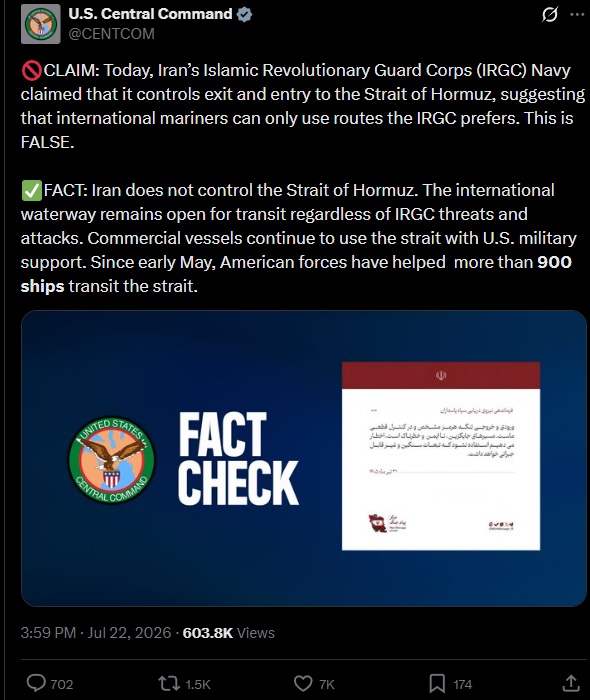
Yesterday, U.S. Central Command (CENTCOM) issued the following fact check on X/Twitter:
Source: CENTCOM
CENTCOM said the Strait of Hormuz is “open for transit regardless of IRGC threats and attacks.”
That’s fine in theory, but convincing captains to cross the Strait at this point is going to be a difficult task. These captains just watched a number of ships burn after missile strikes. Iran has struck numerous ships on the southern route, which passes through Omani waters, and is the preferred U.S. passage.
But the southern route through Hormuz also appears to be heavily mined, and it looks like a few tankers have struck sea mines over recent days.
There’s a heated battle for control of the Strait of Hormuz, and I hate to say it, but Iran appears to be winning. This is their home turf, and they have thousands of anti-ship missiles and drones spread along the coastline. The majority of traffic lately has been taking the northern (Iranian-controlled) path.
Overall, Hormuz crossings have fallen back to about 15 per day. Before the war, 150+ ships were transiting per day. And when the ceasefire was in effect, we briefly got up to 35-40.
Recent strikes on tankers and other ships won’t help. Insurers will be extremely hesitant to offer coverage to ships attempting to cross.
Markets Finally Notice
Investors have mostly shrugged off all this chaos, and U.S. stock markets remain near all-time highs.
But today we’re finally seeing a selloff. The tech-heavy Nasdaq 100 index is down 1.97% as of 2:00 pm ET today, while the S&P 500 is down 1.4%.
Could stocks rally if we see signs of a diplomatic breakthrough? It’s possible. But eventually the market will have to accept the fact that the most likely outcome is further escalation.
If oil stays at current levels, it will negatively affect the global economy in a big way. Prices will rise, consumers will pull back, and the effects will ripple throughout the global economy. If we go much higher, the situation becomes more acute.
We also have to consider the growing strain on fertilizers, industrial metals, and petrochemicals. These are the commodities our world depends on, and a huge chunk of them come from the Persian Gulf.
It doesn’t help that Russia’s energy exports are down sharply due to Ukrainian drone attacks.
Once again, we face a potentially disastrous energy crisis. At any moment, major strikes on oil infrastructure could resume.
Eventually, this conflict will be resolved by diplomacy. But the stage for negotiation will be set on the battlefield.
Both sides want to improve their position by pressuring the other militarily. Neither our U.S. leaders or Iranian ones are ready for compromise yet. Evidently, we need more pain first.
More soon.

Comments: