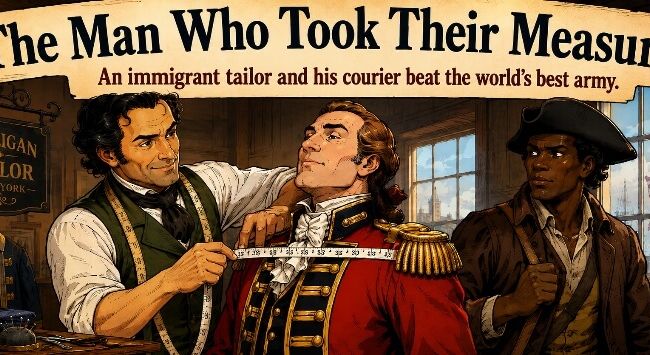

The Man Who Took Their Measure
I was walking through Lower Manhattan early Sunday morning when a window stopped me cold.
It was the poster, pasted across the glass. A tailor fitting a red British coat. A Black man standing beside him. The title read: “Hercules Mulligan and the Spy Network That Saved a Revolution.”
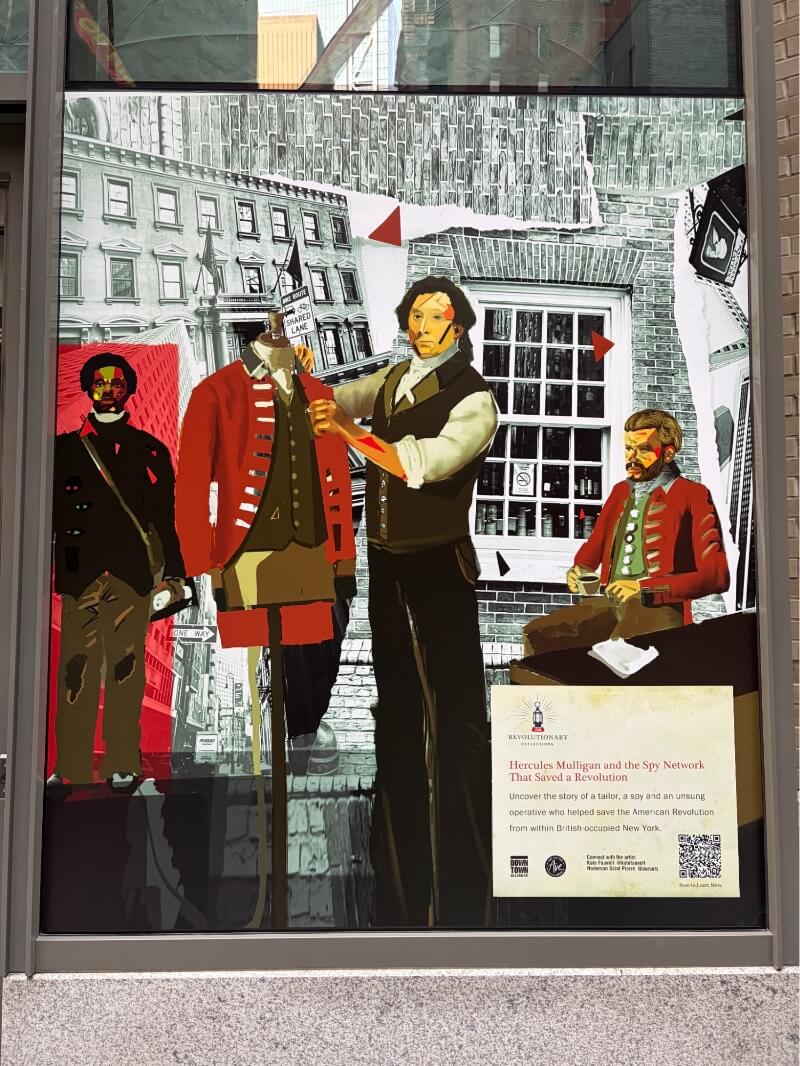
Credit: Sean Ring
I’ve walked those streets a hundred times. I had never heard the name.
That’s a crime. So let me fix it.
The Tailor Who Fooled an Empire
Hercules Mulligan came off a boat from Ireland as a boy. His family landed in New York around 1746. He went to King’s College, which we now call Columbia. Then he opened a tailor shop.
It wasn’t just any shop. It was the best shop in the city. If you were rich in New York, you bought your clothes from Mulligan. And after the British took the city in 1776, that meant British officers, too.
Picture the scene: a proud English colonel walks into the city’s finest tailor’s shop and orders a brand new coat. Mulligan smiles, pulls out his tape, and starts to measure. And he talks, as we know the Irish do so well. Mulligan asks easy questions. He flatters the officer. He listens to his boasts, nodding politely.
The careless officer then brags about the war.
“When do you need the coat back, Colonel?”
“Oh, soon. We march within the week.”
That was it. That was the whole trick.
Mulligan didn’t crack a safe. He didn’t steal a map. He just stood close to vain men who couldn’t imagine that their tailor mattered.
The Blind Spot
The most powerful empire on earth had a blind spot. It couldn’t see the people right in front of it.
To a British officer, a tradesman was furniture. An immigrant was beneath notice. And an enslaved man? Invisible.
That blindness was the crack in the armor. And Mulligan drove a wedge straight through it.
He often knew the British army’s next move from one small tell: when they wanted their uniforms finished. Need it fast? They’re marching soon. It was intelligence hiding in a tape measure.
The British generals had maps, gold, and the finest army in the world. They didn’t have the one thing that wins wars. They didn’t know what was happening on the ground.
But Mulligan did.
Cato Carried It
Mulligan gets the name on the window. But he didn’t get there alone.
The intelligence had to travel out of the city, past British checkpoints, and into Washington’s hands. Mulligan couldn’t make that trip. A well-known merchant taking long walks toward enemy lines would hang.
So the messages went with Cato.
Cato was a black man enslaved in the Mulligan household. He slipped through the lines, carrying secrets, because the British never dreamed a man like him could matter to the war.
Understand the stakes. If Mulligan were caught, he was a wealthy white merchant with connections. He might be traded or jailed. If Cato were caught, he faced a rope.
He was caught. British soldiers seized him and beat him hard, trying to make him talk. The man running the questioning had tortured other American spies. Cato said nothing. They let him go.
Think about that. He was fighting for a “liberty” that, at the time, didn’t include him. And he risked everything anyway.
Mulligan later helped found the New York Manumission Society, which pushed to end slavery in the state. Make of the story what you will. Just don’t leave Cato out of it, even though history nearly did.
Twice, He Saved the General
The legend credits Mulligan with saving George Washington’s life twice.
Once, late on a freezing night in 1779, a rushed officer came in, needing a coat, and let slip that the British planned to capture Washington within a day. The warning went out. Washington slipped the trap.
Two years later, a huge supply order tipped Mulligan off that hundreds of soldiers were being sent to catch Washington on the road. Again, the warning went out. Again, the general got away.
When he turned traitor, Benedict Arnold named Mulligan a spy. Somehow, the fast-talking tailor argued his way out of the noose.
Wrap Up
When the British finally sailed away in 1783, Washington marched back into New York as the most famous man alive.
The morning after, he chose where to have breakfast. He walked to the home of Hercules Mulligan.
Washington’s message was unmistakable. The tailor was a patriot, and Washington owed him.
To be fair, much of this story reaches us as oral history. Careful historians warn the paper trail is thin. Read it with open eyes. But the bones are solid, and the lesson is timeless.
The people who change history are rarely the ones on the balcony. They’re the ones in the room, holding a tape measure or carrying a message no one thought to search for.
The empire watched its generals. It should have watched its tailor.
Go look this man up. Then look up Cato. You’ll walk away taller than when you started.

Comments: