

'This Is OUR Hemisphere'
Welcome to 2026 and a new year with Paradigm Press. We all hope that you had a good holiday season, and perhaps took some time off to relax, recharge and regroup. Many thanks for subscribing. And now, let’s get back to work and make some money, right?
Over the past couple of weeks, I pondered what to discuss in my kickoff article for the year. I thought I’d write about President Trump and his new focus on “battleships” because it has to do with rebuilding the military, plus shipbuilding, revitalizing the U.S. industrial base, and all sorts of really great investment ideas. But that will have to wait because…
Yeah, Venezuela.
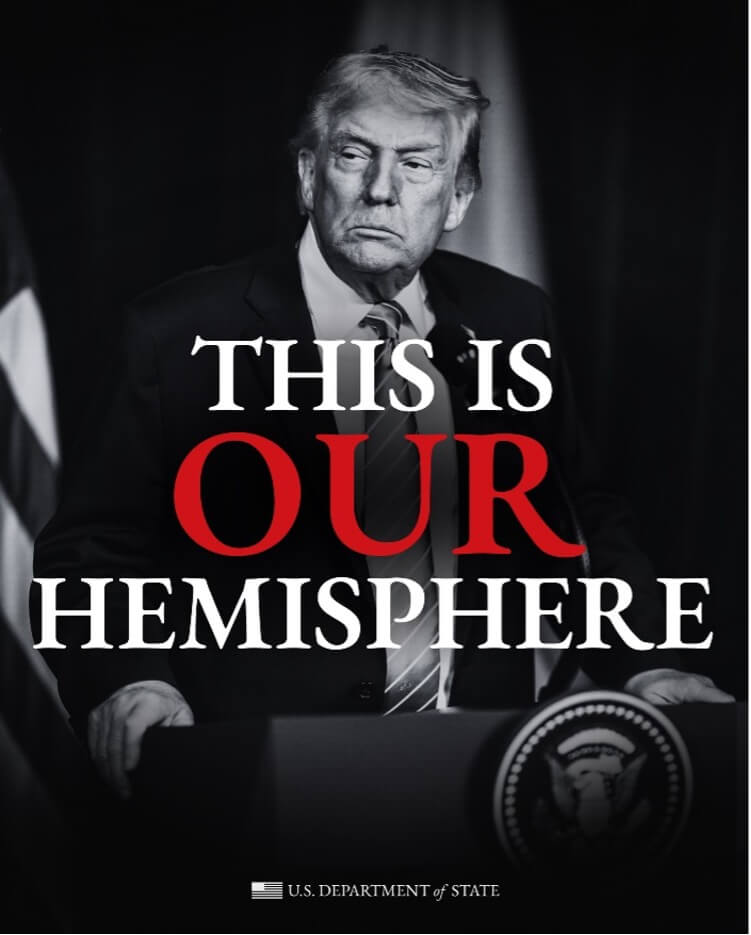
“This is OUR Hemisphere, and President Trump will not allow our security to be threatened.” Official image and statement released by the U.S. Department of State.
“War for Oil?” Not So Fast…
“Venezuela is all about the oil,” say some, like the editors of The Economist, who just released a headline story entitled, “Donald Trump’s Great Venezuelan Oil Gamble.” And there’s a long list of other voices spouting old, tired bromides about a war for petroleum.
People will think what they want, but this is not Iraq in 2003. Nor, in my view, is the so-called “oil gamble” angle the right way to process what just happened in Venezuela, as I’ll explain in a moment.
And even if Venezuela IS “all about the oil,” it’s still not really about oil… except that, yes, you should own shares in key, oil-related companies that will, no doubt, do well in the years to come. On that point, see below.
So, what’s behind the Venezuela op? Well, first, let’s reframe and clarify what happened in Caracas last Saturday morning; it wasn’t the beginning of a war. That is, per black-letter U.S. law and procedure, what occurred in Venezuela was what cops call a “good bust.”

Venezuela “President” Nicolas Maduro in U.S. Custody. White House photo.
Stated another way, U.S. authorities performed a daring and well-executed arrest of two accused and properly indicted individuals charged with serious crimes. And in actual, no-kidding fact, the prime legal agency behind the Venezuela operation was the Department of Justice (DOJ), although obviously with the able assistance of the Department of War. And yes, the military and intel side of the op was brilliant in terms of spies on the ground, electromagnetic warfare, and kinetics, but that’s beside the point.
The takeaway is that what happened was not the beginning of a war, let alone beginning a war for oil. Along these lines, no less than 4-star Air Force General Dan (Raisin’) Caine, Chairman of the U.S. Joint Chiefs of Staff, called the Venezuela action an “apprehension operation.” Which is to say: not a war.
Or consider the words of the U.S. Ambassador to the United Nations, Michael Waltz, who told the Security Council, “There is no war against Venezuela or its people. We are not occupying a country. This was a law enforcement operation in furtherance of lawful indictments.”
Okay, yes… U.S. military aircraft, ships, troops, drones, satellites, spies and much else engaged in capturing and detaining Venezuelan head of state Nicolas Maduro and his wife. But it was not to start or wage a war, and not for oil (again, see below). So, no, this is not 1939 redux, and not like Trump invaded Poland or something.
In grabbing Maduro and his wife, U.S. forces did not act with either political intent or operational-strategic mandate to engage in large-scale combat with Venezuela’s armed forces, let alone to seize and occupy territory. The focus of the mission was a basic “grab and nab” of a drug kingpin, similar to what police forces do all the time, at home and abroad.
Except, of course, that this particular drug kingpin happened to be Venezuela’s head of state, which is definitely unusual. But the man’s political title is not a valid defense when he does non-head of state things like be a narco-oligarch. Seriously, there’s a vast body of both U.S. and international law on this topic.
Along these lines, it’s worth noting that – per news accounts – when Army troops from Delta Force kicked down Senor Maduro’s door, and he and his wife prudently raised their hands to surrender, they were taken into formal custody by a sworn U.S. federal law enforcement agent who read the two detained individuals their Miranda Rights.
Then the captives were taken to a U.S. Navy ship offshore and placed into custody of U.S. Marshals. Eventually they were transferred ashore to a DOJ airplane (a distinctly non-military Boeing 757), and flown to New York, then ferried in a DOJ helicopter to a civilian detention facility in Brooklyn. And yesterday (Monday), they appeared in a U.S. district court before a federal judge for arraignment, each with their respective defense lawyers. And while many news reporters were there as witnesses, not a single serving U.S. soldier or sailor was anywhere in sight.
Meanwhile in Caracas, the people and institutions of Venezuela’s gangster-government remained behind, alive, unharmed, intact, in power, and in control of every square meter of that nation, to include the oil industry, top to bottom. Excepting, to be sure, a smallish number of people who resisted U.S. forces when they came to town to grab Maduro and his better half; yes, they got shot or blown up.
Also yesterday (Monday), Maduro’s vice president, a committed revolutionary Communist named Delcy Rodriguez, assumed power as Venezuela’s acting president. While the entire Venezuelan government of last week, pre-raid, remains installed. As do the Cuban intelligence operatives who remain on site and pull many of the puppet strings in that nation.
Thus, for all the fireworks and bluster, the U.S. has rearranged exactly nothing within the governing structures of Venezuela. The place remains an economically moribund, gangster-narco-state, run by true-believing Communists.
If this was the start of a “war,” it’s not much of a war. No Venezuelan land was seized, virtually no combat power was wrecked, and the entire government apparatus remains intact, absent the criminally accused Maduro and his bride. Just saying…
And now, what about that oil?
Ah Yes, What About the Oil?
Venezuela has what petroleum geologists like to call “beaucoups oil.” And I know about these things because, long ago, I began my professional life as a petroleum geologist.
The U.S. Geological Survey estimates over 300 billion barrels of resource in Venezuela, which puts that nation at the top of the list of world oil domains. Here’s an illustration:
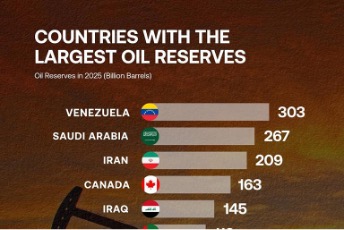
Countries with largest oil reserves. Courtesy MSN.
Clearly, Venezuela’s oil reserves are far ahead of those in Saudi Arabia, Iran, Canada and her oil sands, Iraq, and down the list even Russia and certainly the U.S. with about 40 billion barrels identified and on the national books.
But in general, most of Venezuela’s oil has a big problem that presents massive challenges to geologists, chemists, engineers, transport specialists, refiners, accountants and politicians. That is, the geological fact is that most of Venezuela’s oil is what’s called “heavy, sour crude;” and the term “ultra-heavy” also pertains. Think in terms of gooey asphalt on a hot day.
In essence, most of Venezuela’s oil is thick and tarry, composed of long-chain hydrocarbon molecules. It’s viscous like cool molasses, does not flow well in a pipeline, and requires all manner of engineering and chemical tricks just to lift it to the surface, let alone transport it, store it at a terminal, and load it onto a tanker for export.
At the refinery, Venezuela’s heavy oil is high in sulfur (i.e., “sour”), which requires specialized methods to process. It’s also high in metal content, which again fouls the refining chemistry.
Still, it’s possible to blend Venezuelan crude oil with other forms of oil and then refine it. And in fact, many U.S. refineries were built in the 1950s and 60s to process Venezuelan gunk. But in recent years, due to Venezuelan politics (long story), U.S. oil imports from that country are somewhere around negligible to nil.
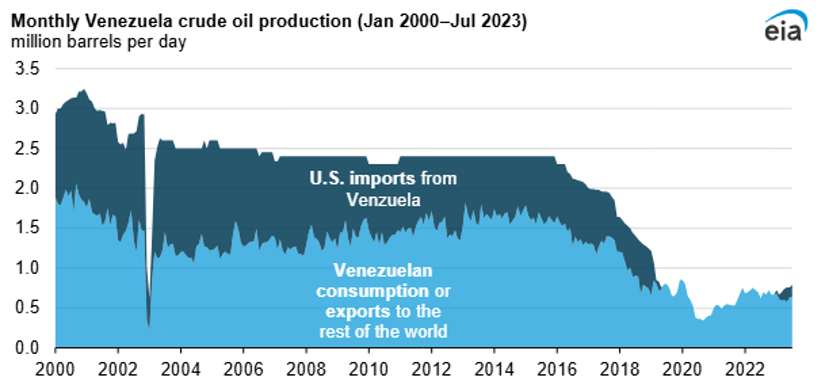
Venezuela crude oil exports, highlighting U.S. supply. Courtesy Energy Information Agency.
So, does the U.S. need Venezuelan oil? Not really. Although sure, yes… U.S. refineries can use it. But anymore, U.S. refiners can get by just fine absent Venezuela, as we see in the graph above of American non-imports over the past seven years.
Meanwhile, notice how Venezuela’s oil output has dramatically fallen from previous levels over the past 25 years, which coincides with the Communist/gangster rule of the late Hugo Chavez and the more recent Nicolas Maduro. In essence, their ignorant and destructive approach to managing the country’s oil industry has been ruinous.
In essence, Venezuela’s oil sector is chronically under-invested to the point of being a widespread wreck. Right now, equipment that remains is old and worn. Pipelines, pumps, power systems, storage tanks, roads and much else are under-capitalized and under-sustained. I’ve seen credible estimates that Venezuela’s oil sector requires over a trillion dollars (that’s trillion, with a “T”) of new investment over the next decade, overseen by a not-small army of technicians and engineers who are not currently resident or available in that nation.
Again, and no matter what President Trump says, or the news media, or Wall Street analysts, or definitely anyone within the still-functioning government of Venezuela, that nation WILL NOT INCREASE OIL OUTPUT by any significant level, not any time soon. It won’t happen because it can’t happen. Not soon and not cheap.
If nothing else, Venezuela requires the energy equivalent of a “Petroleum Marshal Plan” to revise its oil sector. And currently, with oil in the mid-$50s range in price – and priced much lower for Venezuela’s problematic, heavily discounted output – the return on capital investment just ain’t there.
And sure, I could continue all day with details of other oil issues for Venezuela, but you get the picture, right?
What’s Next for Venezuela and South America?
Despite the profound problems, oil does make Venezuela important to the global energy sector. The country runs a vast resource, just not very well.
Meanwhile, consider the situation if Venezuela’s main claim to fame was its exports of plantains and vanilla bean extract, versus oil. Few would really care about the place. Or would they?
Actually, yes. It’s more than likely that China and Russia would still care about Venezuela even absent the oil, if for no other reason that its strategic geography at the south end of the Caribbean Sea and eponymous basin.
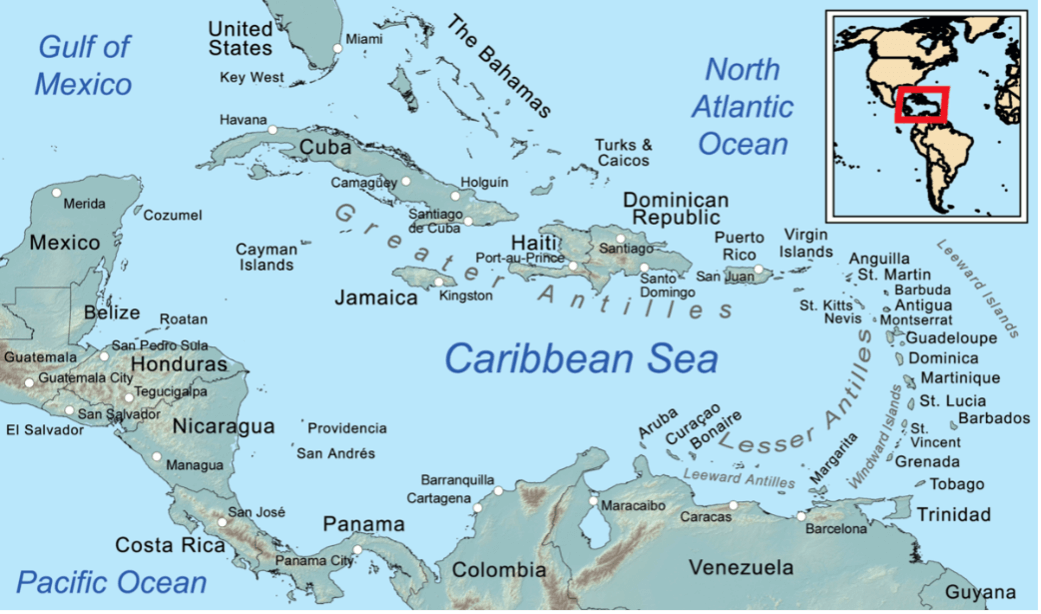
Map of Venezuela and region. Wikipedia.
Ask any serious student of strategy or operations to decipher this map. Obviously, Venezuela holds great value as real estate – if not as a vast and unsinkable aircraft carrier – directly along sailing routes into the Gulf of Mexico (aka Gulf of America), as well as the Panama Canal to the west. And then to the east there’s the middle of the entire Atlantic Basin. So yes, it’s strategic.
Again, I could discuss this all day but you get the picture, right? Venezuela is much more than an oil play. The country has strategic location, not to mention fertile farmland, fresh water, fishing zones offshore, minerals, and the basics of an educated population that has been very productive in recent historical times, pre-Communism of the past quarter century.
And this gets us back to that State Department image at the top of this note, about how “This Is OUR Hemisphere.”
That is, under President Trump the U.S. is strategically adjusting to new balances of power in the world, to new correlations of forces in a multipolar system.
Russia is Russia, with its long-known and advertised “near abroad,” an idea that dates to the 18thcentury and Katherine the Great. While China is China, the colossus of Asia and global center of manufacturing power and much else. And again, people write long books on this, but you get the idea, right?
Clearly, President Trump is refocusing the U.S. on this hemisphere, certainly on North America and also exerting heavy influence in South America.
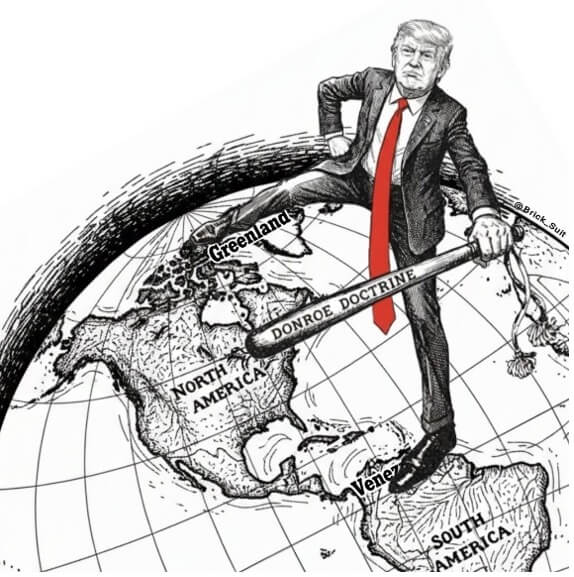
From Monroe to Donroe. Courtesy Brick Suit on X/Twitter.
People can joke around and parody all they want, but Trump is reasserting and revising the old Monroe Doctrine. The original Doctrine of 1823 was President Monroe’s a response to Western Europe’s clear political dysfunction that came out of the Napoleonic Wars, with associated independence movements in Latin and South America to cast off mostly Spanish and Portuguese colonialism.
In the current environment, the U.S. is in essence telling China, Russia and Iran to stay out of America’s backyard. The Caribbean is America’s “near abroad,” to borrow that Russian phrase, and under Trump’s presidency foreign incursions must stop.
This is a new version of Great Power politics, of Realpolitik. For many decades, American policymakers foolishly permitted distant powers to influence and create political rot in Latin and South American states, while Americans paid the price in open borders, mass immigration, drugs, money laundering, human trafficking and other forms of criminal instability.
Trump’s approach appears to be “Our Hemisphere First,” to restore some semblance of geographical security versus acceding to abstract globalist ideals. It’s a work in progress and we’ll see where it all goes.
Investment Angles
You can agree or disagree with what I’ve laid out above. But one thing is pretty much baked into the cake, and it’s that certain companies ought to do well in the years to come as Venezuela rebuilds its oil industry, slowly or at any other rate.
If nothing else, the Van Eck Oil Services ETF (OIH) should do well. Plus, the old stalwarts of oil service firms,Schlumberger/SLB (SLB), plus Halliburton (HAL). And I like Oceaneering (OII) for offshore maintenance and redevelopment.
Oh, and one last item… if you are free on Monday afternoon (Eastern Time), January 19, 2026, you are invited to listen in to a discussion about metals, mining, energy and other investment angles in Argentina and South America.
The host is our old friend, Joel Bowman, who writes from Buenos Aires, and his panel will include the esteemed scholar of hard assets Rick Rule; as well as a wonderful, brilliant old friend and long-time writer from the Agora Financial days, Eric Fry; and yours truly, your humble editor.
Again, here’s the sign-up link for the January 19th “End of the World Summit,” and be sure to mark your calendar.
Thank you for reading, and best wishes for 2026.

Comments: