The Fed’s Pickle, Gold, and Silver

On Friday, Fed Chair Kevin Warsh spooked precious metals with his “hawkish” commentary.
Both gold and silver fell around 3% following the Fed’s press conference.
Warsh talked tough about inflation, leading to fears of interest rate hikes.
According to many financial commentators, interest rate hikes are bad for precious metals. After all, there’s no yield on bullion. So the modern view says that when yields go up, it makes bonds and CDs more attractive, and gold and silver less so.
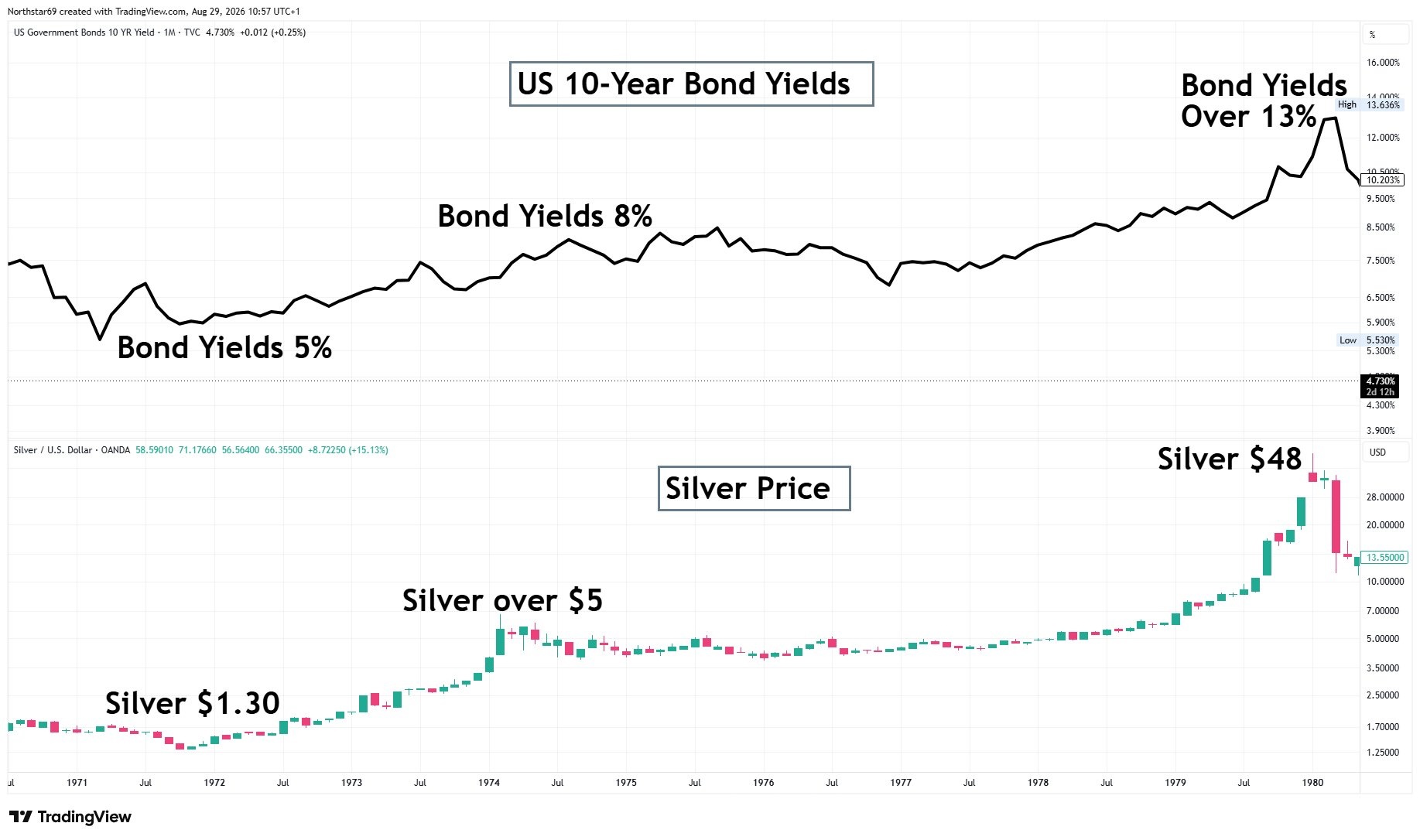
But in reality, the relationship isn’t nearly so clean. See the chart below, which covers the period from 1970-1980. It shows U.S. 10-year bond yields on top, and the price of silver below.
Source: Northstar Charts on X
As you can see, U.S. bond yields and the price of silver moved up together throughout the 1970s. Silver moved from a low around $1.30 per ounce to nearly $50, at the same time yields moved from 5% to 13%.
During the same period, gold moved from $35 to a peak of around $850.
So it’s clear that precious metals can move higher during periods of rising interest rates.
In 1980, interest rates and yields peaked. According to how people think about it today, you might assume that’d be great for precious metals. But gold and silver peaked in 1980 along with rates.
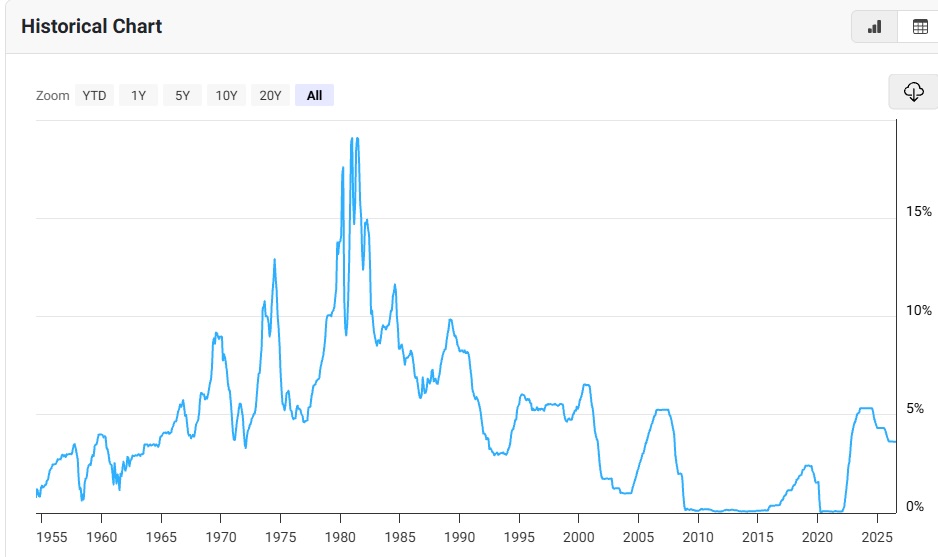
The chart below shows how since 1980, interest rates (fed funds rate) have been on a downward trend.
Source: Macrotrends
The gold and silver bear market lasted all the way from 1980 to 2000, when gold bottomed at $262/oz and silver hit $4.58/oz.
Now it is true that in 2000, following the dotcom crash, low interest rates coincided with a precious metals bull market, which lasted until 2011.
But the relationship is not as solid as some would like you to believe.
Each Era is Unique
Studying the 1970s is worthwhile, especially for gold and silver bugs. There is much we can learn from the price action, causes, and investor psychology.
The 1970s are remarkable because during that decade, gold was de-linked from the U.S. dollar. It was the last decade when we saw sustained stagflation (slow growth, high inflation).
But the ‘70s was a very different time. U.S. debt wasn’t even at problematic levels. Throughout the decade debt-to-GDP remained around 35% (our total federal debt was just about a third of annual economic activity).
Today America’s debt-to-GDP is over 120%. We simply cannot do what Fed Chairman Paul Volcker did in the late 1970s and early 1980s, and jack interest rates up to 20%. If we ever tried to, the cost of paying interest on our debt would soar to around $5 trillion per year within 5 years. And total tax revenue in the country is just $5 trillion per year.
I believe interest rates in the U.S. are currently near the maximum realistic level. Any higher and the debt will compound rapidly. Could it happen? Sure, but it wouldn’t last long.
This is why I continually return to the 1940s, as I believe it’s more similar to our current situation than the 1970s.
In the 1940s, we had unpayable debts from World War II. The way we got out of them was by holding interest rates and yields at artificially low levels. Inflation got as high as 19% annually, and yields on U.S. government bonds was around 2.25%. That path is far more likely than the Fed raising rates to squash inflation.
Tough Talk from the Fed
The other thing we need to realize about the Fed is that central bankers always pretend they are diligent stewards of the currency.
They’ll talk about how inflation above 2% is completely unacceptable, like Warsh did on Friday.
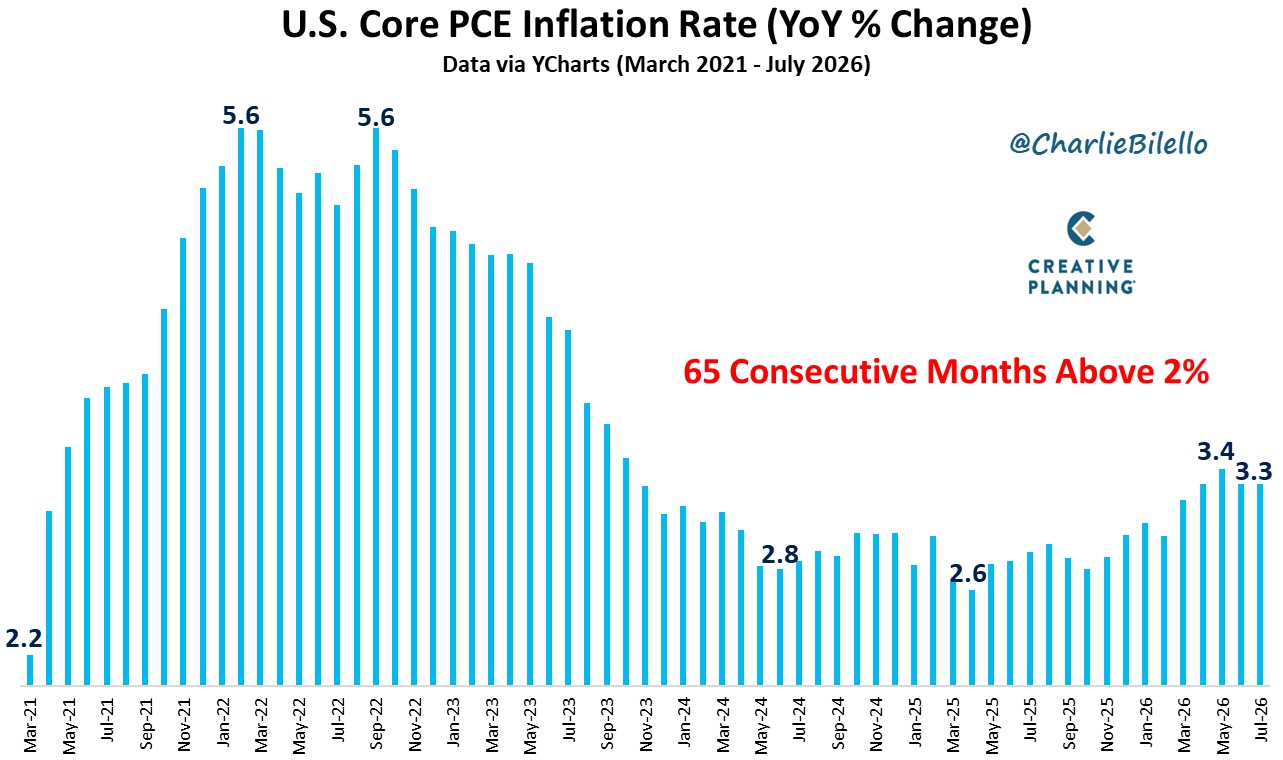
They will do this despite the fact that “Core PCE”, the Fed’s preferred measure of inflation, has been above their 2% target for 65 straight months.
Source: Charlie Bilello
The fact that inflation has been well above target for more than 5 years tells us a lot. If the Fed truly thought they could get back to 2% inflation by raising rates further, wouldn’t they do it?
That brings us back to the debt compounding problem. If they raise rates, or even keep them at current levels, the cost to pay interest on our debt soars.
The truth is there’s no good solution to these problems. And there’s no hard and fast rule about what effect interest rates will have on precious metals.
So precious metals sold off on Warsh’s remarks. But it’s not as simple as “The Fed might raise rates, sell gold!”.
I think the explanation is much simpler. Between July 20th and August 25th, gold rose from $4,025 to $4,678. That’s a very nice move. It needed to take a breather. That’s all.
The U.S. government has a huge pile of unpayable debt. Anyone who assumes we’re going to let interest rates rise much further is mistaken, in my view.
Eventually the only realistic option is to follow the 1940s playbook. Keep interest rates and yields at rock-bottom levels, even if inflation is problematic. Textbook financial repression. Vast sums of money will be printed.
And for me, that means precious metals and hard assets are must-own assets. For at least the next 5-10 years, and possibly longer.