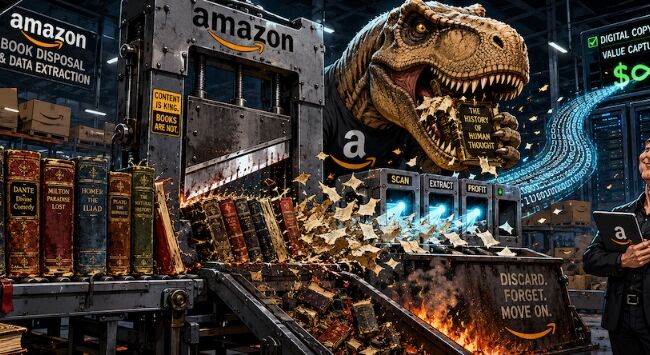

The Book Guillotine
Vandals! Scoundrels! Savages!
I make it a rule not to get offended by things that don’t involve me, lest I sprout blue hair and a nose ring. But this has got me raging as few things do.
If you’ve read my scribblings for a while, you’d know there are few things in life I love more than reading books: beautiful, dusty, dog-eared books, preferably leatherbound. Sure, I take my Kindle on the road to make my bag lighter. But I came home from the US recently with no less than a dozen books weighing down my luggage.
As a parent, there’s nothing more important to me right now than to get my son Micah into the habit of reading. Thanks to the gnat-like attention span of his generation, the ability to read, comprehend, and learn from books will give him an unassailable advantage over his peers.
And yet, in the name of “progress,” which rarely, if ever, moves anything forward, we’re destroying our physical legacy in the name of byte-sized literature and all the sterile consequences that entails.
Calling Out the Vulgarians
A hat tip before we begin. Mike Kobe (Wild Horse), who posts as @Oklahoma_Brave on X, flagged this story. He’s a Comanche-American who loves history and books, and he gave the only advice that matters: hold on to your old books and hand them down to your kids. He saw it first. We must give credit where it’s due.
Now, the story itself.
Jeff Bezos started his empire selling books out of a garage in 1994. Thirty-two years later, his company runs a warehouse in Las Vegas where workers scandalously slice the spines off rare books, feed the loose pages into scanners, and throw the remains away.
That’s the circle of life, Big Tech edition.
That Can’t Be True!
For about a year, rare booksellers noticed something odd. Huge, scattershot orders were coming in. A thousand titles at a clip. The buyers didn’t haggle, and they didn’t seem to care what they got. A history of Connemara sat next to a personal finance guide. No collector buys like that. But a machine might.
The trade suspected AI companies were behind it, but nobody could prove it. So the journalists at 404 Media did something beautifully simple. In July, they teamed up with an independent bookseller who had just received an anonymous 1,000-book order through Biblio, the big independent book marketplace. The seller slipped a $29 Apple AirTag inside one of the volumes and shipped the order.
Then they watched it move.
The tag flew to Milwaukee. It sat two weeks in a distribution warehouse near Kenosha, Wisconsin. A truck hauled it west through Grand Junction, Colorado. Then the signal stopped at LAS8, a high-security Amazon facility in northeast Las Vegas.
The book didn’t land just anywhere in LAS8, either. It ended up in a corner of the building run by a unit called VGT3. The logo painted on its doors is a Tyrannosaurus Rex clutching a book. I wish I were making that up. Somebody at Amazon looked at a dinosaur devouring the written word and thought it was the perfect mascot. It reminds me of the Fabian Society in England, whose logo is a wolf in sheep’s clothing.
At least they’re honest. So let’s take them at their word.
Guillotine Scanning
In the print trade, the machine that chops a book’s spine is called a guillotine. VGT3 runs them at industrial scale. Workers there told 404 Media the job is one thing, all day long: cut the bindings off incoming books so the pages feed the scanners faster, digitize everything, and discard the originals.
Call it guillotine scanning. The book goes in whole. The words come out as data. Nothing physical survives.
Why would the world’s richest companies pay retail for obscure, out-of-print titles just to destroy them? Because pre-2022 human writing is the last clean water supply on Earth.
The open internet is now polluted with AI-generated text. Train a model on AI slop, and you get a photocopy of a photocopy, a machine eating its own output. But a book printed before the chatbot era is guaranteed pure human thought. Rare and obscure titles are even better, because they likely never made it online. That makes them fresh feedstock no rival model has ingested.
So the frontier labs are strip-mining the one asset that can’t be printed: the pre-AI human record.
Amazon wouldn’t confirm the AI angle. The company told 404 Media it buys books “through commercial channels” to improve its products and services. Note what’s missing from that sentence: any mention of AI, and any denial of the destruction.
One bookseller summed up the corporate mindset for the reporters: “They just want the content as a bunch of words strung together.”
The Cantillon Angle
Regular readers know where I’m going. The Cantillon Effect says those closest to the money spigot buy real assets first, before prices adjust. We usually talk about it in terms of land, gold, and equities. But watch what’s happening here.
Flush with cheap capital and AI-bubble equity, trillion-dollar companies like Amazon are converting an irreplaceable physical asset, civilization’s printed memory, into proprietary digital capital. The scanned file doesn’t go to a library. It goes into a private training set behind a corporate firewall. You can’t borrow it, inherit it, or even confirm it exists.
The book was a bearer asset, like the bonds of old. Whoever held it, owned it. No permission was required, no server was needed, and no subscription had to be renewed. The scan is a permissioned asset, owned by a corporation, accessible only through its products, on its terms, and at its price.
That’s the trade Amazon just made, 1,000 books at a time: your bearer asset for their walled garden. And they made it with books they bought fair and square, which is why nobody can stop them.
Not every old book is a Gutenberg Bible. Most of what’s getting pulped is worth twenty bucks. But value isn’t only price. A regional history, a first-person war memoir, a small-press labor of love: these carry information that exists in only a few hundred physical copies. Every copy guillotined brings some titles closer to existing only as weights inside a model.
Wrap Up
Mike Kobe’s advice was right.
Keep your books. Real shelves, real paper. A physical library is knowledge you own outright, with no platform, no license, and no terms of service.
Hand them down. A box of books passed to your kids is a bearer instrument of civilization. It works during blackouts (with candles, of course), and it never gets a software update.
Buy the odd book and the local one. Regional histories, out-of-print technical manuals, small-press runs. These are exactly what the scanners want, which tells you what’s becoming scarce.
And think about what this signals for the broader trade. The AI complex is now paying real money for physical inputs. Books today, but also copper, power, land, and water. When digital empires start hoarding analog assets, believe the hoarding, not the press release.
Amazon’s first product was the book. Its newest facility eats them. If that’s not the clearest chart of where this era is headed, I don’t know what is.
The T-Rex on the door is a confession. Believe the barbarians.

Comments: