
Jim Rickards: Inside Trump's ‘Donroe Doctrine’
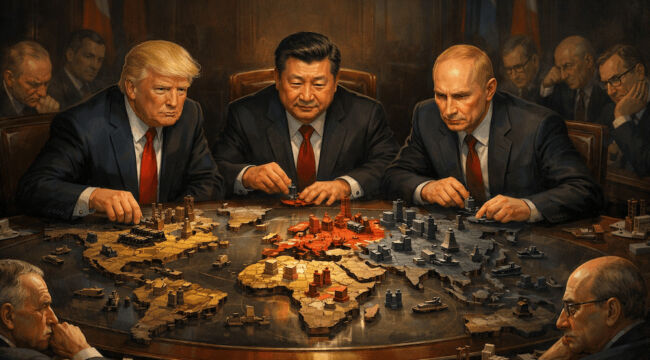
The geopolitical chessboard, after two decades of relative calm, is heating up again.
Major powers are maneuvering their pieces, looking to secure their own interests and spheres of influence.
China is eyeing Taiwan and expanding its reach worldwide. Russia is on the verge of winning in Ukraine, and taking a big chunk of territory. Putin also appears to have aims of bringing neighboring allies into the Russian Federation.
Power struggles are playing out across Africa, Asia, and South America.
And now President Trump has arrested Nicolas Maduro and taken control of Venezuela. Needless to say, the implications here are massive.
Fortunately our friend Jim Rickards just recorded a new interview where he breaks down the entire situation and explains what it all means.
Today, let’s review Jim’s key insights. Then we’ll link to the full interview at the end.
The Donroe Doctrine
The Monroe Doctrine was a foreign policy implemented in 1824 by U.S. President James Monroe. In essence, it was an agreement with Europe that they would stay out of the Western Hemisphere, and we wouldn’t meddle in European affairs.
Now President Trump is enacting his own “Donroe” Doctrine, essentially declaring that the Western hemisphere is under America’s sphere of influence. Interestingly, using the Monroe comparison would imply that the U.S. is taking a step back in Europe and Asia.
The arrest of former Venezuelan President Nicolas Maduro is a statement. The Donroe Doctrine’s first major action.
In Jim’s new interview, he explains, “Venezuela has the largest oil reserves in the world. But their output is lower than it should be.”
Naturally, Trump will look to have U.S. oil firms dramatically increase Venezuela’s production. The President said as much on Saturday, shortly after Maduro’s arrest:
“We’re going to have our very large U.S. oil companies, the biggest anywhere in the world, go in, spend billions of dollars, fix the badly broken infrastructure, oil infrastructure, and start making money for the country,”
In the new interview, Jim explains that it will take a lot of time and money to bring Venezuela’s oil production up to its potential. But if the country can become a major producer again, the implications are big.
Venezuela kicked out U.S. companies and seized their assets long ago. Now these companies will finally regain access to a very large resource base. American oil majors like Chevron and Exxon are trading higher today on the news.
Importantly, Jim notes that China buys the vast majority of Venezuela’s oil. They were previously paying for that oil using Chinese yuan currency. Now it’s likely they’ll be paying in dollars, if they are allowed to buy it at all. Trump just gained another card to play in the trade war.
Next, Jim reminds viewers that America is already the world’s largest oil producer. With Venezuela’s reserves now essentially under U.S. control, this could create an oil bloc to rival OPEC.
Bloomberg’s Javier Blas put together a chart showing the potential oil empire that Trump is attempting to assemble:

Source: Bloomberg
Remarkable.
Beyond Venezuela
The apparent ease with which the Trump admin pulled this plan off is a powerful statement.
In the interview, Jim notes, “There are a lot of other leaders in the region who Trump is at odds with. I’m not saying Trump is going to go in and kidnap Sheinbaum [Mexican President] or Lula [Brazilian President]. But he could attack drug facilities in Mexico.”
For a few months now, Jim has been discussing the possibility of military strikes against Mexican drug cartels. Now that the Donroe Doctrine is in effect, the chances of this happening are up.
Jim also discusses how the Venezuela situation could affect decision making in Brazil, where President Lula has imprisoned his conservative opponent, former President Bolsonaro. He hints that this might make Lula think twice about messing with Trump’s allies in the country. And I suspect it will.
Mr. Rickards also explains that American control over Venezuela’s oil reserves could even affect the war in Ukraine. If Trump is able to substantially increase oil production, this would hurt Russia and make them more likely to agree to the President’s peace deal.
And let’s not forget about Iran. The removal of Maduro is a reminder that America still wields significant power through its special forces and intelligence agencies alone.
It’s no surprise the world looks to Jim Rickards for geopolitical analysis. This interview is essential viewing for anyone seeking to understand the implications of the Donroe Doctrine.
Because of the importance of this topic, we’ve unlocked Jim’s latest interview for everyone. Normally these pieces are only available to members of Strategic Intelligence. Feel free to share widely.
Enjoy:
Watch Jim’s full interview with Paradigm Press Publisher Matt Insley.

Comments: