
Better Than Machiavelli
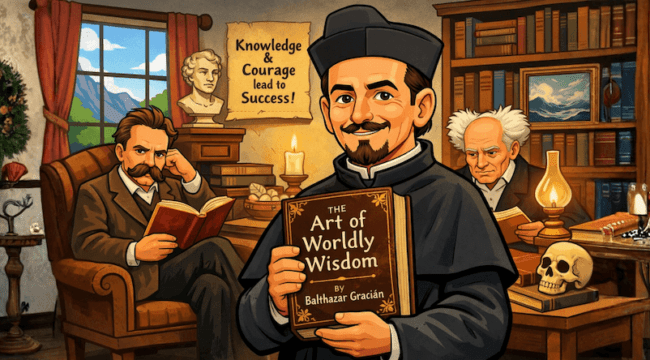
There’s a book sitting on the shelves of some of history’s sharpest minds, and yet most people have never heard of it. Nietzsche called its author “Europe’s greatest moralist.” Schopenhauer translated the book himself and kept it on his nightstand.
A Spanish Jesuit priest named Baltasar Gracián wrote The Art of Worldly Wisdom in 1647. It’s a collection of 300 short maxims about how to move through the world without being eaten alive by it. Each one is a golden nugget of practical wisdom, the kind that makes you put the book down and stare at the ceiling for a minute.
Gracián wasn’t writing for idealists. He was writing for people who had lived enough life to know that talent alone doesn’t win, good intentions get you nowhere without social intelligence, and the world judges you not by what you meant but by what happened. In other words, he wrote for adults. He wrote, in many ways, for people who are exactly the age you are now — old enough to have been burned a few times, wise enough to want a better map.
Here are five things Gracián understood about life that most people spend decades figuring out on their own.
1. Prudence Is Not Timidity — It’s the Master Skill
Gracián elevates prudence above all other virtues. As Gracián defines it, prudence is the ability to see clearly, think ahead, and act deliberately rather than reactively. “It is far easier to prevent than to rectify,” he writes.
How many professional problems, strained friendships, or financial headaches in your own life began because someone (you, or someone around you) acted on impulse when a pause of five minutes might have changed everything? Gracián’s point isn’t that you should be slow or fearful. It’s that the person who anticipates — who thinks two moves ahead the way a chess player does — operates with an enormous advantage over everyone reacting to the present moment.
He also warns against staking everything on a single outcome. Don’t put all your hopes, your identity, your security into one throw. This is the kind of thinking that keeps you resilient when things, as they inevitably do, go sideways.
2. You Can’t Lead Anyone Until You Can Lead Yourself
“First be master over yourself if you would be master over others.” It’s one of those lines that sounds like a fortune cookie until you really sit with it.
Gracián argues that self-knowledge and self-discipline are virtues and prerequisites for effectiveness in the world. Vanity drives a person to make poor decisions because their ego is doing the thinking. The person who can’t control their temper telegraphs their vulnerabilities to everyone around them. The chronically anxious person sees threats that aren’t there and misses opportunities that are.
Gracián asks for an honest self-inventory. Know your chief fault — the tendency that most reliably gets you into trouble — and work on it with the same seriousness you’d bring to any important project. For some people, it’s stubbornness. For others, it’s the need for approval, or a sharp tongue, or a habit of catastrophizing. Whatever it is, it will cost you until you name it.
There’s something particularly useful about this at midlife and beyond. By 55, most of us have enough history with ourselves to actually do this exercise honestly. We know what our patterns are. Gracián simply asks whether we’ve decided to do anything about them.
3. Reputation Is Capital — Spend It Carefully
This is where Gracián sounds most modern, because what he’s describing is something we now understand intuitively in the age of professional networks and social media: your reputation precedes you into every room you enter.
His maxim is “Do, but also seem.” He’s not encouraging phoniness. He’s making a cold-eyed observation that doing excellent work in obscurity produces far fewer results than doing excellent work and being known for it. As he says bluntly, the world judges outcomes. The project that failed spectacularly will be remembered long after the ten that quietly succeeded.
This means being economical with your words. Know that unnecessary talk, clever criticisms, and casual disparagement of others all leave residue. The person you mock at dinner tonight might be the person whose opinion matters in three years. The colleague you undermine in a meeting will remember. Gracián counsels a kind of social restraint that isn’t about being inauthentic but about understanding that everything you do and say is a deposit or a withdrawal from an account you’ll need to draw on later.
He also notes the particular danger of making enemies of people who have nothing to lose. Someone with status, reputation, and a future has reasons to behave with restraint. Someone with none of those things has no such incentive. It’s a point that sounds ruthless but is accurate.
4. The People Around You Are Your Fate
Gracián writes that you should study human nature “as closely as any book,” and the reason is straightforward. The people you spend your time with shape who you become, what you’re exposed to, and what happens to you. Wise friends, he says, “engender success.” Foolish or envious ones do the opposite.
This isn’t about being calculating in your friendships. It’s about being honest about relationships having direction. They either pull you up or pull you down, expand your thinking or narrow it, energize you or drain you. Most of us know this instinctively but resist acting on it because cutting ties feels disloyal, or because familiarity is comfortable even when it’s limiting.
Gracián places special emphasis on mentors and protectors. These people are ahead of you, can teach you, and have already navigated terrain you haven’t reached. At 55, you may be that person for someone else now. But the logic works in every direction. Maintaining proximity to people who are wiser, more experienced, or more capable in areas where you want to grow is one of the highest-return investments you can make.
He’s equally clear about who to avoid: the malicious, the unstable, the envious, and anyone whose reputation would contaminate yours simply by association. Some of this is self-protection. Some of it is recognizing that certain people are genuinely toxic, not because they mean to be, but because that’s what they reliably produce.
5. Be Ethical. Be Adaptable. Know the Difference.
This is perhaps Gracián’s most nuanced point, and the one that most distinguishes him from simple cynicism. He is not telling you to be duplicitous, manipulative, or unprincipled. He is telling you that rigid moralism, the insistence on applying the same response to every situation regardless of context, is its own kind of failure.
Real wisdom, for Gracián, involves timing. Knowing when to speak and when to be quiet. Knowing when to press an advantage and when to let things settle. Knowing when a situation calls for flexibility rather than a principled stand that accomplishes nothing except making you feel righteous.
He accepts that the world is flawed and that you will sometimes need to practice reserve, hold your cards close, or decline to share everything you know or feel. This isn’t hypocrisy; it’s discretion. The difference between the two is intention and character. A person of integrity who chooses their moments carefully is very different from a manipulator who has no fixed values at all.
The deeper point is about adaptability. Have the capacity to see both the advantages and disadvantages in any situation, and to adjust without losing your core. In Gracián’s view, the person who can do this consistently is more effective and more stable, because they’re not perpetually at war with reality.
Wrap Up
The Art of Worldly Wisdom has survived nearly four centuries because it describes human nature, which hasn’t changed much. The social dynamics Gracián mapped in the courts and institutions of Habsburg Spain are recognizable in every modern office, family system, and community.
What makes it worth reading now, specifically, is that it rewards experience. Many of these maxims will land differently in your 50s or 60s than they would have in your 20s, because you’ve lived enough to recognize what Gracián’s describing. The person who made an enemy unnecessarily. The moment you spoke, when silence would have served you better. The relationship that cost you more than you care to admit. The opportunity that slipped by because you hesitated, or the one you rushed into.
Gracián’s book doesn’t moralize at you. It simply holds up a mirror to the world and asks whether you’re going to navigate it with your eyes open or closed.
At this point in your life, the answer should be easy.

Comments: