

Gold and Silver vs. The Fed
Yesterday, the Federal Reserve increased interest rates by 0.25%.
During the press conference, Warsh conveyed a hawkish message (meaning the Fed is likely to hike more).
Gold and silver fell immediately after the Fed decision to hike. Here’s a chart posted by our buddy Sean Ring yesterday in the Paradigm app. See that red candle down at the end? That’s when the Fed announced the rate increase.
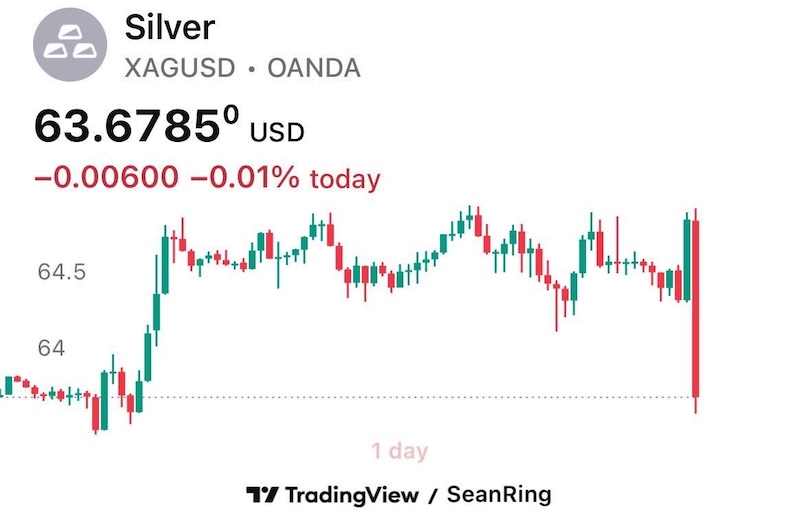
It wasn’t a big move. We went from being up around 1.5% to flat. But the timing was unmistakable. As soon as the hike in fed funds rate hit, precious metals dumped.
So is it as simple as “higher interest rates = lower precious metals prices?” The theory is that when yields on U.S. Treasuries rise, gold becomes less attractive.
But it’s not really true, as we will explore.
Because today, gold spiked 2.4% higher to $4,387 per ounce. Silver jumped 4.29% to $66.56. Now that’s a nice move.
Back to the 1970s
The 1970s is one of my favorite periods to study. It was a decade of brutal stagflation.
Investors who thrived did so by buying hard assets. Gold, silver, real estate, commodity producers.
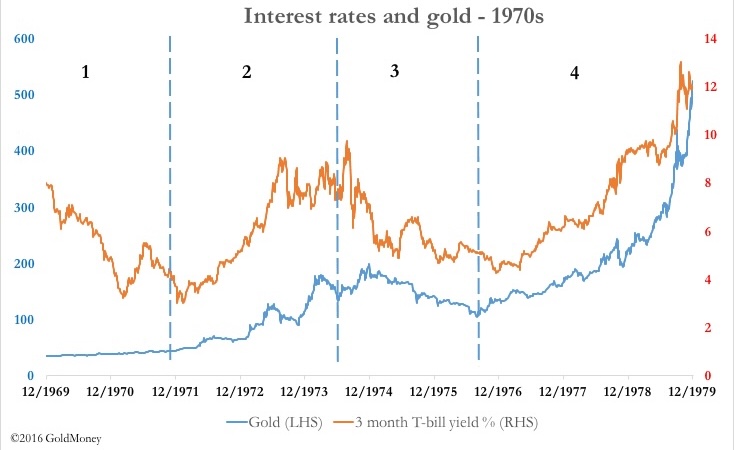
Let’s take a look at how interest rates and gold interacted during the ‘70s. The chart below shows the yield on a 3-month Treasury bill (orange line) and the price of gold (blue line).
Source: GoldMoney
As you can see, throughout most of the decade, gold and yields (an expression of interest rates) rose together.
For example, in 1974, investors could buy a 3-month T-bill which yielded around 7.4%. That seems good, right? Well, the problem is that inflation peaked at 12% that year.
So even if you had short-term Treasuries paying 7%, you still lost around 5% purchasing power. In a single year.
So the real (inflation-adjusted) yield on short-term Treasuries was around -5% in 1974.
So even though the rates and yields rose, it wasn’t enough to keep up with inflation.
Now take another look at the chart above. From late 1974 to 1976, gold and interest rates fell together. More evidence that lower interest rates don’t always mean higher precious metal prices. (side note – I wrote a dedicated piece about the mini gold bear market from ‘74-76 here).
Then from August 1976 to January 1980, gold rose more than 7x! At the same time interest rates exploded higher to a peak of nearly 20% in early ‘80.
Clearly, gold can thrive during periods of rising interest rates. Because when the Fed is raising rates, it’s usually due to inflation. Which drives people into gold…
The 2000s Gold Bull
Now let’s look at the period from 2000 to 2011. A major bull market for gold and silver. Gold rose from a low of $250 an ounce to $1,900. Silver jumped from $5 an ounce to nearly $50.
Let’s look at a chart I created, which is similar to the one above. Gold price in blue (left side), 3-month Treasury bill in orange (right side).
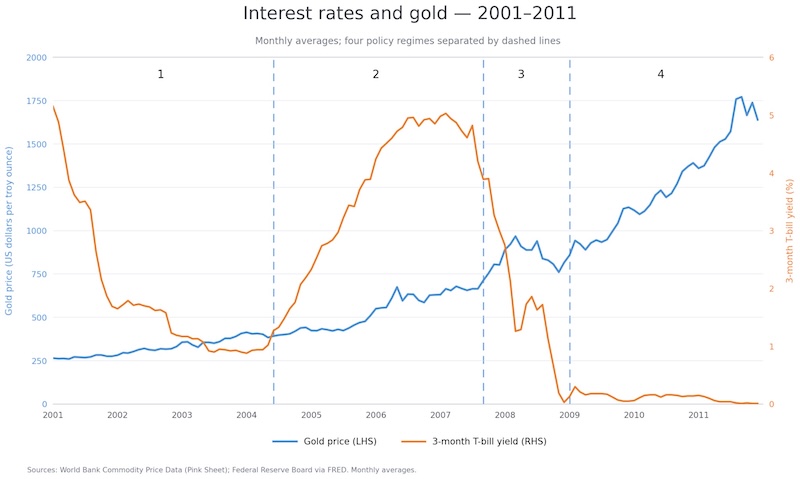
Note that gold rose steadily, almost throughout the entire period. As interest rates rose and fell, gold marched on. With a few brief dips, particularly during the global financial crisis.
So it’s not as simple as “lower rates = higher gold” and “higher rates = lower gold”. Sometimes it’s the exact opposite.
When the Federal Reserve and other central banks raise rates, it’s almost always due to problematic inflation. The same reason people buy gold and silver.
So even if the Fed does continue to raise rates for the next few years, it’s not necessarily bad for precious metals.
Personally, I don’t think they can continue to raise rates much more. They might push it another 1% higher, but as we have discussed, this is going to be very problematic for our debt situation.
Higher rates = higher yields on government debt. That means the amount we have to pay in interest spikes rapidly.
So the more they raise rates, the more debt and deficits will grow.
No matter what they do from here, more inflation is coming. They can’t hike rates to the 10%+ level they’d need to be to kill inflation. It’d kill our debt-bloated economy, and end up making deficits soar even higher.
As regular readers know, I believe the Fed and Treasury Department will eventually get desperate. As the cost to pay interest on our debt approaches $2 trillion, they will have to act. That’d be 38% of total tax revenue going to pay the vig.
I still believe that they’ll have to resort to yield curve control. Buying our own debt at a massive scale to push yields down. If you’re not familiar with the concept, check out my article from last month, Gold Smells a Rat.
In short: I’m staying long gold, silver, and miners with a roughly 17% portfolio allocation. I believe these assets will be key to surviving the monetary chaos ahead.

Comments: