
What’s Going on With Our Navy?
Today, let’s discuss aircraft carriers; namely, recent news accounts about poor food and living conditions aboard the long-deployed USS Abraham Lincoln (CVN-72), as well as President Trump’s recent order about future vessels using steam catapults versus something called an electromagnetic launch system (EMALS).
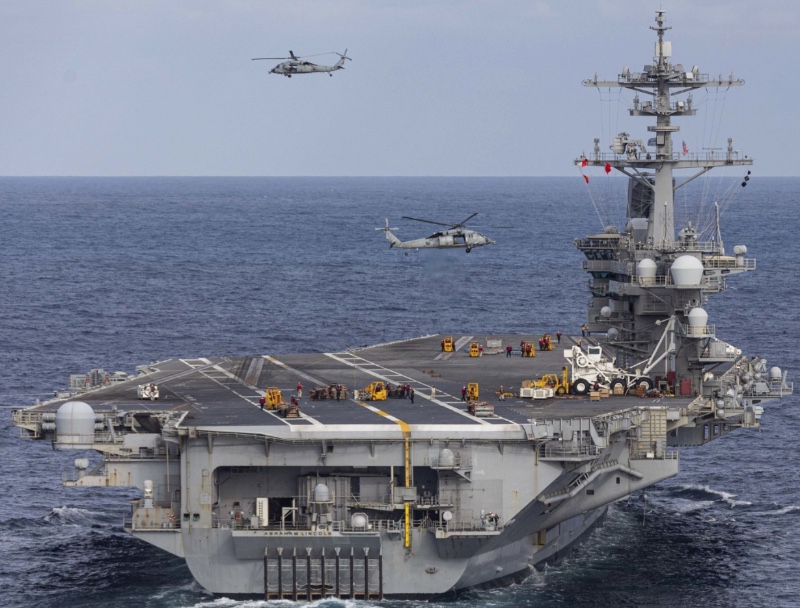
USS Abraham Lincoln (CVN-72) Credit U.S. Navy.
These are not just “Oh-yeah-military-stuff” stories. Indeed, these stories open the door to several Very Big Pictureissues: war, peace, operational tasking, military procurement, supply chains and industrial base (or lack thereof). And it’s all far beyond gossipy, political hit-job soundbites. So, let’s dig in…
Napoleon and Me – Same Ocean, Different Remote Islands
First, I’ve been traveling. In fact, I just spent two weeks on an arid volcanic island out in the Atlantic Ocean. It’s kind of like what happened to Napoleon, except I didn’t invade Russia or lose the Battle of Waterloo.
Indeed, I traveled to the far-off island of my own free will, to study geology; to observe and examine basalts, ash deposits, pyroclastics, aka “oceanic plate shield volcanoes.” My goal was to learn about mantle hotspots and energy/mass transfer from deep inside the earth to the upper crust.
To me, this kind of continuing education effort is “scientific” geology that helps me improve on the industrial side. That is, if you understand how energy and mass flow around in the earth’s crust, it helps to decipher why and how certain minerals form in certain ore deposits. And of course, that helps to find more gold, silver, copper, etc.
On the island, I had cell phone coverage and Internet, but I was kind of busy. Along the way I saw some headlines about how U.S. sailors are allegedly getting bad food and live in stark conditions aboard a deployed aircraft carrier, USS Lincoln.
And yes, this Navy news caught my eye… cuz I’m an old Navy guy with a few aircraft carrier deployments in the logbook (see below). But I was preoccupied with my own geology work and besides, I’m far from the facts of the story. The Lincoln is in the North Arabian Sea, and I was a continent and more away, out in the far Atlantic. Plus, I don’t receive Navy message traffic and absolutely can’t say what’s in the food storage lockers of Lincoln, or any other Navy warship or logistics vessel in that theater.
But over the past weekend I flew home, and the vagaries of airline travel put me in Switzerland for a day, where I had a chance to catch up on the “news.”
And in my humble assessment, there’s something quite wrong with what the public is being told. So, let’s put it all into more perspective…
I Know a Few Things
Begin with the fact that I – like hundreds of thousands of other current and former Navy people! – know a few things about aircraft carriers and long deployments to distant places. In 1985 I pulled a seven-month haul on the long-gone ex-USS Constellation (CV-64), across the Pacific and Indian Oceans and up into the North Arabian Sea. And we sailed all the way back, I’m pleased to say.
In 1990-91, I worked in what’s called “combat logistics,” and supported wartime carrier operations in the Mediterranean and Red Seas during Desert Shield and Desert Storm. That is, my job was to move stuff from Point A ashore to Point B, a gray hulled vessel making a wake out in the middle of some vast body of water. There’s nothing easy about it.
In the 90s, I sailed the Atlantic aboard ex-USS Enterprise (CVN-65) and later crossed the blue Pacific out of Japan, aboard ex-USS Independence (CV-62). And I have the flight jacket to prove it.
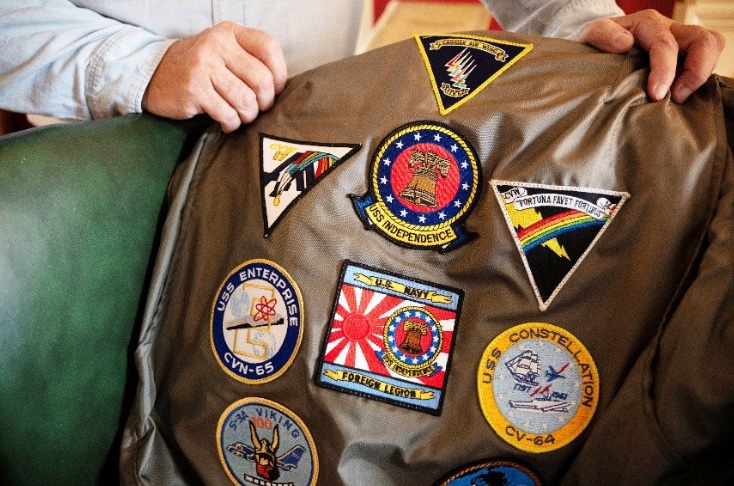
Your editor’s flight jacket. BWK photo.
Then in the early 2000s, working in the Med region, I did more of that combat logistics stuff in the early days of the wars in Afghanistan and Iraq. Long stories; not here.
So, I’ve sailed on a few aircraft carriers to a few places, and I know a few things. Now, any questions? Okay, you… in the front row.
- Are long deployments mentally tough and stressful? Yes, absolutely, totally. And like it or not, however down-in-the-dumps you might feel at times, you’re surrounded by 5,000 other people. Do you want some privacy? No way… But do you want some friends? Well, they’re not too far away either.
- Do sailors try to commit su!c!de by jumping off ships? Actually, yes, sad to say… It’s been happening since the days of sailing ships. Modern-Navy-wise, every couple of deployments there’s a story about some guy who jumps over the side. Take 5,000 people, age 18 to about 40 or so; put them under high stress for six months or more, somebody cracks and you get an “Oscar” – slang for “man overboard.”
- What about the news accounts of a guy who jumped off Lincoln, bobbed in the water for an hour, and was rescued? Well… it seems to be true and hey, miracles happen. That is, again per news accounts, somebody jumped; and at night I hear, which makes it very hard to find him. And in the middle of fighting a war, ships and helicopters diverted, located the individual and pulled him out. He’s now receiving psychiatric counseling.
- Frankly, this dude is lucky he didn’t get eaten by sea snakes and jellyfish. That was a huge fear when I flew in the North Arabian Sea arena. The intel officers briefed us that there were sea snakes and jellyfish in the water, and that’s all I needed to hear. The last thing I ever wanted was to get wet and become jellyfish food. Meanwhile, oceans are big and people are small; so, when you go into the briny sea your only true hope is that somebody misses you and sends help. Which is EXACTLY what happened here. In other words, we have a system for finding lost souls and in this case it worked as advertised.
More questions? Yeah, you in the second row:
- Do ships run out of fresh produce and milk? Absolutely… after about a week at sea! After that, it’s whatever can be canned, frozen, powdered, freeze-dried, boil-a-bag, preserved in plastic bins, etc. It’s been that way for a long time.
- Can all this preserved food become bland and boring? Yes, definitely. Just hope that you have some creative minds at work in the ship’s galley.
- Does the Navy resupply food to ships at sea? Of course! Since… like… the Civil War. And today, there’s food along with jet fuel, spare parts for airplanes and other ship functions, ammunition and related items like fuses and guidance kits, mail and packages, and much else. It’s a very complex operation.
- Do Navy ships keep food preparation spaces and mess decks clean? Yes, because nothing degrades combat effectiveness like hundreds of people getting food poisoning. So, cleanliness of food prep is a maniacal fixation on Navy ships.
- What about news accounts of crummy food, or not enough food? Well, I’m not there onboard USS Lincoln, but it doesn’t shock me that there might have been (or still are?) problems; I’ve experienced similar issues in my own past. But I’m inclined to think that if Lincoln had food prep issues, it’s been on occasion, due to vagaries of high-tempo operations in a war zone where resupply at sea is not at all easy. Because systemically, the Navy does have entire programs to move food and mail to ships at sea.
- So… What’s the problem with Lincoln? Why the headlines about crummy food and terrible conditions? Well, we’re here, not there on the ship; and we don’t know the facts, and news media sometimes twist a small amount of truth into a big lie. We’ll find out eventually, when more “real” news comes out. But for now, don’t discount raw politics and the creation of negative, emotion-triggering narratives in the current American cultural climate. Which leads to another discussion…
U.S. Has Very Deep Problems
Okay, enough day-to-day news. Let’s define a deeper problem: thirty-five years of high level, strategic failure in Washington, D.C. Yes, shocking. I know…
First, why are aircraft carriers – and do NOT forget the other ships in the battle group! – on these long-long-long deployments? Eight months, nine months, ten months… Because the Navy, and of course Congress and a long string of U.S. presidents, did not build enough ships, that’s why.
Long ago, the Navy had 18 large-deck aircraft carriers; then 16, 14, 12, and now “11” although it’s really 10 because USS Nimitz (CVN-68) is soon destined for decommissioning.
Long ago, the Navy had enough carriers to cover operational assignments in a way that allowed for six- and seven-month deployments. Now? Too many commitments, which is why we see these 8-, 9-, 10-month hauls.
Plus, add the task of fighting a war against Iran, with a high operational tempo. And include the important military fact that Iran shoots back at the carrier and its associated ships. My war-planning days are behind me, but fighting Iran ought to require six or more carriers (and air wings), which obviously will not happen.
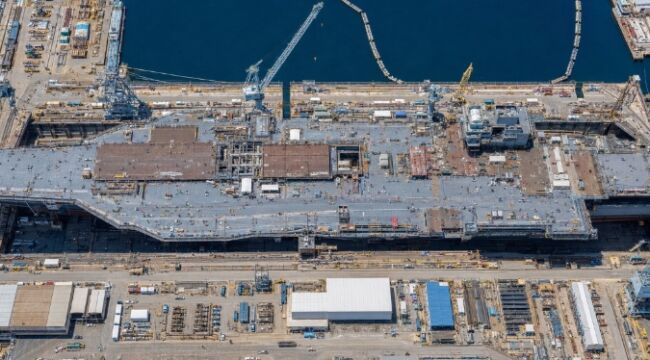
Meanwhile, how long does it take to build an aircraft carrier? Well, try 18 years. Yes, 18 years. No typo.
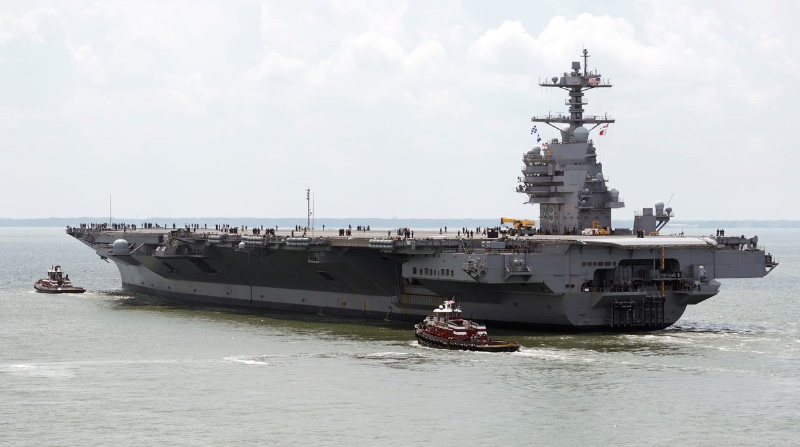
Pre-Commissioning Unit John F. Kennedy departs Newport News for acceptance trials. Credit: HII.
In fact, just last week the USS John F. Kennedy (CVN-79) left Newport News Shipbuilding, a division of Huntington Ingalls Industries (HII). The ship is undergoing what are called “acceptance sea trials,” the final major evaluation phase before the vessel is handed over the Navy for commissioning, currently projected for March 2027.
From authorization to commissioning, this new JFK vessel took 18 years to build and bring to the fleet. Or ask the question another way: are there any fast fixes to add more aircraft carriers? Umm… nope. Things like this don’t get built fast. It’s called an “industrial base” issue
Meanwhile, why can’t the Navy bring enough supplies to its deployed ships? Because for 35 years the Navy – and Congress and a string of presidents – have failed to buy and build enough “combat logistics” vessels; the ships that haul fuel, ordnance and other supplies, certainly food.
Right now, in the North Arabian Sea arena, the Navy has just four combat logistics vessels to shuttle food and other cargo from ports in East Africa, Diego Garcia and South Asia, into the theater to replenish Lincoln and numerous other smaller vessels. Plus, a couple of “oilers” that haul jet fuel and other odds and ends. Overall, it’s not enough so the immediate workaround is to hire third party vessels, but now we confront restrictions on how suitable non-military ships are for military logistics (another long story).
I could continue, but… The story is “not enough” industrial base, supply chains, shipyards, skilled tradespeople, ships and sailors; plus, too many tasks for the Navy, and not enough steel and people to cover the long waterfront. It’s not that Navy people – from deckplate sailors to bigshot admirals – don’t know what to do out on the water. They just can’t cover all the missions with the available resources, and the system is stretched thin.
Right now, President Trump and his senior people are the political targets (and what else is new?). But the root of the problem goes back many decades, to a country and governing class that became strategically lazy, if not kind of stupid about reality.
Policymakers blew off kinetic issues like having “enough” ships and people to do the jobs. Presidents and Congresses failed to fund procurement. Institutional Navy didn’t fight for its long-term interests. And people write books about these things.
The EMALS Issue
One last item. Last week, President Trump signed a memo that instructed the Navy to investigate going back to steam catapults on carriers, versus continuing with EMALS. Among other journalistic malpractice, no less than the Wall Street Journal presented it as a cavalier dictate about “ripping out” entire sections of ships to replace EMALS with steam.
No, no, no… WSJ is completely wrong. Trump signed an order that gives the Navy 60 days to explain the virtues of EMALS over steam, now after several years of operation. This might impact construction of one carrier (CVN-81, future Doris Miller), which is in the very preliminary stages of construction, with a few keel-pieces in place and not much else.
If Navy does go back to steam, it will require long-lead buys of numerous systems and machinery, but HII certainly knows how to build these things after all the Nimitz-class vessels it has constructed.
Again, the EMALS controversy is just the news media and political hacks looking for click-bait stories. Don’t be fooled.
And that’s all for now. Thank you for subscribing and reading.

Comments: