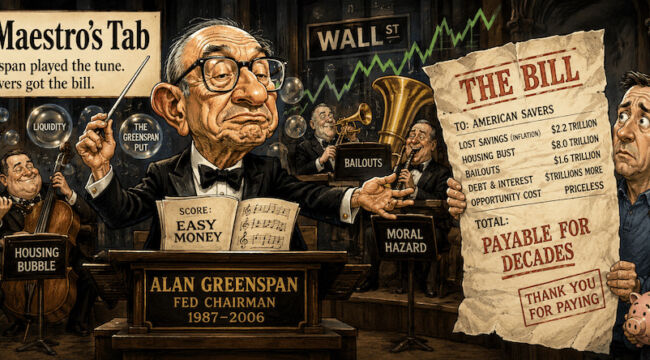

The Maestro's Tab
Alan Greenspan is dead.
He was 100 years old. He died Monday morning from Parkinson’s disease, at home, with his wife, Andrea Mitchell, beside him.
I felt an incredible sadness when I found out he had died. Not because he was taken from us too soon. Clearly, he had lived long enough.
But because he was a man so close to greatness, and would’ve attained it… had he exercised his better judgment.
I also thought about the naivety of my young banking career. I really thought he was a hero. It’s as if Zero Hedge likes to torture me, A Clockwork Orange-style, every time it runs this Time magazine cover:
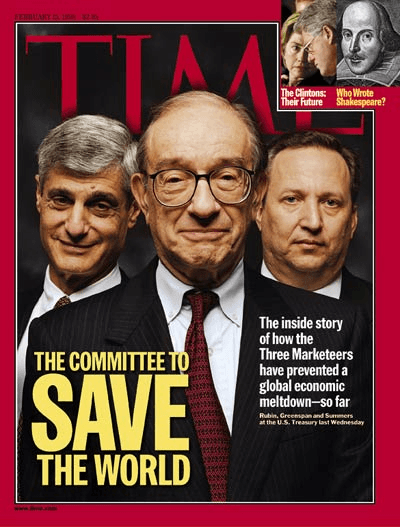
Credit: Time magazine and Michael O’Neill
I’m not so much ashamed of having once subscribed to Time. I’m ashamed I nearly had this cover framed.
Of course, the tributes are poured in. “A giant.” “A maestro.” “The greatest central banker of the modern era.”
Indeed, Greenspan was brilliant.
But in the long run, he was also the man who handed the Federal Reserve a loaded gun and told it to aim at savers.
The bill he ran up is still being paid. It will be paid for decades. And the people paying it weren’t the ones who got the benefits.
The Maestro Rises
Greenspan took the Fed chair in August 1987. Black Monday happened 2 months later. The Dow dropped 22% in one day. Greenspan’s response was crisp and clear. The Fed would supply liquidity. Markets stabilized. The legend was born.
Except for the Recession of 1991, the 90s saw a booming economy. Unemployment fell below 4%. If you can believe it, the government actually ran surpluses for the final four years of the Clinton Administration. The stock market hit new highs all the time. Bob Woodward called him “The Maestro.” Congress treated him like an oracle. Senators who couldn’t explain a balance sheet nodded along to his Fedspeak as if it were gospel.
I vividly remember former US Senator Phil Gramm embarrassing himself by calling Greenspan the “greatest central banker in the history of the world” during the Senate’s confirmation vote on Greenspan’s fourth term as Fed Chair. The Maestro sat there, listening to the effusive praise, utterly mortified.
Greenspan called his Fedspeak “syntax destruction.” He once told Congress: “I know you think you understand what you thought I said, but I’m not sure you realize that what you heard is not what I meant.”
The press ate it up. Wall Street loved it. The man was untouchable.
The Greenspan Put
But underneath the boom, something was rotting.
Every time markets stumbled, Greenspan cut rates. Every time there was a hint of trouble, such as the 1994 Bond Debacle, the Russian default in 1998, Long-Term Capital Management’s bailout, or the fraud known as Y2K, the Fed was ready with cheap money.
Markets learned the lesson fast: If you bet big and things go wrong, the Fed will bail you out.
Traders called it the “Greenspan Put.” It was an implicit promise: losses have a floor, but gains have no ceiling. Take more risk. The Fed has your back.
Needless to say, this isn’t how free markets work. In a free market, bad bets get punished. Bad bets teach people not to make any more bad bets. When you remove that punishment, you guarantee more bad bets.
Ludwig von Mises spent his career explaining this concept, which he called “malinvestment.” Murray Rothbard wrote about it in detail. Nobody in Washington read either man. But here’s the tragedy: Alan Greenspan once had read them. He had been an acolyte of Ayn Rand in the 1950s and 1960s.
In one of his lectures for Rand’s followers, Greenspan called the creation of the Federal Reserve “one of the historic disasters in American history.”
Amen, Alan. Amen.
The then-Randroid saw the gold standard as an important restraint on governments’ ability to foment booms and busts by printing money.
Then he became the central banker and got a whiff of power.
The Dotcom Bubble
By the late 1990s, the Fed’s cheap money had inflated the largest speculative bubble in American history up to that point. Internet companies with no revenue, no profits, and no coherent business models raised hundreds of millions of dollars.
CNBC became must-see TV during the dotcom boom. People who had never followed markets tuned in. Many middle class investors learned the hard way that the Nasdaq was no high‑yield savings account.
Pets.com. Webvan. Kozmo.com. The names are almost funny now. They weren’t funny to the people who lost their life savings.
$5 trillion in market value evaporated between 2000 and 2002.
After the bust, what did Greenspan’s Fed do? It cut rates to 1% and held them there.
This move set the stage for everything that followed.
The Housing Bubble
With rates at 1%, capital needed somewhere to go. It went into housing. Mortgage originators lent to anyone who could fog a mirror. “No Income, No Job, or Assets? No problem, we’ve got NINJA loans.” The incentives said to lend, so they lent.
Why did no one care? Because Wall Street simply packaged the loans and sold them as AAA-rated investments to unsuspecting foreign banks and sovereign wealth funds. If you think Ivy League grade inflation is bad, you should see the bonds and bond tranches that ratings agencies gave AAAs to in 2005-2008. That’s how a US-based crisis spread worldwide.
When asked about the housing market, Greenspan dismissed concerns about a bubble. Local markets might be overpriced, he said. But there was no national bubble.
He was wrong by $8 trillion. That’s how much household wealth was destroyed when the housing market collapsed in 2008.
“Those of us who have looked to the self-interest of lending institutions to protect shareholders’ equity, myself especially, are in a state of shocked disbelief,” he told Congress in October 2008. (Editor’s note: Keep this comment in mind for later.)
The Maestro finally had discovered free markets require free prices. That is, when you fix the price of money below what the market would set, you create a lie that looks like prosperity… until it doesn’t.
He said he had been right about 70% of the time.
The 30% almost broke the world.
His Legacy
The obituaries have been kind. They always are.
Paradigm Press’ own Enrique Abeyta wrote on our app’s Daily Feed:
While there are many critics of the Fed, my view is that they should ultimately be judged on the results. Those results are economic stability, growth, and high employment. Objectively, based on those measures, the US economy has absolutely CRUSHED it in the last 50 years. Far outpacing every other developed economy in the world by a huge amount. RIP Alan Greenspan – you did your job!
Greg Ip wrote a touching piece in The Wall Street Journal about Greenspan and his days covering the Fed.
But the Journal’s editorial board penned a piece called “The Myth of Alan Greenspan,” much to my surprise. They blasted his 2008 comment (above) about self-interest.
That comment, which received enormous publicity, let the political class off the hook and fed the belief that the panic was a crisis of capitalism that needed more regulation. Greenspan never admitted the failure of monetary policy or of the regulators at the time who had allowed Citigroup and other banks to create the off-balance-sheet vehicles that failed.
Libertarian historian and writer Tom Woods echoed that sentiment:
Because of Greenspan’s earlier association with Ayn Rand, and because the general public knows so little about the Fed, when the 2008 crash occurred, people generally went along with blaming “capitalism” — even though the Federal Reserve is a non-market institution created by act of Congress and enjoying a government-granted monopoly, and even though Greenspan’s manipulations overrode what the market was trying to say.
Greenspan’s legacy is 2008, and the undeserved reputational damage that the market economy suffered as a result.
Knowing this, it’s really no mystery why Mamdani is the Mayor of New York City and went 3-for-3 in the recent New York elections.
@Handre wrote:
In 1966, a younger Greenspan wrote an essay called “Gold and Economic Freedom.” He laid out the case with precision. The gold standard protected savers from confiscation by inflation. Welfare statists hated gold because it stood in the way of their deficits. He wrote that the abandonment of gold made deficit spending a “scheme for the hidden confiscation of wealth.” He was right. He knew it. Then he took the job running the printing press.
Finally, Bill Bonner wrote right here in the Daily Reckoning:
Rand was in raptures when her smooth disciple was summoned to Washington. Now, she crowed, she had ‘her man’ at the Fed.
She did not have him long. Principles are cheap furniture for a struggling philosopher or a journeyman saxophonist; he may keep them about the parlor all his life and dust them fondly. But the Chairmanship of the Federal Reserve calls for principles of another make. Volcker had wrestled the inflationary beast to the floor, now the politicians could spend and borrow more freely. But they needed THEIR man at the Fed.
There lay Greenspan’s true historic office. The famous “Greenspan put” was nothing grander than this: he stood ready to catch every gambler who flung himself off the ledge — and so, he presided over the largest carnival of phony prosperity the world has ever staged.
Greenspan created the template for all those who subsequently sat in his chair. He normalized the idea the Fed could and should manage the business cycle by manipulating rates. He trained two generations of investors to see the Fed as a backstop, not a brake. He turned the central bank from a lender of last resort into a permanent subsidy machine for reckless gambling.
Ben Bernanke took that template and applied it after the 2008 crash. He pushed rates to zero, and held them there for years. Janet Yellen kept he foot on the yield curve. Jerome Powell cut again during COVID.
It’s little wonder hedge fund managers are weeping over Greenspan’s death. But at least they have Warsh now…. right?
The Patience Tax we have written about in the Rude Awakening — the punishment of savers, the rewarding of borrowers, the destruction of the returns that once made prudence rational — has Greenspan’s fingerprints on it. So does the False Boom. So does the Ratchet.
He didn’t invent central banking or create fiat money. But he made both seem benign, even beneficial, for long enough that no serious challenge to either was possible.
A Complicated Man
Alan Greenspan was not a monster. He certainly was not stupid. He was, by most accounts, genuinely kind in person, a lover of classical music and economic data, a man who worked hard and thought seriously about hard problems.
In his youth, he had also seen clearly. Indeed, as @Hande wrote above, his 1966 essay, “Gold and Economic Freedom,” is one of the cleanest defenses of the gold standard ever written. He argued that central banking was a mechanism for wealth transfer from the productive to the politically connected. He understood the Cantillon Effect.
Then power arrived, and understanding bent.
Sadly, this is normal. When you serve at the pleasure of a small group of powerful people, your incentives bend toward their preferences rather than the truth. Greenspan served four presidents. He kept his job by keeping them happy. Keeping them happy meant cheap money when the going got rough.
Wrap Up
Alan Greenspan was 100 years old. He lived long enough to see every bubble he helped inflate burst. He lived long enough to watch the Fed he led become something that would have appalled the young man who wrote against it.
History will call him a maestro. That is not quite right.
He was a gifted man who used his gifts in the service of a system he once knew was broken. The music he made was beautiful enough that the audience didn’t notice the structure collapsing around them.
You noticed. That is why you are here.
The tab is still open. It will be for some time.
Rest in peace, Mr. Greenspan. We are still cleaning up.

Comments: