
This “Unobtanium” Metal Powers the Future of Tech
Imagine a metal so rare that if it were an eye color, only 36 people would have them…in whole world. Now, imagine it is incredibly useful for aerospace technology.
The element is named rhenium.
Before 1905, it was merely a predicted element. They knew something should be on the periodic table there, but not what.
And then Japanese scientists discovered it in 1908 but misidentified it. Finally, it was identified in 1925. But it didn’t trade commercially until 1928.
A kilogram of the stuff cost $10,000 at the time ($190,000 today). It was so rare and so difficult to refine that it cost a whopping $5,390 per ounce in today’s dollars.
It took decades before we figured out what to do with this expensive metal. But by the 1950’s, tungsten-rhenium and molybdenum-rhenium alloys became critical for aerospace applications.
However, it really became commercially important in the 1970’s, with specialty gasoline catalysts and high-temperature nickel alloys.
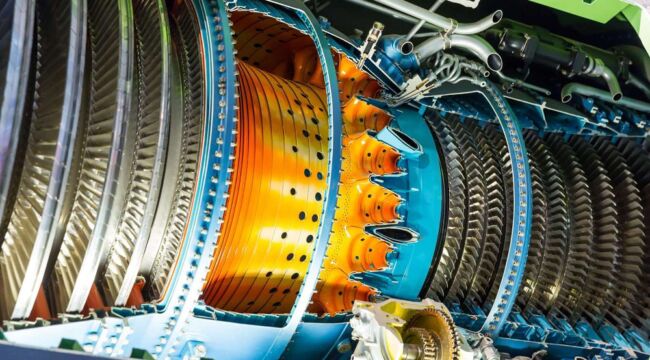
The nickel alloys go into the hottest sections of jet engines, rocket engine nozzles, combustion chambers, and gas turbines. The addition of rhenium strengthens these materials used in extremely high temperatures.
Rhenium resists oxidation (rust) and high temperatures. That makes it perfect for electrical connections in high performance switches used in aerospace and defense systems.
However, it is rhenium’s membership in the 2D transition metal dichalcogenides (TMDs). TMDs appear to be the most promising functional materials for post-silicon, high-performance devices.
When combined with sulfur (rhenium disulfide) it creates a material with unique electrical properties. That opens some doors for potential use in next-generation electronic and optoelectronic devices.
According to Advanced Science News:
The unique structure of this anisotropic 2D material has endowed it with layer-independent electrical and optical properties, suitable for application in field effect transistors (FETs) and photodetectors.
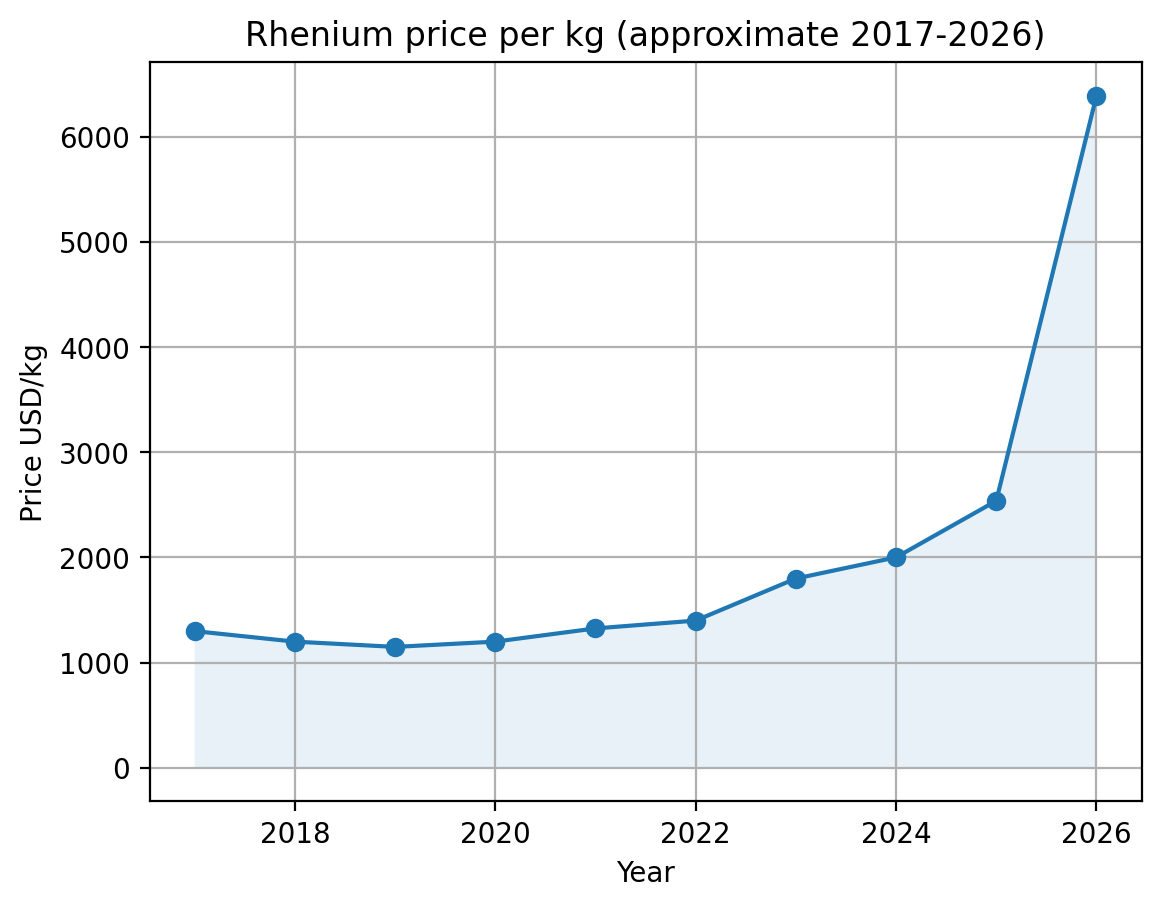
That’s a complicated way to say that TMDs could replace silicon in advanced computer chips. As its utility grew, so did demand. You can see the impact on its price over the past decade:
Today, the world mines about 50 to 60 metric tons of rhenium per year. Compare that to copper, where the world produces 23 million metric tons per year.
Today, the aerospace/defense industries consume about 80% of the annual rhenium supply. As we mentioned earlier, it’s a key part of jet engines and rocket thrusters. However, it also goes into the frames of late generation fighter jets. The jets require up to 6% rhenium in their alloys. That allows them to operate at much higher temperatures than traditional metals.
The second largest demand for rhenium comes from catalysts in petroleum refining. Refineries use platinum-rhenium catalysts to make high-octane gasoline. These catalysts resist sulfur and nitrogen “poisoning”. That gives them a much longer life than catalysts made of just platinum.
But that’s looking into the past. The future is all about demand for rhenium disulfide TMDs:
- Next-Gen Semiconductors: Over 72% of semiconductor R&D groups are prioritizing 2D materials like rhenium disulfide because they maintain a stable direct bandgap regardless of layer thickness, a major advantage over other TMDs.
- Advanced Optoelectronics: there is a growth in rhenium disulfide in near-infrared (NIR) photodetectors and sensors.
- Flexible & Wearable Tech: Rhenium TMDs can be exfoliated into layers thinner than a nanometer but retain a high strain tolerance (above 10%). That makes them useful for flexible displays and wearable biosensors.
- Quantum Computing and AI: Engineers are trying rhenium thin films for superconducting quantum circuits and hardware for neural networks.
That’s why rhenium is so important for tech investors going forward. Unfortunately, there is no direct play on rhenium mining.
The bulk of this metal comes from copper mining. Chile currently produces the bulk of this material. Alloy recycling produces about 25% of total supply.
We will continue to explore the metals which will power the future. And share attractive investment ideas as we find them.

Comments: