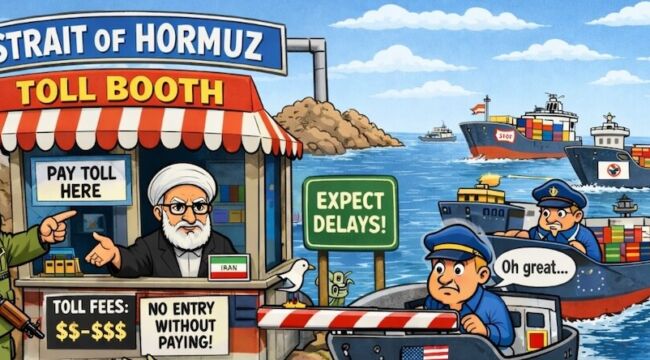

The Toll Booth Returns
One of my favorite things about driving through the Italian Alps is seeing all the medieval castles on the cliffs. Their ornate, haunting beauty lurks menacingly above the smooth new EU-sponsored highways that run along the valleys.
Why were they built there? For centuries, the main source of revenue for the Lombards, the Savoy family, or the Italian state (at different times for different passes) was tolls for crossing the Alps. Take Reifenstein Castle. It guarded the Brenner Pass route. Knights slept eight to a bed. They watched for traders. No pay, no pass.
Think Trump’s tariffs, Old Europe style.
Now picture this. You’re sailing a merchant ship down the Rhine. Suddenly, a castle looms on the cliff above you. Armed knights block the river. Pay up, or your cargo goes to the bottom of the river.
That’s how the European river network ran for centuries.
Fast forward to today. You’re an oil tanker captain. You need to get through the Strait of Hormuz. Iranian Revolutionary Guard boats pull alongside. Pay $2 million in Chinese yuan. Or turn back.
Same racket. Different century.
Welcome to 2026, the Year of the Returning Toll Booth.
Hugo Grotius Had a Dream
In 1609, a Dutch lawyer named Hugo Grotius published a slim but explosive book. He called it Mare Liberum (“The Free Sea”).
His argument was simple. The ocean belongs to no one. It’s like air. Every nation has the right to sail it. Trade freely. Go anywhere.
Why did he write it? Because Portugal was sinking Dutch ships. Portugal claimed a monopoly on the route to India. Their attitude: our ocean, our rules.
Grotius said that was nonsense. His idea spread. It changed the world.
But Grotius had a client. He wrote Mare Liberum for the Dutch East India Company. Profit drove principle. Free seas meant Dutch profits. Keep that in mind.
Castles on the Rhine
Grotius dreamed of open seas. But rivers told a different story.
As I alluded to before, the Rhine was medieval Europe’s main highway. It linked Switzerland to Germany and the Netherlands. It moved grain, wine, silver, and spice. Commerce flowed along it every day.
So did extortion.
By 1254, some 79 castles lined the Rhine. Each one was a toll booth with a garrison. Lords built them on high cliffs for a reason. Catch the merchant traffic below. Demand payment. Enforce with arrows if needed.
Pay gold, or your ship sinks.
Merchants grumbled. But they paid. Because the goods still needed to move. The lords understood leverage perfectly.
The Holy Roman Empire ran largely on Rhine toll revenue. It was robbery, institutionalized. Just like income taxes these days.
The Barbary Pirates Ran the Same Scheme
It wasn’t just rivers. The Mediterranean had its own toll collectors.
From the North African coast, the Barbary pirates ran a protection racket for centuries. They raided ships. They took cargo. They enslaved sailors. And they accepted tribute in the form of annual payments from European nations, in exchange for being left alone.
England paid. France paid. Even the young United States paid, until Thomas Jefferson said enough.
Jefferson sent the Navy. The First Barbary War, 1803 to 1805, broke the back of the tribute system. The message was clear: America doesn’t pay tolls.
Free seas required muscle.
Pax Britannica: 100 Years of Open Water
In the 19th century, Britain provided the muscle.
Though it’s barely more than a few rubber ducks now, back then, the Royal Navy was the most powerful force on Earth. It crushed piracy worldwide. It destroyed the slave trade. It signed treaties with Arab coastal rulers. The deal was to stop attacking ships or face British guns. Most chose to stop.
The result was Pax Britannica. British Peace. A century of open seas.
Trade exploded. Goods moved freely from Liverpool to Cape Town, then to Mumbai, Singapore, and Hong Kong, and back again. Any nation could ship anything, anywhere, with reasonable safety.
Britain got rich, of course. Free seas tend to benefit whoever controls the most ships and ports. But the freedom was real. The tolls were gone.
After World War II, America took over. The U.S. Navy enforced freedom of navigation across every ocean. The UN codified it in 1982 with UNCLOS (more memorably and sarcastically known as LOST, for reasons we’re witnessing right now) — the Law of the Sea Treaty. No tolls. No castles. Open water for all.
That arrangement lasted 80 years.
Iran Builds Its Castle
The Strait of Hormuz is 21 miles wide at its narrowest point. 14 million barrels, or 21% of the world’s oil, pass through it every day. There is no practical alternative route for most of that cargo.
Iran sits on one side. Iran knows exactly what it has.
Last month, Tehran turned the strait into a toll waterway. Not a full blockade. Smarter than that. A selective one.
China pays in yuan. Ships pass. India and South Korea negotiate terms. They pay something. “Friendly” nations get escorted through by IRGC Navy boats. Others get turned back, or worse.
The toll runs about $2 million per ship.
Oil markets responded immediately. Brent crude hit $113 a barrel, up 74% at one point, from February’s open. American gas prices jumped $1.25 a gallon. The IEA warned it would get worse this month.
For your reference, during the 1973 Arab oil embargo, gas prices rose from $0.33-$0.38 to $0.55-$0.84, depending on where you were in America. Right now, the national average is $3.84. If the war lasts until June, that average may rise to $7.
The castle is working exactly as intended.
Trump Calls the Bluff
President Trump didn’t mince words. On March 16, he told allies: “Countries must help secure the strait. It’s their oil.”
He’s not wrong. China depends on the Strait of Hormuz for 90% of its oil imports. Europe isn’t far behind. America, now an oil exporter, needs the Strait far less than it once did.
Trump warned NATO: send ships, or face “very bad” consequences. The UK and France balked.
History is not encouraging. Medieval traders paid the Rhine lords. European nations paid tribute to the Barbary rulers for centuries before Jefferson stopped it. Right now, China is paying Iran in yuan. The precedent is resetting itself.
Wrap Up
Hugo Grotius was right about the theory. The seas belong to no one. Trade should be free.
But like the law and our borders, the theory needs enforcement.
The Dutch Navy backed Grotius. The Royal Navy backed Pax Britannica. The U.S. Navy backed 80 years of free postwar trade. Remove the navy, and the castle wins every time.
Iran understands this. They didn’t close the Strait. They monetized it. That’s actually more sophisticated than a blockade. A blockade invites a military response. A toll booth invites negotiation, payment, and, eventually, acceptance.
The Rhine lords ran their castles for 200 years before anyone stopped them.
America spent 80 years providing global maritime security. Now the bill has come due… and it’s denominated in yuan. But the thing is, the rest of the world doesn’t mind paying… or negotiating.
The question isn’t whether Iran can run a toll booth. They’re already running it.
The question is, who builds the castle on the other cliff?

Comments: