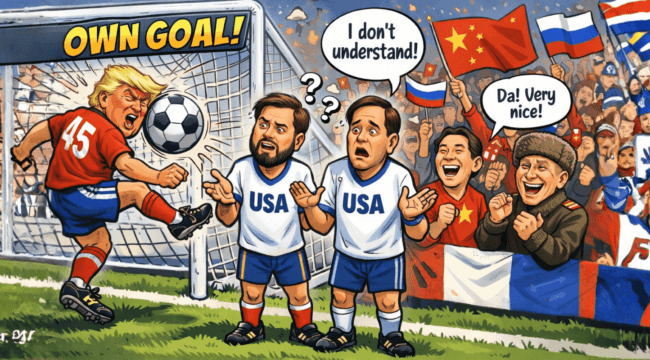

The Donald Scores!! ...Wrong Net
You probably know this already, but indulge me. It’s material to the plot.
Donald Trump — a man who spent four years screaming at Jerome Powell to cut rates, who practically begged the Fed to juice the economy on demand like it was a vending machine for political convenience, who treated monetary easing as something between a birthright and a campaign promise — nominated Kevin Warsh to be the next Federal Reserve Chair.
Kevin Warsh.
Let that sink in for a moment. The man who dissented against quantitative easing back in 2010, when the rest of the committee was still arguing about whether the crisis was over. The man Wall Street traders quietly refer to as “the hawk’s hawk.” The man whose idea of a productive afternoon is a faster balance sheet runoff, a stern lecture about unanchored inflation expectations, and perhaps a light bedtime read on the dangers of financial repression.
Yes. That Kevin Warsh. The man Trump just handed the keys to the most powerful economic institution on the planet.
Let’s make sure we understand what has just transpired. Trump, who wants lower rates, cheaper mortgages, a roaring stock market, and a booming consumer economy heading into the 2026 midterms, will install at the Fed someone who will almost certainly keep rates higher for longer, accelerate the shrinkage of the balance sheet, raise the bar for any further easing, and bring to the role a level of institutional hawkishness that makes Jerome Powell look like he was practically handing out free money on street corners.
In a bid to “restore Fed credibility” and play tough on inflation, Trump may have just made his own economic messaging completely, bewilderingly, and almost impressively incoherent.
What the Minutes Said
Before we get to the political theater, let’s deal with the Fed itself. In short, the January FOMC meeting minutes, released yesterday, weren’t a love letter to the rate-cut crowd.
The committee left the federal funds rate unchanged at 3.50%–3.75%. The meeting minutes showed “limited willingness” to lower rates until members see “additional progress” on inflation. Additional progress that, by their own admission, could take “several months.” In central bank speak, “several months” means “don’t hold your breath.”
Allegedly, a few FOMC members wanted more aggressive wording that would have left the door open to rate hikes if inflation proved more stubborn than expected. They didn’t get their way. But the fact the conversation is happening at all tells you something important. The hiking cycle remains an option, and nobody at the Fed pretends otherwise.
Market pricing has already moved sharply to reflect the new reality. The consensus that had previously assumed three or even four cuts across 2026 has repriced down to one or two later in the year. (And that’s the optimistic scenario.) The baseline is now “on hold for longer, mild easing later.” Not a cutting cycle, but a waiting game played out over quarterly press conferences and carefully parsed dot plots. At the same time, American households continue to pay higher mortgage rates and wonder when the Trumpian cavalry is arriving.
The path of least resistance, absent a sharp deterioration in the labor market or a genuine inflation downside surprise, is a prolonged pause. The Fed talks tough to keep financial conditions from easing too much. It delivers modest cuts, eventually and grudgingly, like a parent handing over the car keys to a teenager they don’t quite trust yet. That’s the scenario. File it under “not what Trump ordered.”
Enter Warsh
And into this already complicated environment walks Kevin Warsh, nominated by President Trump to succeed Powell when Powell’s term expires in May.
His confirmation is working its way through the Senate with the customary political friction. For example, Senator Thom Tillis (R-NC) has stated he won’t support the nomination until the Senate resolves the parallel investigation into Powell’s conduct. But let’s assume Warsh gets through. What does it actually mean?
By any reasonable reading of his record, Warsh is more hawkish than Powell on inflation, more aggressive on balance-sheet normalization, and more philosophically committed to the idea that the Fed’s primary job is price stability. His nomination was one of the factors that strengthened the dollar in recent weeks, as markets interpreted it as a signal that Trump would preserve Fed independence and not turn the institution into a rudderless rate-cutting machine.
Here’s where it gets ironic. Trump nominated Warsh because he wanted to signal seriousness on inflation and restore confidence in the institution. And Warsh’s hawkish credentials accomplished exactly that for the bond market, the dollar, and institutional credibility. But the side effect is that Warsh’s arrival tilts the policy mix toward “higher for longer,” quantitative tightening, and a raised bar for any further easing.
In other words, Trump wanted a Fed Chair who would look credible. Mission accomplished. But a credible hawk isn’t a compliant dove. The president is learning the distinction the hard way.
Of course, Warsh’s arrival doesn’t guarantee rate hikes because most FOMC members want to see evidence of inflation accelerating again before the next move shifts from “hold” to “hike.” Warsh’s position merely raises the bar for easing and lowers the bar for hikes. It doesn’t flip a switch into a new tightening cycle.
What This Means for Gold and Silver
Let’s talk about the metals, because the “hawkish Fed plus hawkish chair” narrative is already producing volatility in gold and silver, and it’s worth separating the signal from the noise.
Gold is currently trading above $5,000. Silver is pushing into the high $70s. Gold appreciated by roughly 64% year over year, driven by tariffs, geopolitical risk, central bank buying, and Asian investor demand. That mix of structural drivers doesn’t evaporate because Kevin Warsh gave hawkish testimony to the Senate.
In the short term, yes, “higher for longer” rhetoric and a dollar that strengthens on restored Fed credibility will produce headwinds for precious metals. We’ve already seen it. When Trump announced the Warsh nomination, gold pulled back as the dollar caught a bid. Rising real rate expectations compress gold’s appeal relative to yield-bearing assets. It’s textbook economics, and it will keep happening.
But the bigger picture remains intact. Investors, from the People’s Bank of China to emerging market reserve managers across the Global South, are still buying physical gold at a pace that reflects a secular shift in reserve management away from the dollar. That’s a structural reallocation. It doesn’t respond to FOMC minutes. Geopolitical risk is rising. Asian retail and institutional demand for gold and silver as stores of value has increased.
Mainstream institutional forecasts still see gold potentially approaching $6,000 over a 12- to 24-month horizon if central bank purchases remain robust. Silver is expected to benefit from both monetary demand and accelerating industrial consumption for solar panels, electronics, and green energy infrastructure. Analysts are calling for record-high price ranges and a continued compression in the gold-silver ratio.
The practical implication is to expect sharp, painful corrections on hawkish Fed headlines. Treat them accordingly. But unless you see a sustained rise in real yields and a clear rollover in central bank and Asian physical demand happening simultaneously, you are watching a high-volatility bull market, not the beginning of a secular bear. Though I must admit the gold “safety” trade is on, the silver “greed” trade is probably taking a breather.
The Midterm Problem
Here is where the story gets interesting… and dangerous… for Republicans.
Trump’s entire economic brand heading into the 2026 midterms was supposed to be constructed around a simple, powerful narrative: we brought costs down. Lower mortgage rates. Relief at the grocery store. An affordability story that speaks directly to the households that flipped from Biden to Trump in 2024 on the back of inflation rage.
That narrative requires the Fed to cooperate. And the Fed, led eventually by a Warsh who campaigned on hawkishness and institutional credibility, isn’t going to cooperate on Trump’s preferred timeline.
We know from research on the 2024 election that inflation is an electoral weapon of mass destruction for incumbents. It didn’t matter that headline GDP was solid. It didn’t matter that unemployment (fake numbers though they were) was low. Voters felt squeezed at the pump, at the supermarket, and at the mortgage closing table. They punished those in charge. That dynamic eviscerated Biden and the Democrats. In 2026, the same logic now applies with the party labels reversed.
Democrats already understand this. They are already framing the Warsh nomination as evidence of Republican economic recklessness, a White House “seizure” of the central bank dressed up as concern for price stability. Whether or not that framing is honest, it’s politically effective, and it doesn’t require Democrats to defend their own record. Just point at the chaos, point at the mortgage rate, point at the grocery receipt, and ask: better off?
Trump wanted to tame the Fed. What he may have done instead is hand the opposition a ready-made cost-of-living argument that runs on autopilot all the way to Election Day 2026.
Wrap Up
The Fed minutes, the Warsh nomination, the hawkish committee composition, and the repriced rate-cut expectations — taken together — paint a picture of an economic environment that is politically treacherous for the party in power and structurally complex for investors trying to navigate it.
The metals will be volatile. The Fed will delay rate cuts. The mortgage relief will arrive later than promised, if at all. And the question that hangs over every Republican Senate race in 2026 is the same question that hung over every Democratic Senate race in 2024: Are you better off than you were two years ago?
Shocks don’t announce themselves in advance. But the next one is already on its way.
Has anyone in the West Wing noticed?

Comments: