
The Day the World Nearly Ended
President Trump’s deadline for Iran to make a deal ends tonight at 8:00 pm ET.
It’s the most tense geopolitical environment of my life. More so than the beginning of the War on Terror, even.
To find anything similar, we need to go back to the Cold War.
Specifically October 27, 1962. The height of the Cuban Missile Crisis.
Off the coast of Havana, Soviet submarine B-59 was in a rough spot. It was submerged and surrounded by a group of 14 U.S. Navy ships.
The temperature in the sub was well over a hundred degrees. Batteries were low, and the air conditioning was busted. They had no way to communicate with Moscow without surfacing.
Fuel and chemical fumes clogged the air, and some of the crew were passing out from heat stroke.
American destroyers were dropping depth charges on the sub. I’ll explain why shortly.
What the Americans didn’t know is the sub was equipped with a single nuclear torpedo.
Yes, the USSR made nuclear torpedoes even back then. The weapon was roughly as powerful as the bomb dropped on Hiroshima, 15 kilotons.
The Soviet Captain, Valentin Grigoryevich Savitsky, furiously told his men, “Maybe the war has already started … We’re going to blast them now. We will die, but we will sink them all. We will not disgrace our navy.”
Fortunately firing the nuclear torpedo required approval from the 3 highest ranking officers. The captain and one other agreed to fire, but Chief of Staff Vasily Arkhipov vetoed the decision.
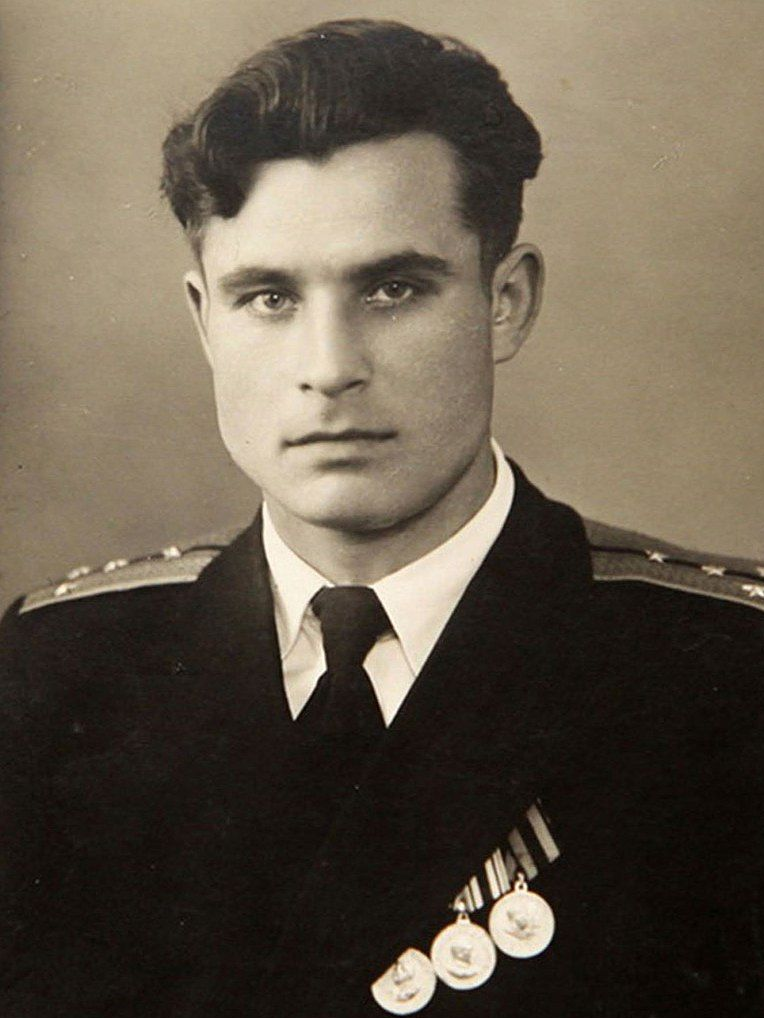
Vasily Aleksandrovich Arkhipov
Arkhipov convinced the captain to surface. It was their only choice. Other than launching the nuclear torpedo, that is.
The Soviet captain exchanged tense words with a U.S. destroyer, got in touch with Moscow, and retreated home.
The world barely escaped nuclear war that day. If that nuclear torpedo had hit the group of U.S. Navy vessels, the situation would almost certainly have spiraled out of control.
Communication via Depth Charge
How did we get so close to total war with the USSR?
Well, the Soviets placement of nuclear missiles in Cuba obviously played a key role. But then again, we had nuclear missiles in Turkey, pointed at them.
And there’s much more to the story. Reckless actions were taken by both sides to get so close to nuclear war.
In the National Security Archives there is a transcript of President Kennedy’s briefing with his National Security Council on October 24, 1962.
JFK’s top military people had discovered the Soviet submarines and were determined to confront them.
But the subs were deep underwater, so we had no way to communicate with them.
Secretary of Defense McNamara and his team devised a unique method to communicate with the subs.
They would drop small “practice” depth charges directly on the vessels to encourage it to surface. These weapons have relatively small charges, but the Soviets had no idea they weren’t full depth charges.
Here is an excerpt from the transcript, via the National Security Archives:
McNamara: This is a new procedure I asked them to set up yesterday, Alex.
Alexis Johnson: It is a new procedure.
McNamara: We have depth charges that have such a small charge that they can be dropped and they actually hit the submarine without damaging the submarine.
JFK was shocked by this development. His brother RFK jotted down the President’s reaction. From the National Security Archives:
It was after McNamara made this point in the discussion, Robert Kennedy jotted down later that day, that he thought “these few minutes were the time of greatest worry by the President. His hand went up to his face & covered his mouth and he closed his fist. His eyes were tense, a/mast gray, and we just stared at each other across the table.”
McNamara’s team had apparently sent word of this new communication method to Moscow, but the submarines had been out of contact, and the captains off Cuba never got word of this new “signaling arrangement”.
Here’s a longer piece of the transcript, and you can review the entire thing here. It’s simultaneously fascinating and disturbing.
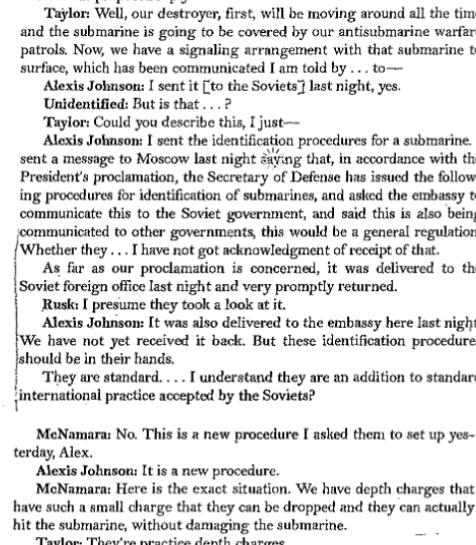
Countdown to …?
64 years after the Cuban Missile Crisis, we find ourselves in another tense geopolitical environment.
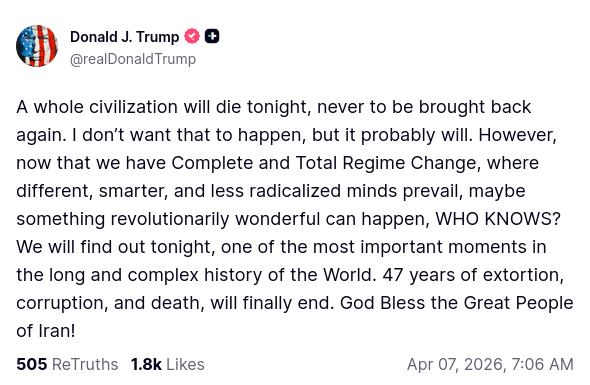
President Trump’s deadline for Iran to re-open the Strait of Hormuz ends at 8:00pm ET tonight.
You’ve all seen Trump’s latest post on the matter, but here it is just in case:
Meanwhile Iran’s Revolutionary Guard (IRGC) stated the following:
“Until today we exercised GREAT restraint in selecting retaliatory targets, but now all these considerations are REMOVED.
US & allies will be deprived of region’s oil and gas FOR YEARS”
Are both sides capable of carrying out their threats? Absolutely. With a few hundred cruise missiles, the U.S. and Israel could cripple Iran’s economy for decades. Power plants, oil facilities, natural gas plants, and bridges. Millions would likely die of hunger.
Is Iran equally capable of carrying out its threats? Yes. They could absolutely cripple Saudi Arabian and other Gulf countries’ oil production and refining. It would almost certainly cause a global financial crisis, possibly a depression. Widespread famine in 3rd world countries. An epic stock market crash.
And remember, Iran can likely keep the Strait of Hormuz closed for more than a year with their stockpiles of drones and anti-ship missiles.
Iran has also stated their Houthi allies in Yemen will close the other critical chokepoint, the Strait of Bab el-Mandeb. That would cut off another key transportation route, which is also Saudi Arabia’s last oil export path.
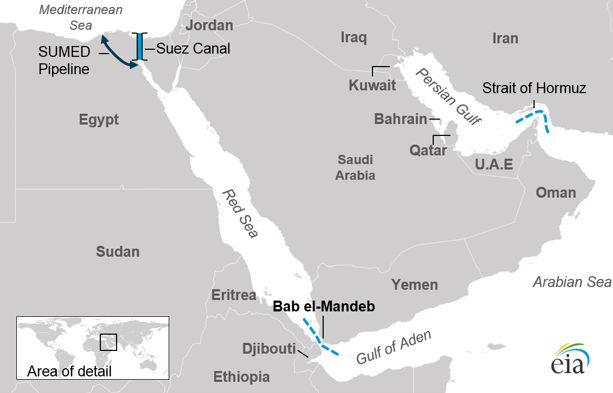
Both sides are capable of devastating economic and humanitarian destruction.
We’re on the brink of absolute chaos, as we were in 1962.
Mutually Assured Depression
During the Cold War, mutually-assured destruction (MAD) ruled the day.
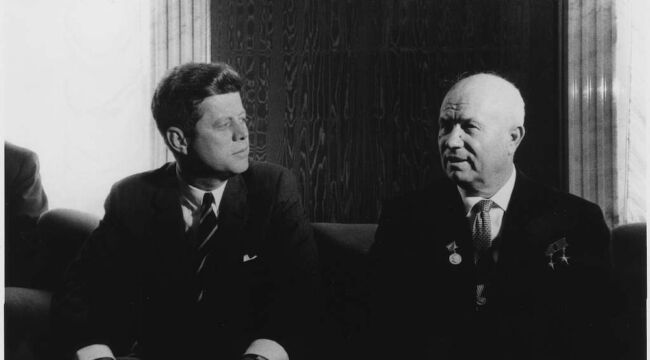
Eventually JFK and Khrushchev both made concessions, compromised, and made a deal. We pulled our nukes out of Turkey, and the USSR pulled theirs from Cuba.
Something similar needs to happen today. But will either side bend? Doubtful, for now.
Things may need to get closer to a severe global crisis before that happens.
We’re not even speaking directly with Iranian leaders. Messages are being passed through intermediaries like Pakistan. The negotiations are not yet serious.
I still hope that a deal comes before Trump’s deadline tonight. An extension, ceasefire, anything would do.
Because if this war keeps accelerating, we are on track for an unprecedented economic disaster.
Never before has society been so dependent on oil, gas, and petrochemicals. Not to mention all the other goods which flow through these Straits.
Finding a resolution to this war will require humility from both sides. Neither appears to have much. For now, we are miles apart from the Iranians on expectations.
If we get a deal tonight, and it looks like it can hold, I’ll be surprised but thrilled.
But for now, I remain hedged with a hefty cash position. I hold puts on a number of U.S. and European stocks and indexes, and a few short ETFs. With that said, my shorts/hedges are still small compared to my long holdings.
I still love gold and silver here, and am still holding the majority of my miners. Petrobras remains a core holding, as do other Brazilian stocks. South American stocks are still a nice place to hide out from this chaos.
But if we get to the total war stage, everything will take a hit.
Tomorrow we’ll delve into whatever happens tonight, and continue to help readers navigate these chaotic times.

Comments: