
No Brakes
President Trump’s latest post on the Iran war is out.
In it, he says a deal with Iran “probably will be reached”.
But he goes on to say that if an agreement isn’t reached, our military will completely obliterate Iran’s power plants, oil wells, and Kharg Island (where the country exports 90% of its oil).
Here’s the full post via Truth Social:
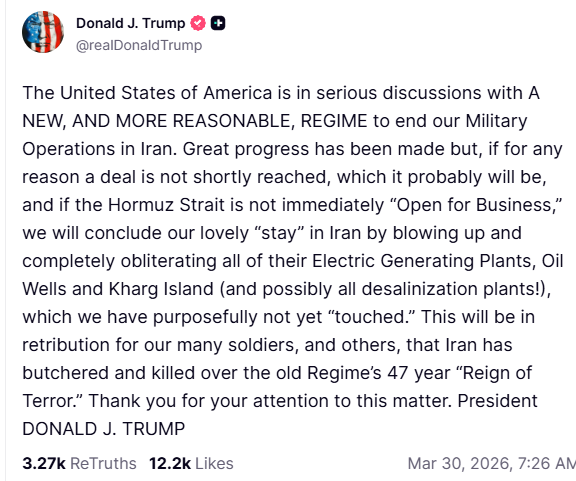
Source: Truth Social
The fact that he says the “new regime” is more reasonable could point to a desire to make a deal.
But the threats, if carried out, would bring us up near the top of the escalatory ladder.
We don’t know how many ballistic missiles, drones, and launchers Iran has left. But my guess is they’re saving enough high-end options for such a scenario.
Even before Trump’s post this morning, strikes on energy infrastructure were accelerating. The picture below is from Israel’s Haifa oil refinery, which was apparently hit by an Iranian drone this morning.
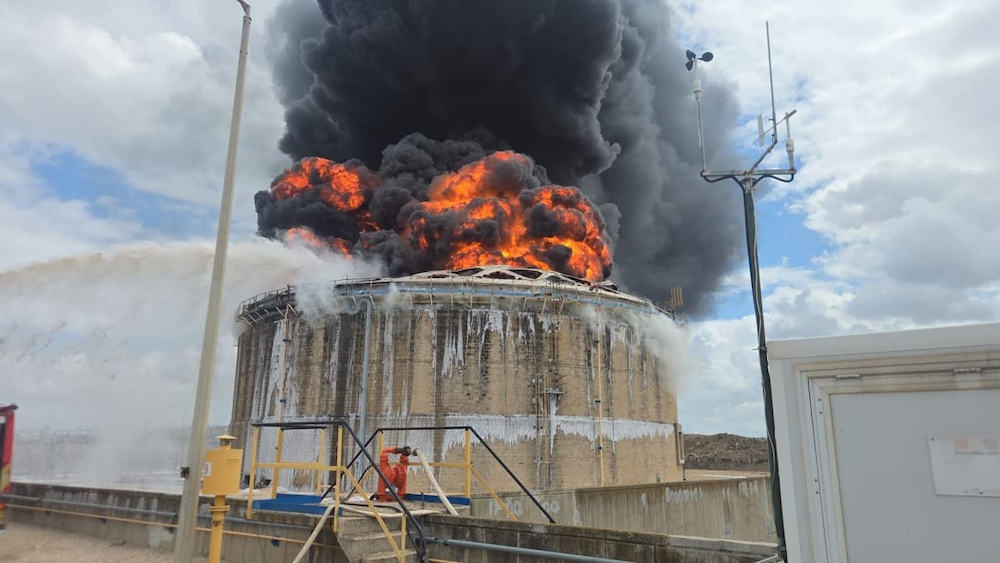
President Trump was asked about a response to the refinery strike by a reporter. His reply was simple, “You’ll see.”
Iran’s capital, Tehran, has been hit extremely hard over recent days. Power outages have been reported across the city.
A chemical plant in Israel was hit, and shortly after, one in Iran was destroyed.
A few days ago, Israel struck Iran’s largest steel plants and a nuclear site. Iran hit a major aluminum plant in the UAE.
U.S. and Israeli military bases in the area have also been hit hard, with valuable planes and radars hit over recent days.

An American E-3 Sentry AWACS was destroyed by an Iranian drone in Saudi Arabia
It is worth noting that the Wall Street Journal initially reported the plane as being “damaged”, when it was clearly destroyed.
We do not have good visibility into the level of damage due to satellite coverage being restricted in the West.
Israel and all of our Gulf allies have also put strict censorship in place. Anyone filming and uploading footage of missile or drone strikes is being arrested.
And not much footage is coming out of Iran, due to the fact that they’ve shut down the internet, and the regime is also cracking down on anyone sharing negative footage.
Most of what we’re getting are leaks and official releases that governments judge to be beneficial.
The fog of war is extra foggy currently.
Failing Brakes
This war continues to accelerate. And unfortunately, I don’t see a good path to peace.
Each side is miles apart on their expectations for a deal. Iran is demanding the U.S. abandon its regional bases and compensate the country for its losses. Not going to happen.
The U.S. is demanding that Iran cripple its missile and drone capabilities, hand over its enriched uranium, and stop supporting proxy forces in Lebanon and Yemen. The uranium was already offered before the war, but the other two would seem to be non-starters.
While there is at least some communication between Trump’s team and Iranian leadership, it’s all through 3rd parties (Pakistan and Oman, reportedly).
So instead of talking directly, we’re playing pass the message.
The only possible factor that could lead to a ceasefire or deal is that all sides are likely running low on missiles and drones.
That could pause the conflict for a year or so, long enough for all sides to re-arm and repair. But it would almost certainly be temporary.
Hopefully I’m missing something here.
Market Impact
Despite the ongoing chaos, markets continue to yawn. Today U.S. stocks are down only slightly as of 1:30pm ET.
Meanwhile in Japan, stocks dropped 5%. Japan and much of Asia are almost entirely reliant on the Strait of Hormuz for their oil and gas supply. The U.S. is much better off, at least energy-wise.
But oil is priced globally, so we will still feel the effects. Additionally, fertilizer prices are soaring, which will impact food in a major way. Plastic production has plummeted, which will lead to shortages and price hikes.
A recession is almost certain. And Jim Rickards seems to agree. In a recent interview at CPAC, he said that markets are not pricing in current risks.
Today Jim posted the following in the Paradigm Press app’s Daily Feed:
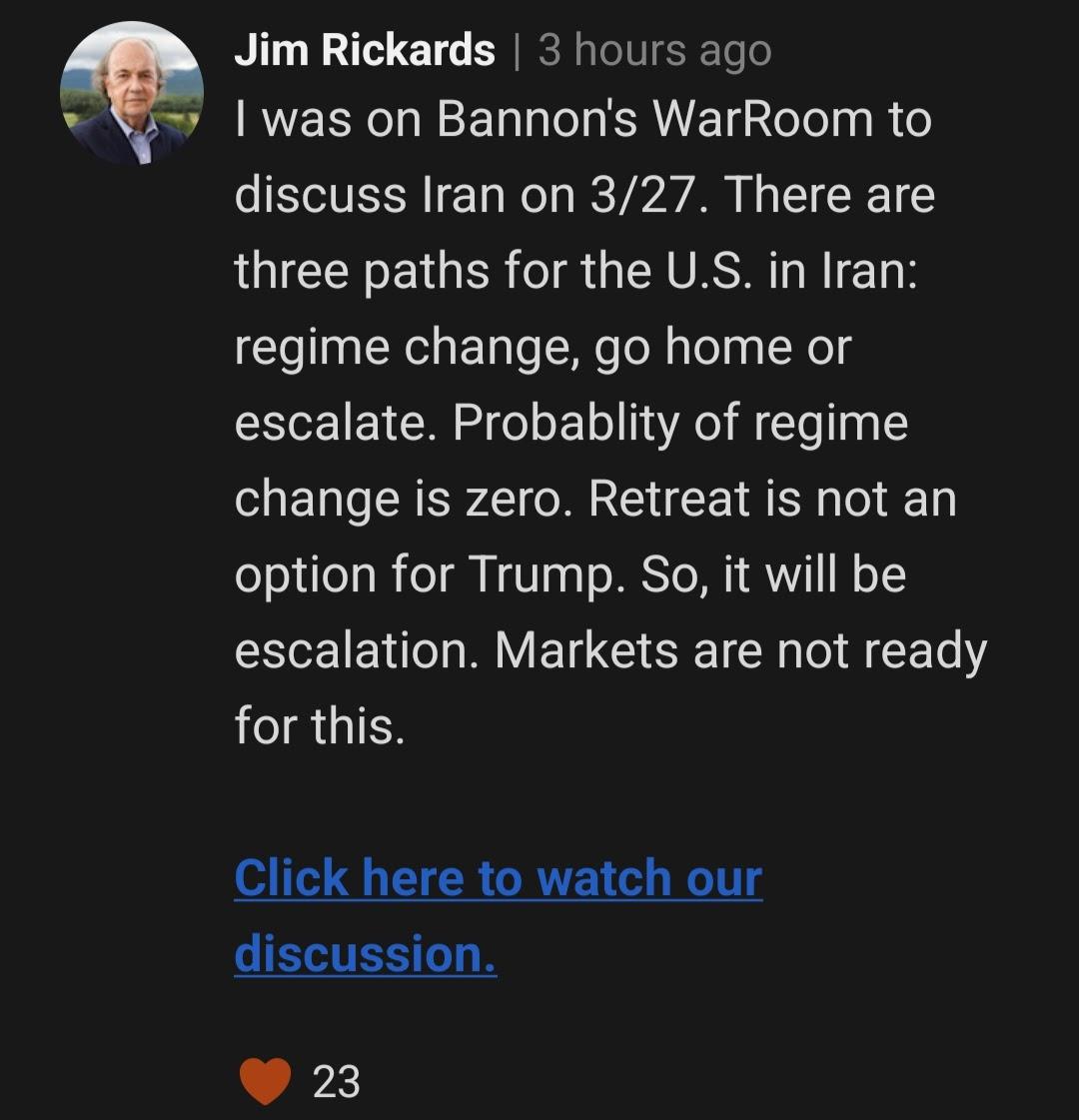
Download the Paradigm Press App Here
I agree with Jim’s analysis. Trump is unlikely to quit now, with Iran still controlling the Strait of Hormuz and threatening U.S. and Israeli assets. And markets aren’t pricing the risks properly.
Further escalation remains the most likely option, by far.
The S&P 500 and Nasdaq are both down about 8% since the war began.
But we started out at an extremely expensive level. The downside in stocks far outweighs the upside from here.
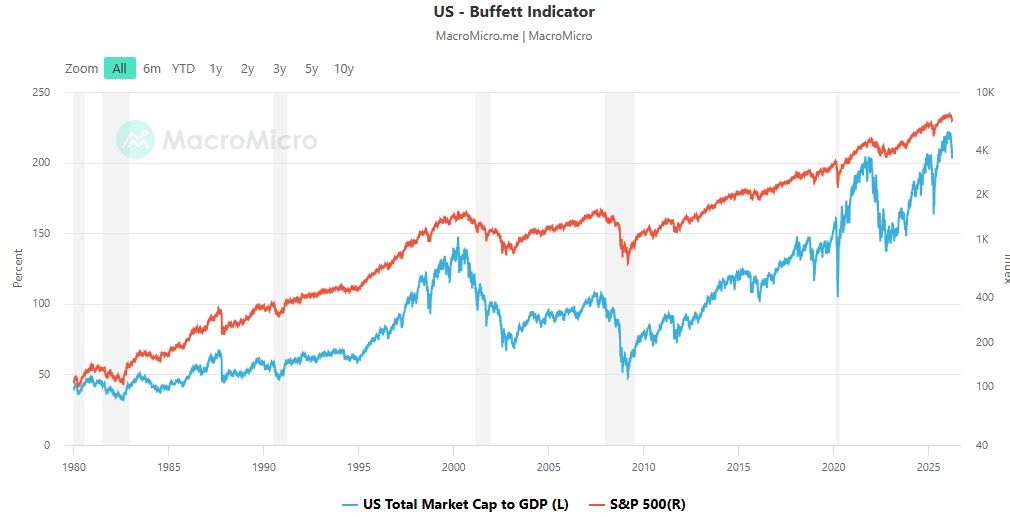
Below is a chart showing the Warren Buffett Indicator, a measure of how expensive stocks are. It simply compares the value of all U.S. stocks to GDP (US economic output).
The blue line is the Buffett Indicator:
Source: MacroMicro
We are still at levels more expensive than the dotcom bubble in 1999-2000.
As I’ve been mentioning from the beginning, it would be wise to take some profits here and raise cash. And maybe buy some puts/hedges, but only if you know what you’re doing or are following one of our experts here like Jim Rickards and Dan Amoss.
I continue to hold large positions in oil and gas stocks such as Petrobras (PBR, PBR.A) and Exxon Mobil (XOM). If you want easy diversified exposure to U.S. energy companies, the XLE ETF is an easy choice.
The pullback in gold and silver has provided a nice buying opportunity. They may fall a bit further, but long-term, precious metals are going higher. I am avoiding buying any more miners for now, due to their heavy exposure to oil prices. However, if they fall to levels that are irresistible, we will let you know.
Money Printing Ahead
President Trump is likely to send out stimulus checks to struggling Americans at some point this year. Around 65% of Americans live paycheck-to-paycheck, and this energy spike is going to hit hard.
The President is requesting an additional $200 billion to support the war effort. More debt, more money printing.
The Federal Reserve will almost certainly cut interest rates at some point. While some are arguing for rate increases, this seems highly unlikely. Besides, higher rates wouldn’t help lower oil-driven inflation anyway.
Even before this war began, markets were in a fragile fundamental state. Now I don’t like the outlook for most stocks at all.
We are still near record-high valuations for U.S. markets, and much of the rest of the world is far more vulnerable to oil and natural gas disruption.

Comments: