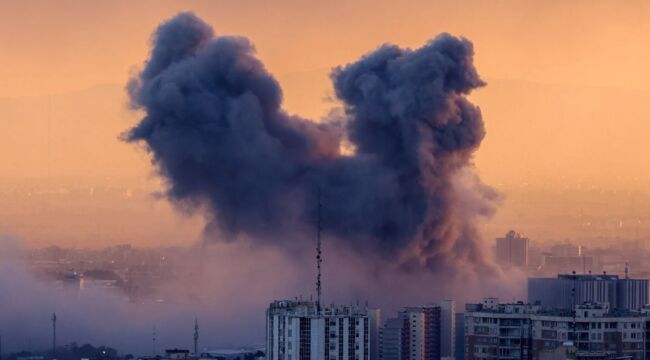

Jim Rickards’ Most Surprising Iran Takes
I’ve been a fan of Jim Rickards’ work for around 10 years.
He came onto my radar in 2016 when he predicted Donald Trump would win the election. I saw a clip of him saying the polls were crooked. And that turned out to be a great call.
Jim is never afraid to speak his mind. And his contrarian predictions have uncanny accuracy.
So I’ve been following Jim’s work on the Iran situation closely. Just today he put out a new Iran writeup with surprising, even disturbing ideas in it.
This is what Jim does. His research is sometimes unnerving, but it is always well thought out and logical.
Today, we’re going to cover a few key aspects of Jim’s new report and add context with maps and graphics.
Let’s get started…
Can Iran Wait it Out?
In a section titled, Can Iran Win?, Jim begins by acknowledging that the U.S. and Israeli forces have done far more damage thus far:
Notwithstanding Iran’s limited success in counterattacks, it’s clear that the U.S. and Israel have inflicted far more damage on Iran than Iran has inflicted on the region.
That asymmetric damage ratio will continue to grow. The U.S. and Israeli attacks will expand even as Iran’s capacity to strike back is being heavily degraded.
However, there are deeper considerations here. For example, while taking out the 86-year old Ayatollah Khamenei was satisfying to many, it also handed the Iranian regime a propaganda victory. Here’s Jim:
Martyrdom – The first point is that the deaths of Ayatollah Khamenei and many of the top leaders of Iran may not have been unwanted by them. This is something the Western mind can barely comprehend.
In Islam, martyrdom is considered a blessing from Allah. It guarantees the martyr a place in paradise.
Is it possible that Khamenei and other leaders gathered in one place intentionally knowing that they would eventually be hunted down and killed by the U.S. and Israel? Why not gather in one place and become martyrs together?
This idea of martyrdom applies to the successors and replacements of those killed on day one. Many of those successors have been killed also. To the secular West, this is counted as a military victory.
But to the theocratic Muslim, martyrdom is the victory. This process unites almost all of Iran in a celebration of Allah’s divine will. The more martyrs we create, the stronger Iran becomes as an Islamic Republic.
Again, this is hard for the Western secular mainstream to grasp, but killing their leaders is making Iran stronger. There’s an almost Nietzschean vibe for the Iranian survivors.
This is the type of analysis you won’t see on cable news. Martyrdom is a powerful force in the Islamic world, and there is a decent chance that Khamenei embraced the prospect of death. Even if this isn’t objectively true, what matters is how it is perceived by the world’s 230 million Shia Muslims. And they take this stuff very seriously.
The Ayatollah’s killing could lead to a more unified Iran, and even spread to neighboring Shia populations in Bahrain, Iraq, and beyond.
Challenging Topography
Jim goes on to describe how challenging a ground invasion would be due to Iran’s terrain:
The Terrain – Westerners also have little idea just how big Iran is. It’s the 17th largest country in the world by area out of 195 countries. It also has the 17th largest population in the world with 86 million people.
Iran is not a giant like India or Brazil, but it is far larger than Americans realize. The terrain is challenging with large mountain ranges and deserts. This is not a country ripe for a land invasion like Iraq or Syria.
Iran is far larger than Ukraine, which is still holding out against Russia after four years of war. Iran has what military strategists call strategic depth, which offers the ability to retreat without surrender. Iran isn’t going anywhere and it will not easily be subdued.
Here is a topographical map of the country. Note how mountainous Iran is compared to Iraq directly to the West.
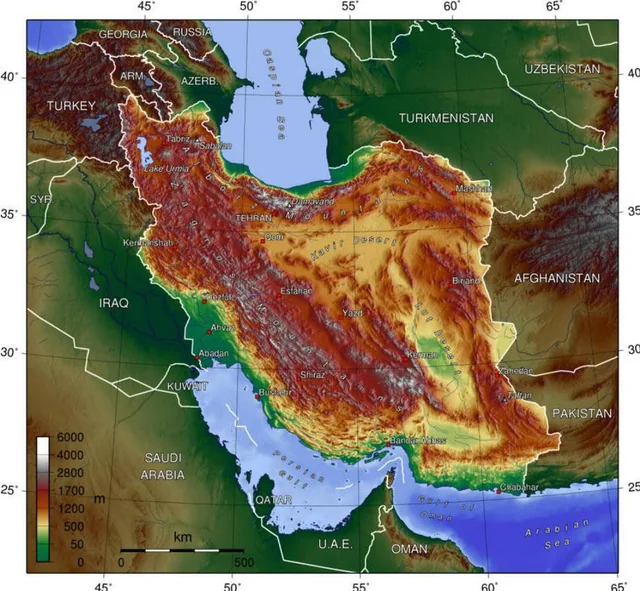
Compared to Iran, Iraq is about as flat as Illinois. It would make an extremely challenging ground invasion. Still, President Trump is not ruling out the prospect of boots on the ground.
How Long Will U.S. and Israeli Munitions Last?
The next item Jim tackles is perhaps the most challenging. A looming shortage of key munitions.
A U.S. Munitions Problem – Most importantly, the U.S. and Israel are running low on offensive and defensive bombs and missiles. This is the result of the massive bombing attacks on Iran, the need to fire thousands of anti-missiles to shoot down thousands of incoming drones and missiles, the fact that the U.S. has allowed its military industrial capacity to atrophy, and the large number of weapons wasted in Ukraine.
The U.S. sent seven Patriot anti-missile batteries to Ukraine at about $1 billion each. All seven were destroyed by Russian hypersonic missiles. I’m certain the U.S. wishes it had those batteries today to protect U.S. bases and troops near Iran. The senile Biden and neocon warmongers may be to blame, but the damage is done.
The U.S. and Israel have inflicted enormous damage on Iran and will continue to do so in the short run. But within weeks, the magazines will run low, and the U.S. will be scrounging around in South Korea and Japan for replacements.
Good luck with that.
U.S. industrial output of 800 cruise missiles per year cannot keep up with Israel and the U.S. launching 100 per week. Ships need to reprovision. Repairs cannot be neglected. Diego Garcia is days away from the battlespace. The U.S. will be badly stretched.
So Jim estimates that America produces around 800 cruise missiles per year. And we’re currently launching about 100 per week. Maybe more. Not great. There are stockpiles, of course, but those are supposed to be for emergency use only. Does this qualify?
Additionally, many U.S. bases close to Iran have been hit by Iranian missiles and drones and have essentially been abandoned. Fortunately U.S. soldiers are largely out of the line of fire. But it also makes refueling and re-arming challenging.
Here’s a map, via the Wall Street Journal, showing the approximate positions of U.S. bases and naval assets in theater:
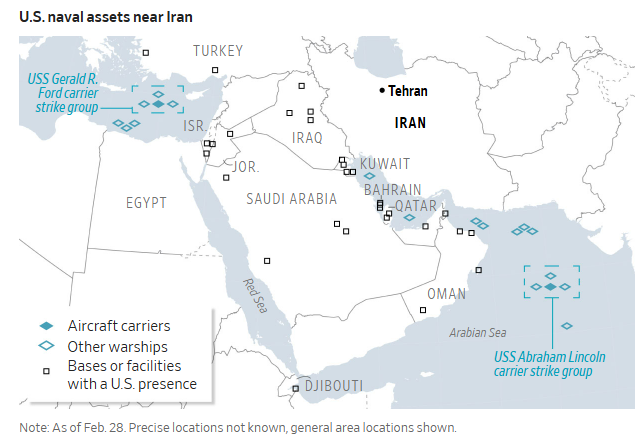
Source: WSJ
(Note: Since this map was published, the U.S.S. Gerald Ford carrier strike group has moved through the Suez Canal into the Red Sea, likely headed to the Arabian Sea.)
To refuel, re-arm, and repair, The U.S.S. Abraham Lincoln carrier strike group would normally go to Bahrain or another nearby base. But those bases have been hit hard. So now they will likely have to go to Diego Garcia, which is thousands of miles away. Here’s a map:
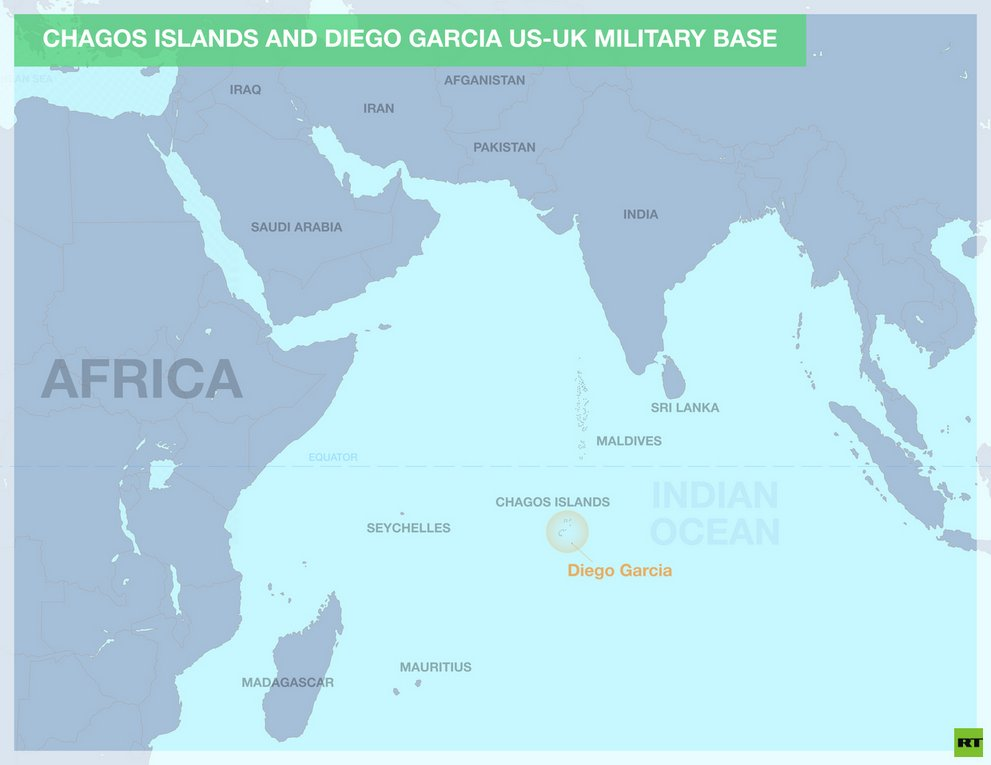
Source: RT
Jim closes his report with a note about the uncertain outcome of a war of attrition.
Iran has a united population; reports of internal protests are greatly exaggerated, especially after the ayatollah ordered the killing of 5,000 protestors just weeks ago.
It has a robust political system despite decapitation strikes. Drones are cheap and easy to manufacture. They can do just as much damage as an F-15 strike when targeted properly.
Iran has strategic depth, allies in Russia and China, and a strong survival instinct.
In a war of attrition, really a war for survival, victory goes to the last man standing. That may be Iran.
This is why we read Jim Rickards. Smart contrarian takes you won’t hear on mainstream media.
In war, the number one mistake is to underestimate your opponent. We should be careful to heed this historic warning.
This war has the potential to escalate in unpredictable and dangerous ways. Economically, geopolitically, and kinetically.
More soon.

Comments: