
The Last Triumph
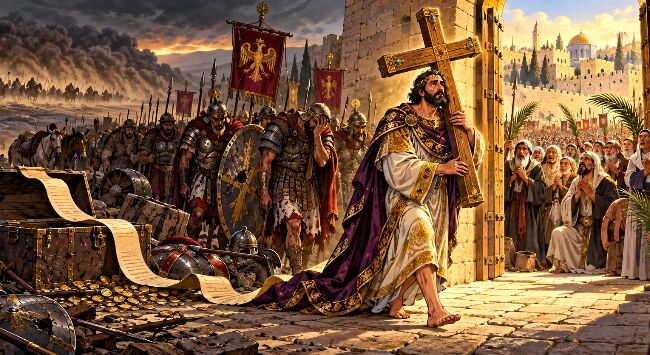
Legend has it that in March 630, Emperor Heraclius rode up to the gates of Jerusalem in full imperial splendor. On his shoulder, he carried the most precious object in Christendom: the True Cross, the wood on which Christ was crucified.
The gate wouldn’t open.
The story says that an angel reminded him that Christ entered this city on a donkey. So the emperor stripped off his robes, removed his shoes, and carried the Cross through the gate barefoot, like a penitent.
The gate had opened for the humbled man.
Historians will tell you the barefoot scene is nothing more than pious legend added centuries later. Maybe. But the core of the story still stands, and it’s one of the greatest comebacks ever recorded.
And yet it’s also a warning that lands uncomfortably close to home in these trying times.
On Monday last week, Catholics around the world celebrated the Feast of the Exaltation of the Holy Cross. Most people never learn how the Cross came home. I, myself, had never heard this story before. So let’s remedy that, because this story holds a lesson about winning nobody in The Swamp wants to hear.
The World Had Fallen Apart
When Heraclius took the throne in 610, the Byzantine (Eastern Roman) Empire was dying.
The Persian Empire under Khusro II had torn through the eastern provinces. Syria and Palestine had fallen. Then, in 614, the Persians had sacked Jerusalem itself, hauled the Patriarch off in chains, and seized the True Cross.
For a Christian empire, this was no mere loss. It was a galactic humiliation. The Cross had become the physical token of God’s protection over Rome. After this defeat, it sat in the Persian treasury.
Things got worse. Persia took Egypt, the empire’s breadbasket. Persian armies camped in Anatolia (the Asian portion of present-day Turkey). The Avars threatened Constantinople (present-day Istanbul) from the Balkans. By the early 620s, that day’s smart money said Rome was finished.
Pride Goes…
Then, Heraclius did something nobody expected.
In 622, he stopped defending and started to attack where the Persians were soft. He marched through Armenia and the Caucasus, straight at the Persian heartland, going around the occupying armies to strike the enemy’s rear.
Late in 627, near the ruins of Nineveh, his army destroyed a Persian force. Then he pushed toward the Persian royal cities and burned Khusro’s palace at Dastagird to the ground.
But Heraclius never took the Persian capital. He didn’t have to. Khusro’s own nobles did the job for him. A king survives only as long as he can pay the small circle that keeps him on the throne. Once Khusro failed, that circle turned. In February 628, his own aristocracy deposed and killed him.
His heir made peace and returned Roman territory and the captives. And most likely in March 630, the True Cross returned to Jerusalem, carried by the emperor himself.
Contemporaries hailed Heraclius as a new David, a new Constantine. He had inherited a corpse of an empire and, in only 8 years, turned catastrophe into the greatest triumph Rome had seen in centuries.
But the good times didn’t last.
…Before the Fall.
The two superpowers of the ancient world had spent a generation grinding each other into dust. Their treasuries were empty, armies were decimated, and their war-torn provinces were broke. People traded back and forth between empires felt little loyalty to either.
Both empires looked mighty on parade day, but they were hollowed out.
These weakened states were so unprepared for what was next that they didn’t even see it coming.
Out of Arabia, armies nobody in Constantinople or Ctesiphon had planned for suddenly attacked.
The Persians were so exhausted, their defeat so complete, their empire simply vanished from history.
And Heraclius, our barefooted hero of 630, lived long enough to watch Syria and Jerusalem fall, all over again, into a new enemy’s hands. His greatest victory turned out to be a funeral parade. He just didn’t know whose funeral yet.
Victory Lap… or Trap?
The most dangerous moment for any power is total victory over an exhausted rival because victory hides its costs.
Though Rome won in 628, it was broke, bled, and brittle.
America held its parade in 1991. The Soviet Union collapsed, and men like Francis Fukuyama declared the end of history. Then we spent 30 years proving we could beat any enemy except our own balance sheet. We’ve had 2 decades of wars in an oversized sandbox. Federal debt went from $5 trillion to north of $40 trillion. We shipped our entire industrial base abroad, only now realizing its true cost.
Like Heraclius, our leaders are running a machine that’s supposed to counter every threat. And every counter drains the treasury a little more.
Meanwhile, the next challenger built ports, factories, high-speed rail, incredible EVs, and supply chains while we argued about the last war.
Armies won’t be knocking at America’s gates any time soon. Still, there’s an obvious pattern: the moment of maximum swagger is often the moment of maximum fragility.
In other words, the turkey is fattest, happiest, and cockiest on the fourth Wednesday in November.
Wrap Up
Whether it’s an empire or an index at all-time highs, ask what the victory cost and who’s exhausted under victory parade’s confetti.
Paper claims on dying empires don’t survive. Own what outlasts The State, not the claims that depend on it.
The city gate opened for a man who carried his own burden. Humility, patience, and low time preference built everything worth keeping, and will keep doing so.
Heraclius got his miracle. He carried the Cross home barefoot while the crowds wept.
Though the empires of his world are dust, we’re lucky that his lesson walked out of the gate with him.
Have a great day.

Comments: