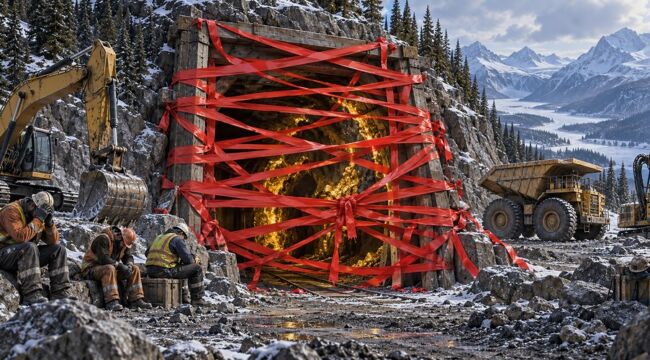

The Politics of Gold Mining Stocks
Last week, I was at the Java Connection in Whitehorse, Yukon. I was in town on my way to see two projects up above Dawson City. Two men sat down at a table next to me.
I couldn’t help but overhear their conversation. It focused on the Eagle Mine and the continued fallout from the disaster.
The conversation highlights some risks to investors in Yukon mining companies.
In 2024, gold producer Victoria Gold’s heap leach pad collapsed at its Eagle Mine. The collapse broke through the containment area and allowed cyanide laced ore to enter Haggart creek. Haggart creek leads to the Yukon River, a major artery in the region.
Sounds horrible doesn’t it?
Ranj Pillai, the Yukon Premiere at the time, indicted the mining industry at large:
The mining sector has had its fair share of bad actors, unfair practices, and the inherent desire – driven by the greed of corporate executives and shareholders – to cut corners, shirk responsibilities, and break the law.
He compared Eagle to the Clinton Creek mine. That was a true environmental disaster. A bankrupt asbestos mine that the operator abandoned. It cost the taxpayers millions of dollars in cleanup.
The comments fanned the flames of community anger. The politicians rode the wave of emotions and threw the company to the wolves.
The implication was that Victoria Gold was greedy and negligent. That they’d made their money and would stick the cleanup on the People of the Province.
That’s not the case.
The collapse at Eagle wasn’t the waste pile. It was the leach pad. That’s where all the gold gets produced. The miners stack the ore on a super-thick pool liner. Then they spray a diluted sodium cyanide solution on it. The cyanide grabs gold ions as it passes through the layers of ore.
The solution, now “pregnant” with gold, gets piped off the bottom of the pad and treated. They remove the gold and recycle the solution back to the leach pad. This is a simple, proven process for gold mining.
The collapse at Eagle was the leach pad. There was about 265,000 ounces of gold in the material that collapsed. That’s worth over a billion dollars today.
If there was negligence, it wasn’t greedy corporate executives. They would take the money first and leave the cleanup costs.
Rather, it’s a legitimate accident that cost the company everything. At the time, the company was worth C$500 million in market value. After the collapse, Victoria Gold went bankrupt.
The boogeyman in all this was the cyanide used to process the gold ore. And while you don’t want it in the environment, it’s the least bad chemical to deal with. If you have to have a chemical release, cyanide is a good option.
As long as it doesn’t get into the ground water, it will break down in a few weeks. That’s the case at Eagle. The collapse happened in June 2024. It killed fish and introduced cyanide to the local watershed. The government monitoring program stopped finding cyanide by August the same year.
That’s because a cyanide molecule is one hydrogen ion, one nitrogen ion, and one carbon atom. Sunlight and oxygen quickly break it down into inert byproducts. That’s far better than pollutants like mercury or arsenic, which last decades.
The result of the collapse, Victoria Gold went bankrupt. Price Waterhouse Coopers received all the assets. They are actively selling them off now. So, the mine isn’t gone, just the company. And the rumor is that a Singaporean mining company will buy Eagle and put it back into production.
Since the Eagle Mine collapse, the government turned over. The new Territorial Government has yet to fully approve a new mine. In April 2026, the government issued conditional approval to BMC Minerals for its Kudz Ze Kayah lead zinc mine. There are 52 conditions that the company must meet. And it still needs two more permits to begin construction.
The shadow of Eagle hangs over the industry in Yukon. Until the territorial government fully approves a new mine, the political risk remains.
Make no mistake, there are fantastic opportunities for mining investors in Yukon. However, we are sticking to exploration companies and producers for now.
The government must fully approve a new mine before we jump into development projects. There’s simply too much regulatory and political risk.

Comments: