

Putin, Persia and a Perfect Storm for Diesel
It took longer than I expected. But the energy crisis we’ve been warning about since March is here.
Oil wells, pipelines, and refineries are being blown to smithereens in the Middle East, Russia, and Ukraine.
In Russia, Ukraine has been hitting oil refineries with drone strikes on an almost daily basis. Here’s the latest:
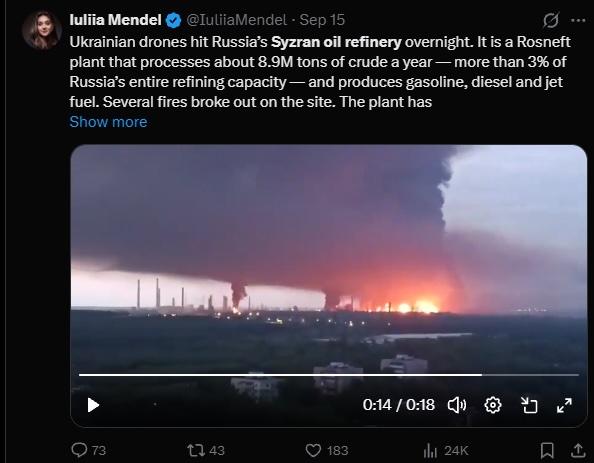
Source: X
Russia was the world’s second-largest exporter of diesel fuel. Now they’ve banned exports entirely. President Trump went so far as to warn Ukrainian President Zelensky to halt refinery attacks. Even Putin agreed to Trump’s proposed “energy ceasefire”.
Yet Ukraine’s drone strikes continue. Zelensky has gone rogue.
Diesel just hit an average of $6.26 a gallon here in the U.S. In parts of California, the price hit $9.99. It would have been higher, but they need to update the pricing software first.
In Germany, diesel is trading at more than $11 a gallon.
America is the largest exporter of diesel fuel in the world. And now Senate Majority Leader John Thune says he is “open to exploring” a ban on diesel exports. He said it casually, as if there wouldn’t be world-shaking consequences (we’ll explore those more below).
And China, which had been relying on its oil reserves instead of buying in the global market, is now gobbling up crude again. In Shanghai, oil currently trades at $138 a barrel, a $35 premium to the U.S. Typically the premium is around $5.
Meanwhile, strategic oil reserves in the U.S., EU, and Asia are at multi-decade lows. We can’t pull much more from them without risking the caverns collapsing.
The Strait of Hormuz remains about 80% closed. The Bab al-Mandab Strait, another key naval chokepoint, is now completely controlled by the Houthis in Yemen. The Houthis have also struck a number of Saudi oil wells and refineries in recent days with missiles and drones.
Saudi Arabia’s key East-West pipeline has been completely disabled by drone strikes, which apparently originated from Iraq. That’s about 4 million barrels per day, off the market for an indefinite period. Roughly 3.8% of global demand. Erased by a few $20,000 drones.
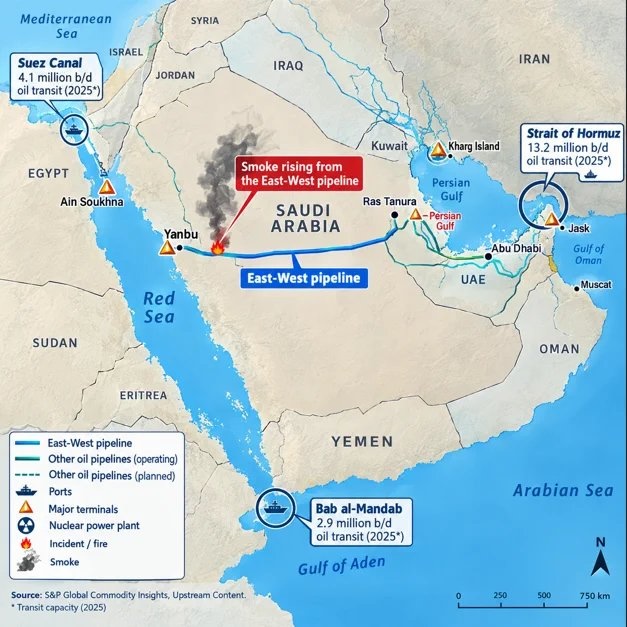
Source: S&P Global Commodity Insights, Upstream Content
This is the scenario we’ve been warning about since March.
About That Diesel Export Ban…
Diesel remains the lifeblood of modern economies. Trucks, trains, generators, and heavy equipment all rely on this critical fuel.
Unless the situations in the Middle East and Russia are resolved soon, prices will continue heading moonward.
With the U.S. being the largest exporter of diesel in the world, the idea of an export ban may sound nice at first.
The price of diesel here in the States would crash, providing relief to businesses and consumers. Everywhere else in the world, it would soar.
But American oil companies would be hit hardest. Refiners’ profit margins would be crushed.
Investors might lose faith in U.S. energy companies, especially refiners, because at any time the government could smash their profitability.
Just look at Petrobras (PBR), the Brazilian oil giant. The government owns a big chunk of it, and in the early 2010s they forced the company to sell fuel to consumers at a loss. This is why the company trades at a P/E of just 5.4 today with a fat dividend yield. It’s been more than a decade, but the company still trades at a huge discount to the market. Don’t get me wrong, we’ve done extremely well with Petrobras, and I still own a lot of it.
But if a diesel export ban comes to pass, U.S. refiners would see their valuations cut.
A ban on diesel is highly unlikely. If it happens, we’d get temporary relief but the consequences would be felt in capital markets for the next 20 years. It would be a serious hit to U.S. oil equities. It’s not a good or realistic option.
Midterms and POTUS
When a reporter recently asked President Trump when the Iran war will end, he replied, “I think very soon, probably right after midterms.”
But does this mean a deal will be struck after the midterms, or that the war restarts? I suspect Trump means we’ll go in full force after the midterms are over. He hinted as much in a recent interview with Laura Ingraham on Fox News:
Ingraham: “Even the neoconservatives are saying if you’re going to go into Iran, go in full. Just go in and take them out.”
Trump: “Well, maybe I don’t do that because of the elections.”
Our own geopolitical guru Jim Rickards says that after the midterms, it will most likely be back to war. Here’s what he wrote in an August 26th update:
Once the midterm elections are over, expect the kinetic war to return with a vengeance.
Win or lose, Trump will be out to punish Iran. Even with a partial resupply of critical weapons, Trump will be eager to go back on the attack, blaming Iran for its failure to do a deal.
I tend to defer to Jim on these matters. His track record on such matters is disturbingly accurate.
If he’s right, the energy crisis will only accelerate after midterms. A resumption of full-scale war will cause Iran to lash out at Gulf oil and gas infrastructure. And despite what neocons may be telling the president, a quick military resolution isn’t in the cards.
$150 oil and $10 a gallon diesel are becoming increasingly likely, unless something changes soon.
I’m still holding out hope that Trump’s team is able to make a deal. One that will stop Iran from acquiring a nuclear weapon, and re-open the chokepoints. But we’re going to have to make some concessions, and that is not something America is accustomed to.
So I expect energy prices to continue rising. I’m holding onto my energy stocks (Exxon and Petrobras), which combined make up about 11% of my stock portfolio. If you don’t have any exposure to oil, I’d recommend getting at least a little.
If we get a pullback in oil prices this week, I might even buy some calls on USO (United States Oil Fund – it tracks the price of WTI crude).

Comments: