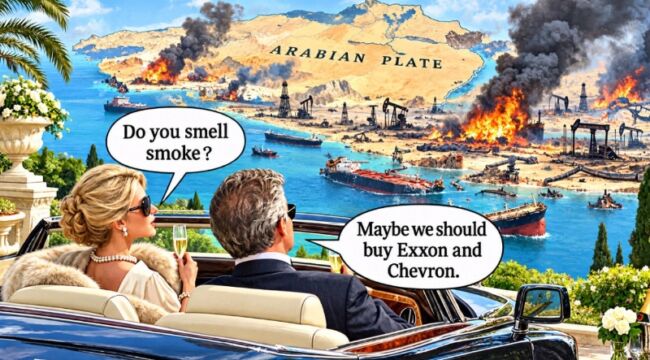

Investing on a New Energy Map
There’s an old Wall Street line: “Buy the rumor, sell the news.”
Well, from the Red Sea, then across Saudi Arabia and into the Persian Gulf, rumors just redrew the map.
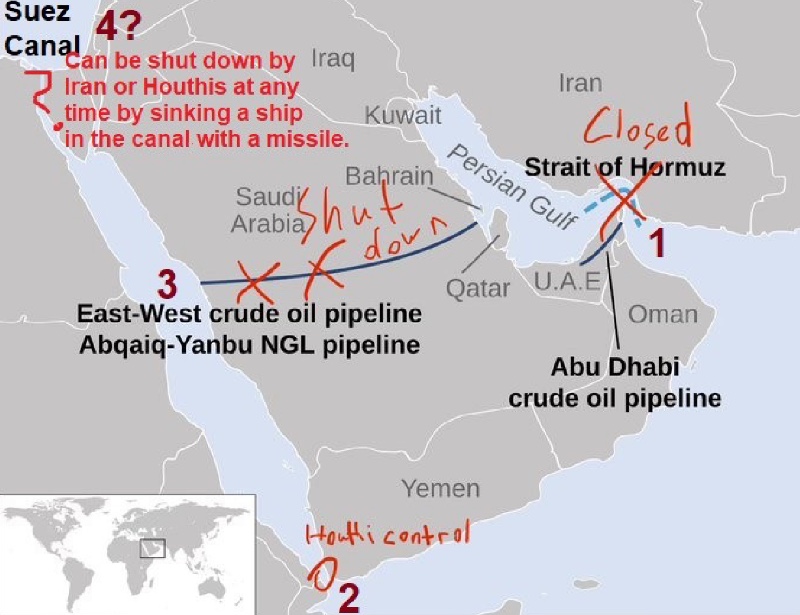
The world’s new energy map. Credit Matt Bracken.
This is the new energy and geographic reality, and it won’t soon return to anything like the old reality, if ever (and probably never). So, prepare and invest accordingly. Let’s dig in…
Own Non-Middle East Energy!
No beating around the bush today. Here’s the takeaway: own energy and oil service plays that operate far from the Middle East! If you already own investments like that, good for you. If not, you need to get moving.
Here at Paradigm Press, my editorial colleagues and I have banged this energy and service drum for many months; even years, depending on how far back you want to go:
ExxonMobil (XOM). Chevron (CVX). Petrobras (PBR). Schlumberger (SLB). Halliburton (HAL). Cenovus Energy (CVE). Syncrude/Suncor (SU). Transocean (RIG). Oceaneering International (OII). Valero Refining (VLO).
All these and more… We told you so.
And if you’re a new subscriber? Well, you weren’t around but here you are now. And many of our ideas still have legs for the marathon ahead.
The Middle East is ground zero for worldwide energy problems. Since the outbreak of conflict with Iran last February, global energy flows are disrupted. Oil prices have bounced around but are generally rising. And now, after what happened last week with Saudi Arabia and Yemen, they’re really rising, which we’ll address below.
The investment opportunity is that, for many years, markets mispriced risk in a historically volatile region. Meanwhile, it’s not as if people didn’t know the risks. Anyone could have visited a decent library and looked up some history about the Arabian region. But then, there’s what’s called “recency bias.” Many people thought that things seemed to be under control.
But obviously, things are not under control.
Energy is a System of Systems
From the pumpjack in the field to the fuel pump down the street, the story of oil is not “just” geology, and I say that as an old petroleum geologist.
Oil is a system of systems: land and mineral rights; exploration and mapping; capex allocations; roads, rigs and drill bits; pumps and pipelines; refineries, terminals and tankers; harbors and ports; insurance and finance; chokepoints and military power… or lack of it.
Now, we’re watching in real time how a seemingly “local” conflict can trigger a global energy and economic earthquake. In Arabia, it’s Saudis versus Houthis; and most people hear that and say, “Huh?”
Because who has time to learn about arcane tribal issues that go back over a century, to the dying days of the Ottoman Empire, let alone research back even more centuries into the dusty mists of ancient times? Who cares, right?
Well, right now we all care. And the short version is that a well-organized militia in Yemen – called “Houthis” – just mauled Saudi military forces and gained control over a strategic stretch of Red Sea coastline. During the back and forth, a key pipeline in Saudi Arabia was wrecked; apparently, the pump stations are destroyed. So now, Saudi is days away from essentially no oil exports, a loss to global supply in the range of 8 million barrels per day.
We have a situation where tankers must reroute; insurers must reprice; refiners everywhere are scrambling; and oil, refined products, fertilizer, other petrochemicals, LNG, container goods, food, and much more must now sail on very different routes and schedules.
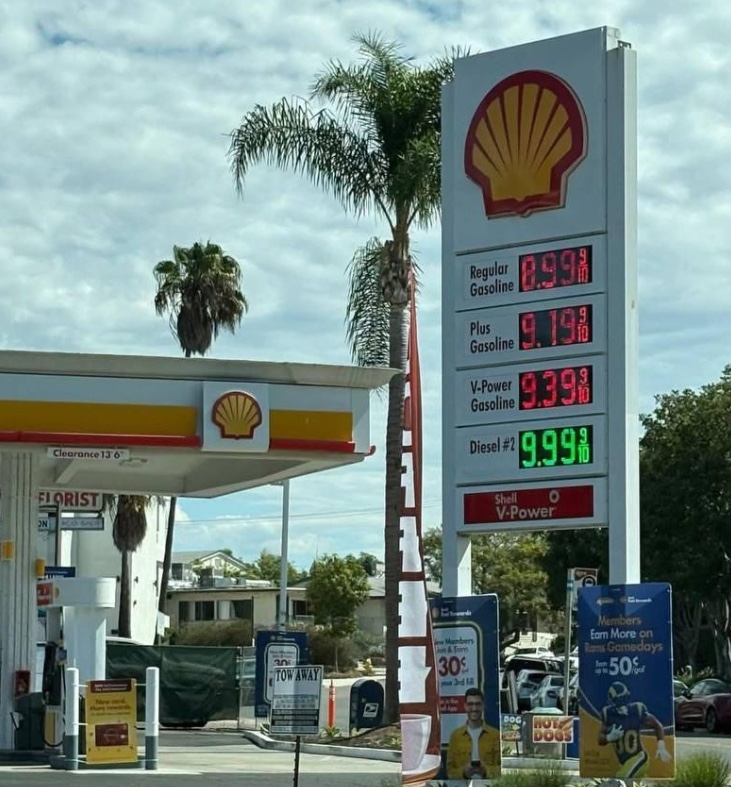
California gas station this past weekend. Credit anonymous Paradigm subscriber.
In due course, your cost of living will increase, while your quality of life will decline. Oh, and here (above) is California diesel fuel at $9.99 per gallon. Note how it maxes out the electronic price screen. No doubt, Shell will find a way to fix that problem.
Two Gates Under Pressure
Go back to that map, above. On the eastern side of Arabia sits the Strait of Hormuz, the narrow exit for Saudi, Kuwaiti, Iraqi, Emirati, Qatari and Iranian energy exports, and much else. It’s been in the news bigtime since the Iran conflict kicked off.
On the southwest corner is Bab al-Mandeb (BAM), the “Gate of Tears,” where the Red Sea opens into the Gulf of Aden and Indian Ocean. Plus, BAM is the gateway to Suez, up north, which leads to Mediterranean ports and Europe. It too has been in the news over the past few years, and now drives much of the energy story.
Basically, if somebody closes or restricts Hormuz or BAM, the world changes fast. If both Hormuz and BAM have problems, then we all have big problems.
That is, with Hormuz under restrictions from Iran, oil producers in the Persian Gulf struggle to move energy out. And now that BAM is under threat, the Red Sea-Suez route becomes unreliable.
Plus, with Saudi Arabia’s East-West pipeline shut down, the kingdom’s land bridge from eastern oil fields to Yanbu on the Red Sea ceases to be a reliable source of oil to global markets; and in fact, becomes just another target.
And consider that the Houthi militia need not defeat Saudi Arabia in any sort of major battlefield sense, like some sort of reverse version of Desert Storm of 1991. They only have to make Saudi oil logistics unreliable.
In other words, Houthi militia – literally, “guys in sandals with AK-47s” – don’t require a blue-water navy or modern air force to disrupt global shipping. They just need to control a stretch of Red Sea shoreline, which is the situation now. They can station observers with binoculars (or use Chinese satellite feed), set up drones and low-end missiles, utilize mines or boarding teams, and generally present enough credible firepower to make shipowners and insurers think twice.
The larger context is that global trade – definitely, the energy trade – runs on sailing schedules, credit and confidence. When ships must stop and await an escort, or divert around Africa, the costs appear everywhere: higher fuel burn, inventory shortages or backlogs, delayed delivery times, higher freight rates, war-risk insurance premiums, and higher prices all down the line.
Of course, oil gets the headlines. But the same shipping lanes that host oil tankers also serve vessels that haul refined products, LNG, fertilizers like urea and ammonia, methanol, sulfur, aluminum, industrial chemicals, auto parts, electronics, textiles and ordinary household goods. You name it. Because you’ll pay more for it.
Saudi Weakness, Houthi Leverage
Since the 1970s, Saudi Arabia has spent massive fortunes on aircraft, missiles, air defenses, advisers and command centers. On paper, it looks formidable. But in combat – certainly last week in Yemen – Saudi military power was abysmal.
One problem is that much of Saudi’s ground force is comprised of foreign mercenaries; they are happy to get paid but not much of a war machine. In fact, last week against the Houthis, Saudi troops were defeated in a debacle.
Plus, Houthis have advantages where it matters. They’re fighting on their home field, in their own mountains and coastal approaches. They excel at improvised logistics and can supplement their capabilities with drones and various Iranian and Chinese missiles. At root, they’ve transformed low cost equipment into strong operational leverage. And again, the Houthis need not conquer Saudi Arabia; just make Saudi oil export routes unreliable.
The quick history is that the Saudi-Yemen border is not a clean line; and it never was, not even in the days of the Ottoman Empire. When the Ottomans collapsed in the 1920s, Saudi claimed vast areas of Houthi land. And the result is a long-disputed, ill-defined “tribal” zone along a range of rugged mountains. Another way to say it is that the Saudi-Houthi conflict is based on historic grievances, religious differences and a long-festering, anti-Saudi anger. So, don’t be misled into thinking it’s all a big, so-called “Iranian proxy war.”
In another universe, perhaps Saudi-Houthi is local conflict with little blast radius. But in this world, with global dependence on Saudi oil exports, we feel worldwide shockwaves. Looking ahead, the picture is ugly for Saudi oil exports. Hormuz is restricted; BAM is under Houthi control; and the Saudi East-West pipeline is shut in, with pump stations blasted to ruins.
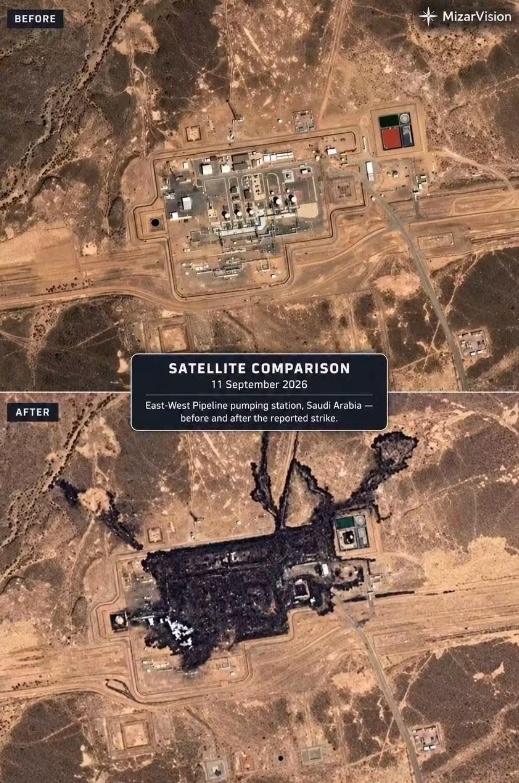
Saudi East-West Pipeline pumping station. Credit MizarVision.
Hence, markets are repricing oil and much else, likely for the long haul.
Washington Stays Out
It’s worth noting that, per news accounts, Saudi Crown Prince Mohammed bin Salman asked President Trump for U.S. military help against the Houthis, and Trump declined to intervene, at least for now.
Clearly, Trump doesn’t want U.S. forces to become the fire brigade for this fight between Saudi and the Houthis. The U.S. has immense combat power available in the Middle East; but right now, the U.S. military has more problems than available assets. So, Trump and his generals must be selective. The policymaking process is clear: Why should the U.S. get involved? And what does the U.S. get out of the mess?
The Investment Lesson
To restate things: the Middle East risk premium just exploded, literally. Hormuz is restricted, BAM is threatened, Saudi’s bypass pipeline is shut down, and even the Suez Canal can be closed by relatively simple military strikes. So, oil is repricing to a much higher level.
This doesn’t mean that Middle East oil disappears. But it does mean that all oil everywhere – even here in North America! – now carries a price premium based on the Middle East risk. Call it the revenge of geography.
Looking ahead, the necessary evolution for energy users is redundancy and security. Generally, this favors non-Middle East producers, definitely in the Western Hemisphere. Plus, service companies, offshore drillers, and LNG that comes out of secure infrastructure.
Other strong plays will be uranium in stable jurisdictions, critical minerals, grid fuel, storage, pipelines, and related energy services that operate in jurisdictions where the route to market is not controlled by a militia with a century-long grudge.
Sad to say, but in U.S. culture the term “energy security” is more of a political slogan than a foundational strategic imperative. Or else, why has the U.S. misallocated so many resources to dumb ideas that range from the “Green New Deal” to draining the Strategic Petroleum Reserve whenever gas prices bump up a few dimes.
Energy security is geographic, such that it defies the tyranny of distance. It requires strategic focus and discipline at national scale. It’s steel in the ground, equipment, skilled labor, defensive power, and the ability to punish bad guys when the map turns ugly.
Looking ahead, the best investment angle is in companies that produce and move energy without having to ask permission from some tribe in the mountains, or wait for Washington to save a Saudi regime that just displayed to the world its martial incompetence.
That’s all for now. Thank you for subscribing and reading.

Comments: