

The Economic War Goes Nuclear
Treasury Secretary Scott Bessent has announced a plan to squeeze Iran economically.
Secretary Bessent warned of an “economic D-Day”, and outlined the plan further in a press conference at 2:00pm ET.
Here’s what Bessent posted on X yesterday:
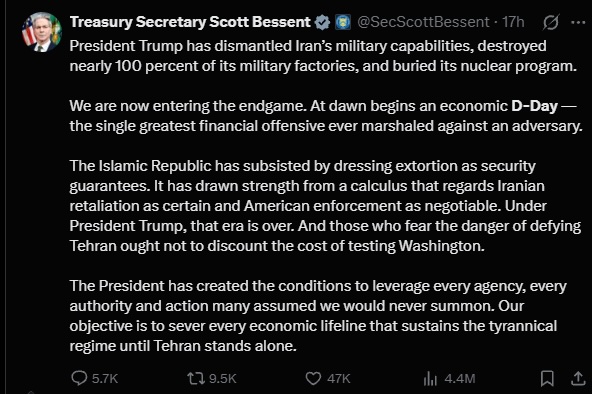
Source: Scott Bessent on X
That last paragraph is particularly important:
“The President has created the conditions to leverage every agency, every authority and action many assumed we would never summon. Our objective is to sever every economic lifeline that sustains the tyrannical regime until Tehran stands alone.”
Bold words. Especially the part about taking actions “many assumed we would never summon.”
By the time you read this newsletter, Bessent will have already given his press conference. He will almost certainly discuss harsh new sanctions. And maybe a few surprises.
The big question is – will this work on the Iran-China-Russia axis?
Brass Tacks
So what are we talking about here? Sanctions against countries and entities that do business with Iran. These are known as secondary sanctions.
This starts with China, which buys 80% of Iranian crude oil. There are a number of banks, shell companies, ports, and insurers which could be targeted.
It is worth noting that back in May the U.S. announced new sanctions against 5 Chinese oil refineries which process Iranian crude. Normally, China at least nods along and accepts the sanctions (even if they quietly find a workaround).
But this time, they flat-out rejected the sanctions. Fox News:
China has ordered companies to disregard U.S. sanctions targeting Iranian oil, forcing a direct test of Washington’s ability to enforce its crackdown on Iran.
A new directive, issued through China’s Commerce Ministry Sunday, invokes a 2021 “blocking statute” that prohibits firms from complying with foreign sanctions deemed illegitimate. The order applies to several Chinese refiners accused by the United States of purchasing Iranian crude, including major independent processors known as “teapot” refineries.
“This is unprecedented. It’s a major escalation in terms of China’s response to U.S. economic statecraft. It is a measure of defiance by Beijing,” said Max Meizlish, a research fellow at the Foundation for Defense of Democracies.
That was a first. And the May batch of sanctions didn’t work to get China to stop importing Iran’s oil.
If Bessent and Trump believe they can succeed now, they must have something big planned.
Limited Financial Ammunition
When the hot war with Iran was ongoing, weapons stockpiles were a primary concern. We burned through years of production of long-range missiles and defensive munitions in a short time.
Some people might assume our financial ammunition is unlimited. After all, we control the dollar. And that is a very powerful tool. But it’s not perfect.
Every time we sanction a country or confiscate its assets, the dollar loses a bit of its shine. Other countries see themselves as vulnerable to such attacks in the future. So they shift from buying U.S. Treasuries to stockpiling other assets like gold.
We saw this very clearly in 2022, when Russia invaded Ukraine. Biden and the EU recklessly seized assets of Russia’s central bank.
This was the catalyst in 2022 that lit the fire under gold. Central banks around the world began to shift out of U.S. Treasuries and into bullion.
Our own Jim Rickards predicted the effect this would have on gold in April of 2022, when the metal was trading at $1,900 per ounce. From The Stars are Aligning for Gold:
The second reason to own gold is the unprecedented economic war between the U.S. and Russia that’s raging side by side with the shooting war in Ukraine. Economic results always receive some consideration in times of war, but there has never been a war where the economic costs of sanctions are greater and more long lasting than the destruction caused by the actual fighting.
One of these costs is a loss of confidence in the U.S. dollar.
It was fully expected that the U.S. would impose sanctions on certain Russian industries, exports and its oligarchs. It was not expected that the U.S. would seize and freeze the reserve assets held by the Central Bank of Russia.
Now that that has happened, every central bank in the world is reevaluating its dollar-denominated reserves and asking itself if the U.S. will freeze those holdings in some future dispute.
Today gold is trading at $4,665/oz. Largely due to central banks buying gold at a record pace ever since.
So there is a cost to financial warfare. Every time we sanction or confiscate assets, it damages the dollar’s status as world reserve currency a little. It creates new friction in the global economy, costing everyone incrementally.
So how far are Bessent and Trump willing to go? Will they attempt to sever ties between Iran, Russia, and China? Honestly, it seems unlikely.
But they are clearly going to attempt something big here. At least some Chinese banks doing business with Iran will almost certainly be sanctioned.
What about Russia, Iran’s other key ally? Well, they’re already under extreme sanctions, so I don’t know what we could do to further persuade them to end their military partnership with Iran.
Recently, Russian oil tankers have been seized by American and European forces. I suppose we could see more of that, but Russia would almost certainly retaliate. And that’s a dangerous path.
It looks like a new global trade war is beginning. And it extends beyond Iran, Russia, and China. New fronts are opening, such as the ones with Canada and the EU.
It’s going to be a volatile next few months. Gold and silver should continue to do well, but if we do get a broad market crash, they may fall along with everything else at first. But then precious metals should recover fast, and outperform stocks and bonds for years to come.

Comments: