

Suckers Bet, Winners Invest
Back in the 1980’s, there was a pizza place outside the Tropicana Casino in Atlantic City. That is where I learned all about casino games. I’d sit in a booth eating a greasy slice of pizza, while my uncle waxed on about blackjack hands or craps odds.
My uncle skipped college and went to dealer school. I used to sit in my grandmother’s kitchen and watch him practice shuffling multiple decks of cards. He always had big red dice or decks of cards with holes drilled through them.
From those late-night sessions, I determined that gambling was entertainment. As in, it cost me money to play. And even when I won, it wasn’t enough to cover my losses.
I still like to sit at a table occasionally because it’s fun. But I’d never consider it a retirement plan.
And yet, we have an entire generation doing exactly that. According to a St. Bonaventure University poll, 27% of all Americans and 52% of American men between the ages of 18 and 49 have sports book accounts.
Of those people surveyed, 85% think that they can make money doing it. In fact, only about 4% of betters made money in the long term. According to a study from the Rady School of Management at the University of California San Diego, 96% lost money. And the survey’s lead researcher said this:
“Only 4% made money from online betting. That is by design. Online gambling platforms often ban or throttle frequent winners’ accounts. There is no right to gamble.”
Seems like a good business. And the marketing is everywhere. I don’t know about you, but I see and hear gambling app ads constantly. Every sporting event on tv, podcasts, YouTube videos, popups, you simply can’t avoid DraftKings, Hard Rock Bets, Fan Duel, etc. And now we have apps like Kalshi, that let you bet on anything.
It’s way too easy to gamble today. And there is a reason for that. Remember the old saying, if you don’t know who the “fish” is at the table…then you are the fish. The fish is the inexperienced player that ends up losing money. In these betting apps, you are always the fish.
There’s a reason those apps are easy to get. They want your information. Just like every other online subscription you have, you become the commodity when you sign up.
Some of these apps will even pay you money to subscribe. I saw an add this week that offered $100 in bets if you put $10 in your account. If you think they are giving you that money out of the kindness of their hearts, well…as we say down here in the south, “Bless your heart”.
These gambling sites make so much money that they can afford to take a small loss to get you in. They know that they will make far more money over the long run. You see, they take a cut from every bet you make. It’s called the hold or the vig.
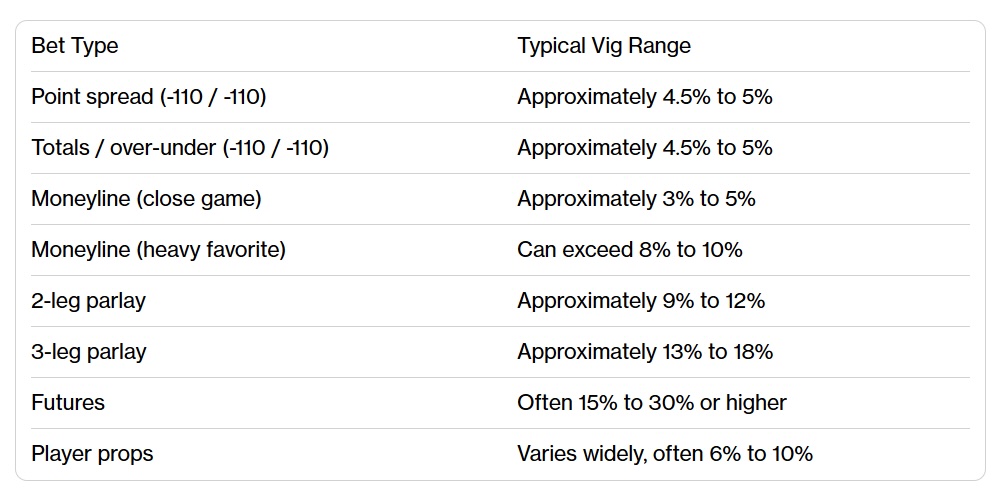
For a big, liquid bet on a football or basketball game, the vig is about 4% to 5%. When you move into player prop bets, the vig jumps to double digits. Futures markets’ bets can go from 15% to 30%.
That’s why gambling apps are not investments.
Money managers’ fees on big managed funds range from 0.01% to at most 1.5% on very active funds. An easy rule of thumb for most funds is less than 0.75%. If the fund charges you 1%, it better be actively managed or have some justification.
If you pay more than 1% management fee, the fund is expensive.
Bets are way more expensive. Remember, you pay at least 5% on any bet with -110 odds. The math on that is not great. Here’s what I mean…
Let’s say you make 100 bets at $110 per bet at -110. If you win half of those bets, you are down $500, because of that vig. Just to break even, you must win 53 of those 100 bets. And that’s just on the basic bets. According to Fox Sports, here are the common vigs you’ll pay on betting apps:
Look, I can’t emphasize enough, how impossible it is to “invest” with gambling apps. This is fun. It’s speculation…but it is not investing.
Imagine you put $100,000 into a fund that pays 7%, and you leave it there for 30 years. If the fund charges you 0.1%, you earn 6.9% and your investment becomes $740,000. If the fund charges you 1%, you earn 6% and your investment becomes $574,000.
This is the kind of math a serious investor uses. And I’ve seen grown men get absolutely irate over a quarter of a percentage point in fees on funds. That’s because a quarter of percent point becomes serious money over thirty years. That’s why you can’t pay 10% per bet and consider it investing.
Online gambling is a huge business that’s growing quickly. According to multiple sources, online gambling will grow about 12% annually through 2033. The market currently is around $100 billion. That could hit $279 billion by 2034, according to Polaris Market Research.
To put that in perspective, the global copper market is only $260 billion. And online gambling could exceed that in less than eight years.
The best bet here is to take the bulk of your betting money and buy the stocks instead. You can do that through funds like the Roundhill Sports Betting & iGaming ETF (NYSE: BETZ).
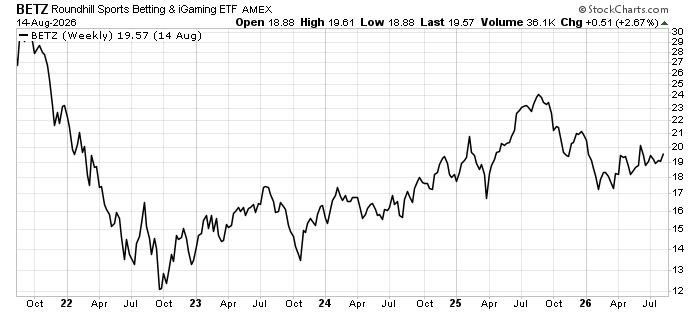
Here are the top holdings of BETZ:
- Evolution AB: 7.2%
- Futter Entertainment: 7.1%
- DraftKings: 6.5%
- Allwyn AG: 6.5%
- Light & Wonder: 5.4%
- Lottomatica Group SpA: 5.2%
- Super Group: 5.1%
- Entain PLC: 5.0%
And the fund managers only charge you 0.75% in vig for BETZ. That’s a solid bet. Certainly better odds than you’ll find on these companies’ apps.
As I said, I’m not fun-shaming anyone. If you love to gamble, go for it.
My grandpop played the numbers every week for as long as I can remember. We would all sit on the couch when they pulled the ping pong balls out of their cages. He was always one number off. We always laughed. It was pure entertainment. At no time did he think it was a retirement plan.

Comments: