
Fighting Gravity in Tokyo
In the 1980s, Japan was the hottest country on Earth.
It was a dominant player in electronics, cars, and other manufactured goods.
Japan’s stock market was ascendent. At its peak in 1989, Japanese stocks made up more than 40% of the MSCI World Index, a key global benchmark.
Today Japanese stocks account for just 5.7% of the MSCI World Index.
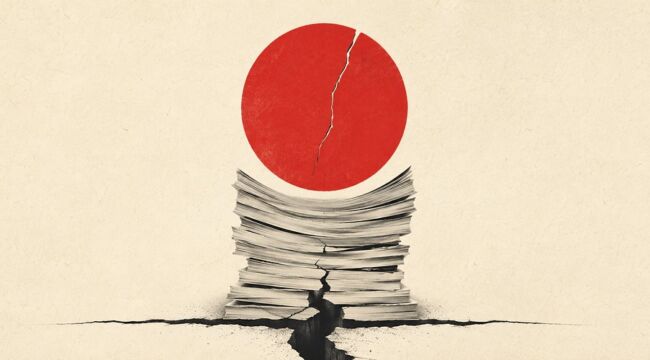
What happened? When Japan’s stock market bubble burst in 1989, the government attempted to “fix” it by lowering interest rates to near zero. Instead of letting bad banks and companies fail, they kept them alive (sound familiar?)
Far too much debt. Artificially low interest rates. Constant bailouts and stimulus packages.
By going to such heroic lengths to save the market, they created a zombie economy.
The result was more than 3 decades of slow growth, poor returns, and a cratered fertility rate.
Bessent Bails Water
On July 31st, Treasury Secretary Scott Bessent was at Camp David with the president.
During a cabinet meeting, a photographer from Reuters captured a picture of Bessent’s notepad. It read “To do: Buy Japanese Yen (JPY) $5 – 10 billion.”
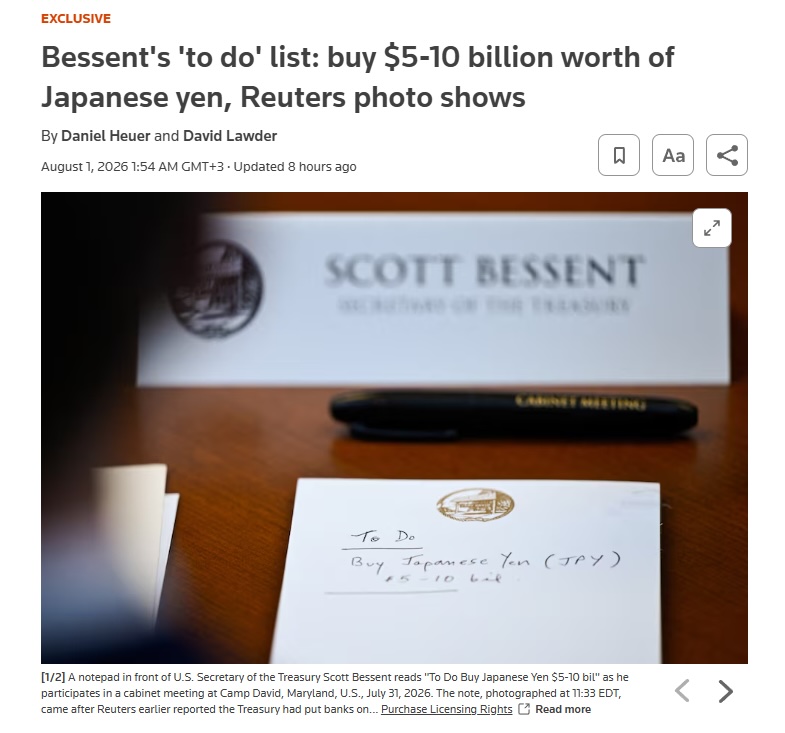
Source: Reuters
This was no mistake. The note was meant to send a message to the market. We’re going to support the yen in a big way, and would appreciate some front-running and piggybacking.
This is an important aspect of government interventions. They want the market to go along with their plan, because that means the cost will be lower.
Bessent is no ordinary Treasury Secretary, though. He’s a highly experienced trader and protege of the infamous George Soros. If anyone can figure out how to postpone Japan’s financial reckoning, Scott Bessent is a good candidate. But it’s going to be an uphill battle.
And it’s not just the Treasury Dept helping Japan. The Federal Reserve is also lending them up to $60 billion using a funding facility called FIMA. Japan transfers the treasuries to the Fed, and the Fed prints new money to give Japan. This is essentially a soft form of yield curve control (YCC). The Fed is taking treasuries off the market to cap yields.
And Bessnet is pushing Warsh to ramp up the scale of FIMA. Eventually the program could reach hundreds of billions of dollars.
Just today Bessnet told CNBC, “We will do whatever it takes to support them in a way that helps the American economy, the American taxpayer.”
But why?
Why Japan?
So why are we “bailing out” Japan, and helping them defend their currency?
Well, they’re a close ally of course. But they’re also the largest holder of U.S. debt, with between $1.14 and $1.4 trillion of treasury securities.
Normally, they would sell those treasuries to support their own currency. But America does NOT want Japan selling treasuries. Yields are already high, and our borrowing costs are absolutely jumping.
If Japan were forced to dump a large portion of their U.S. debt, yields would spike even higher. The Treasury Dept and Fed do not want that.
Former Treasury Secretary Hank Paulson told CNBC, “It’s in our interest and in their interest. We don’t need them selling Treasuries right now.”
Can Kicking
Japan is in a heap of trouble. They can’t raise interest rates much to strengthen the currency. There’s too much debt.
Additionally, the country relies almost entirely on the Middle East for energy imports, and the Strait of Hormuz remains mostly closed. Yet another potential black swan.
Whenever the Japanese debt bubble crisis truly hits, I hope they let it run its course this time. Let companies and banks fail. Let the market set interest rates. Clean house. Full reset.
But it’s unlikely the country will take this approach. Nobody does these days. They’ll attempt to prevent the reckoning at all costs, and kick the can down the road for a bit longer.
A major crisis in Japan could set off a chain reaction that spreads around the world.
Despite its decline, Japan remains a key pillar in international finance. Its artificially low interest rates have fueled the yen carry trade, where traders borrow in yen and buy higher yielding assets abroad. The size and scale of the yen carry trade is massive.
In a recent interview, our colleague Jim Rickards explained how the carry trade unwinding could lead to a global crisis worse than 2008. Watch that here.
This is another reason why it’s “all hands on deck” to save Japan.
The U.S. will do what it can to postpone it, but gravity always wins. When a country is at 240% debt-to-gdp, something’s gotta give.

Comments: