
The Marble Ledger
This past weekend, from my hotel in Midtown Manhattan, I strolled up Fifth Avenue… all the way to the Metropolitan Museum of Art. Along with the Louvre, the British Museum, the Uffizi, the Vatican Museums, and the Hermitage, it’s one of the world’s great museums. (The only one I haven’t been to is the Hermitage. Perhaps I’ll remedy that when Europe and Russia kiss and make up.)
I used to walk around the British Museum and National Gallery in London (another great one) to ease my hangovers on the weekends in my 20s and early 30s. Looking at beautiful paintings, sculptures, and armor soothed my sore head.
But this weekend in the Big Apple, I was sober as a judge. I wanted to get my 10,000 steps in and enjoy myself while I was doing it. But, of course, my curiosity got the better of me.
It’s the ownership panels every time. For a finance guy like me, seeing a benefactor or a patron on a museum plaque doesn’t make me think, “Oh, what a generous person!” Instead, I think something more along the lines of “What proceeds were they turning into respectable transfer mechanisms?”
It’s not money laundering, per se. It could simply be a case of making incomes from landed properties more mobile. I came across two Canova sculptures that were especially interesting from that perspective.
Stone Turned Into Life?
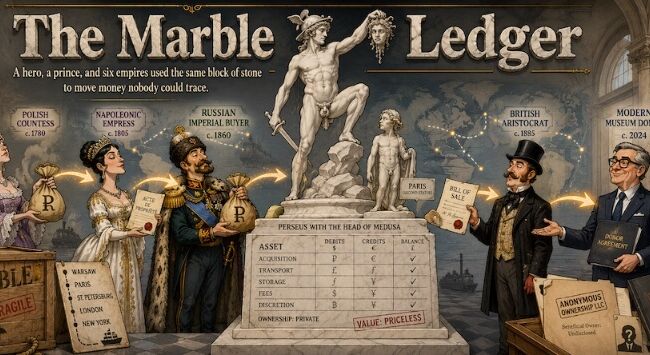
It’s Rome, in 1804. A Polish countess named Valeria Tarnowska walks into a sculptor’s studio. She wants a hero.
She doesn’t want a portrait, but a scene. Perseus, fresh off killing Medusa, holding up the severed head like a trophy. Clash of the Titans, but early 19th-century style.
She visits Antonio Canova, the most famous sculptor in Europe. Medusa may have turned men to stone, but Canova turned stone into sculptures that seem to breathe.
What did Tarnowska actually buy?
She had had land rents and cash, which are boring, forgettable, and hard to move. She turned that capital into eleven feet of marble everyone in Europe would recognize and admire.
You can’t smuggle rental income across a border. But you can transport a famous statue.
You see, art isn’t just decoration. It’s dense, portable, and murky. Nobody quite knows what it’s worth, or who really owns it. High value, easy to move, thick layers of dealers standing between the buyer and the money. The U.S. Treasury has studied this exact combination. It’s the same profile that makes a painting a great place to hide a fortune today.
Canova himself wasn’t laundering money. But he turned wealth into a shape that could cross a border, something no farm or a factory could. And he made the new owner look good for owning one of his sculptures, to boot.
The Second Statue Hides a Cap Table
A few rooms over sits another Canova: Paris, the mythic judge who started the Trojan War with one bad verdict. Same sculptor. Same era. A better story.
Napoleon’s wife, Joséphine, commissioned the original Paris in 1807. It was imperial French cash, spent on a vanity project. When she dies, the statue didn’t vanish into a warehouse. Tsar Alexander I of Russia bought it and put it in the Hermitage. It was part trophy, part power move. Empire handed it to empire, and the story attached to it only grows.
Canova’s workshop did what any studio does with a hit: it made another copy. The Marquess of Londonderry bought one on a trip to Rome in 1823. He shipped it home to London, where it sat in his townhouse for over a hundred years. Long after his house is gone, a donor gave the statue to the Met. A private trophy became part of a public collection.
Look at this lineup:
- Founder: Joséphine, French imperial cash
- Buyer: Alexander I, Russian imperial collection
- Second buyer: Londonderry, British aristocratic money
- Exit: a modern bequest, American museum ownership
The statue never changed, but the wealth transferred. Napoleon fell to Wellington at Waterloo. Empires rotate, as they always do, around the world. Old money faded into museum bequests.
Marble makes good collateral across centuries. It’s an asset that survives every regime change.
Same Play, New Paperwork
Today’s art laundering cases follow the same script as Joséphine and Alexander. The people are worse, but the lawyers are better. That’s the only real difference.
Modern versions look like this:
- Sanctioned buyers route cash through shell companies to acquire blue-chip art, so nobody can trace who really owns it.
- Criminals pledge art bought with dirty money as collateral for a “clean” loan from a lender who doesn’t ask questions.
- Free ports, those tax-free storage warehouses dotted around the world, let art sit unregistered for years, changing hands quietly.
None of this needs fake art or stolen art. It just needs art that’s genuinely valuable and hard to price. That describes a 200-year-old Canova as well as it describes a painting nobody can compare to a recent sale. You know, like a Hunter Biden special edition.
The real engine here is what dealers call the story premium. It never shows up on a balance sheet, but it does most of the work.
A Perseus in your front hall says: “I have taste,” “I have history,” or “I have won something.”
A numbered bank account in Geneva is silent.
A marble hero is loud money, capital that screams victory while quietly moving somewhere new. For the right buyer, that’s the whole point of buying it.
Wrap Up
If you walk through the Met, you’ll see the little labels that give you dates and donor names. But most people don’t realize they’re standing in front of a five-century paper trail.
In more recent times, grand imperial names became more mundane things. Joséphine and Alexander became oligarchs and sanctioned officials. Canova’s studio became a shell company in the British Virgin Islands or a free port in Geneva.
But the trick hasn’t changed: park your wealth in something beautiful, portable, and nearly impossible to price, and watch it cross borders that cash never could.
Perseus is still holding up that head. He’s also been quietly holding six empires’ worth of money for two hundred years.

Comments: