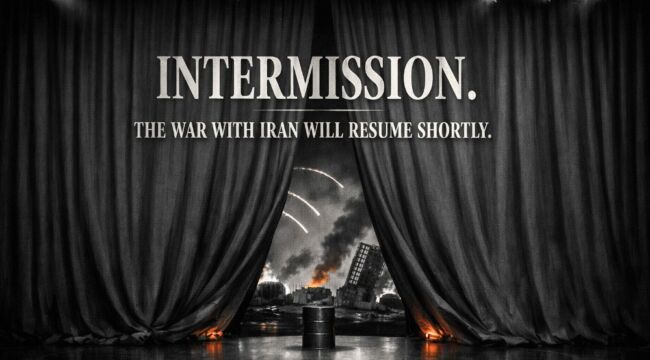

Intermission: The War Will Resume Shortly
Tomorrow, talks between the U.S. and Iran are scheduled to begin.
The discussions will take place in Islamabad, Pakistan.
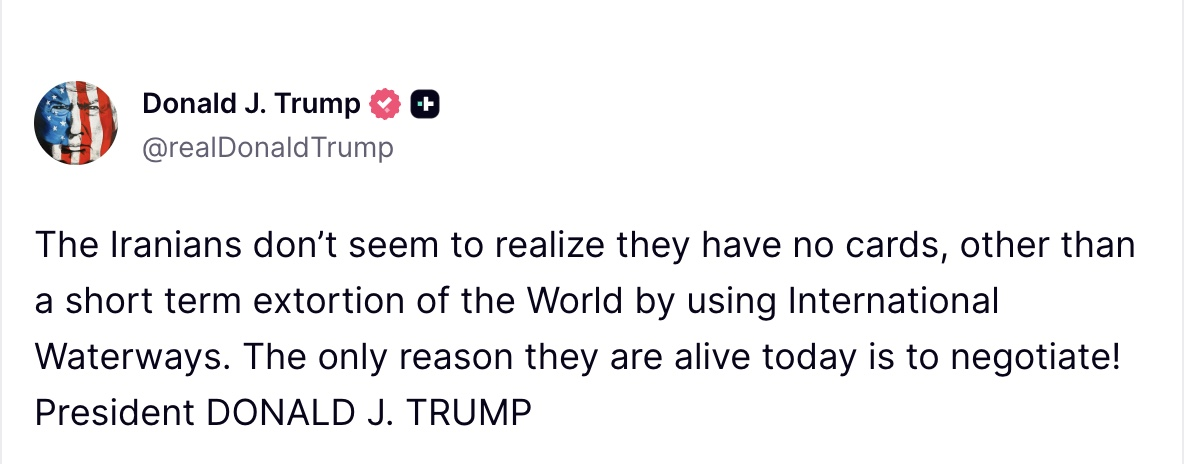
President Trump appears confident going into the meetings:
Source: Truth Social
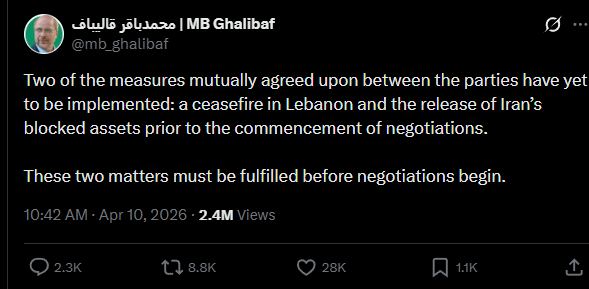
But Iranian leaders, such as Speaker of Parliament Mohammad Ghalibaf, say they are not even willing to negotiate until their money is unfrozen, and Israel’s bombing of Lebanon, and annexation of land, stops.
Source: X
As we covered earlier this week, it does not appear that Israel is about to stop bombing Lebanon. This is a major sticking point for both parties. Israel says it needs to protect itself against Hezbollah rocket attacks, and Iran says Israel is killing civilians along with militants.
Unless we get a ceasefire which includes Lebanon, it’s unlikely these negotiations will go forward.
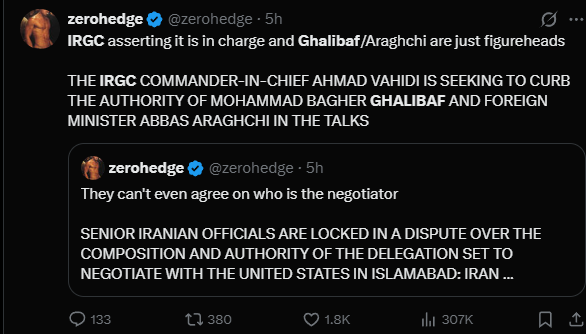
In more disturbing news, rumors are flying that Iranian “moderates” like Ghalibaf are losing influence to Iran’s hardline Islamic Revolutionary Guard Corps (IRGC).
Source: ZeroHedge on X
Iranian “moderates” like Ghalibaf and Foreign Minister Aragachi appear to be pushing for diplomacy, while the IRGC is more interested in preparing for a resumed war. And we don’t know which side will win out, due to all the chaos with Iran’s leadership.
Meanwhile Trump is also preparing for the possibility of a resumption of fighting.
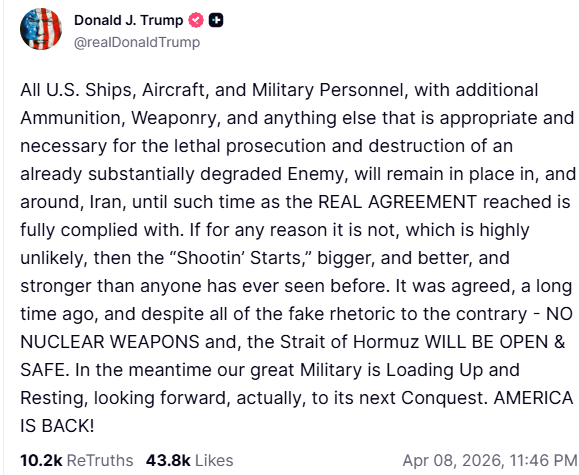
Source: Truth Social
The President continues to move American military assets into the region, and has now committed 80% of our cutting-edge long-range JASSM stealth cruise missiles to the fight, according to Bloomberg.
Lasting Agreement: Unlikely
After some initial hiccups, the fragile truce between the U.S. and Iran is holding. For now.
But the only point the sides agree on is that they’re not currently launching missiles at each other.
With negotiations scheduled to take place tomorrow, both sides are preparing for the possible (likely?) resumption of war.
Our colleague Jim Rickards did an excellent interview with Michelle Makori yesterday, in which he said, “It’s not much of a ceasefire…. the two sides don’t agree on anything.”
And he’s right. The U.S. demands include:
- Severe limits on Iran’s ballistic missile and drone programs
- An end to nuclear enrichment
- Full opening of the Strait of Hormuz
- An end to support for Iran’s proxy/allies in Yemen, Iraq, and Lebanon
These are basically all non-starters. Iran has signaled that it may be willing to give up its near-weapons-grade uranium, but that’s about it.
Meanwhile, Iran demands:
- A permanent commitment to non-aggression
- Withdrawal of all US forces from Gulf region
- Peace in Lebanon, which Israel is currently bombing back to the stone age
- Compensation for the war (possibly in the form of tolls to pass through Hormuz)
- End of all sanctions and UN resolutions
Again, I don’t see our government agreeing to any one of these, let alone all of them.
So even if the negotiations do take place, and I hope they do, it’s unlikely this first round will go anywhere.
If we’re lucky, the U.S. team will be able to convince Iran to open the Strait of Hormuz as talks proceed.
Financial Impact
Meanwhile, the Strait of Hormuz remains closed to nearly all traffic. About 20% of global oil flows. Only a few tankers bound for China and other Iranian “friendly” countries are getting through currently.
Unless the Strait opens very soon, this energy crisis will enter a new dimension. $150/barrel oil is possible near-term, and higher than that if it stays closed for a few more months. And that’s not even counting what happens if more oil and gas infrastructure gets blown up.
In his interview yesterday, Jim also warned, “the fact that you’ve got a dollar liquidity crisis, a private credit meltdown, and a war with Iran, is extremely concerning. And we could be looking – at best – a recession, and possibly something much worse.”
Regarding the Strait of Hormuz, Jim says that due to the fact that the last tankers through the Strait are just arriving at their destinations recently, “now is the time the danger truly kicks in.”
He’s right. It takes time for ships to travel, arrive, and deliver their cargo. We are just now reaching the point where the real supply disruptions kick in.
I strongly recommend watching Jim’s recent interview. He gives a great overview of the current ceasefire situation, economic challenges, and more. Here’s the Youtube link.
Best and Worst Cases
For now, the best outcome I see is a continued ceasefire and Iran agreeing to re-open the Strait of Hormuz, which would re-inject about 8 million barrels of oil per day back into global markets. That’d be an amazing outcome for this initial meeting.
The tough part will be hammering out a lasting agreement. And that’s what we need for markets to find certainty and confidence. Right now it looks like both sides are simply resting and re-arming.
The worst case, of course, is a full resumption of the war. More targeting of oil, petrochemical, and natural gas infrastructure.
Stock markets are not currently pricing in the possibility of a bad outcome. At all. They are pricing in a peachy resolution where everything turns around tomorrow.
So I will continue to hold an oversized cash position, with a few hedges, until the smoke clears. Don’t get me wrong, I haven’t sold everything. But I’m back up to around 18% cash, which is a lot for me.
If we do get another escalation, I want to have cash ready to buy select assets. Because the downside potential for stocks from here is significant.
Eventually this situation will be resolved, and oil will come back down to a more reasonable level. But my guess is it won’t be as soon as most people think. And oil could go a lot higher than most investors imagine before that happens.
A lot of economic damage can be done before this war is over. Even if the war ends tomorrow, oil won’t return to normal levels for some time. And volatility will remain high until that resolution happens.
More on Monday.

Comments: