
Cartel Chaos Threatens Miners
Mexico accounts for around 24% of the world’s silver production.
The country is blessed with rich precious metal deposits.
Unfortunately the country is also home to some of the most vicious drug cartels in the world.
Miners can’t resist the temptation to operate in Mexico, but sometimes the consequences can be terrible.
Vizsla Silver (VZLA), an up-and-coming precious metal mine developer in Sinaloa, recently discovered this in the worst way.
Ten workers were kidnapped from near Vizsla’s Panuco project. The mine is in Sinaloa state, an area known for heavy drug cartel presence.
Sadly, it appears that all ten of the kidnapped workers were killed.
Members of the Sinaloa Cartel were allegedly extorting the company for 200,000 pesos per month in order to allow them to operate in the area.
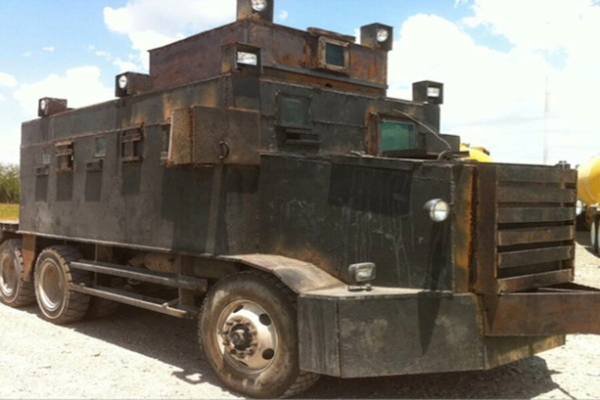
A cartel armored vehicle looks straight out of Mad Max
When the workers were kidnapped, the cartel members allegedly demanded 10 million pesos per worker, an amount which was not paid. At least, that’s supposedly how it went down.
A few of the cartels which operate in the area are considered terrorist groups by the U.S. government, so paying a ransom may have been a serious crime. Clearly, operating in these areas is no simple matter.
Four suspects have been arrested in connection with the murders. We’ll know more as the investigation progresses.
Consequences and Outlook
Vizsla Silver shares are down almost 50% since the murders took place, far more than the average miner.
The Panuco project is Vizsla’s flagship mine under development. Panuco has more than 224 million ounces of silver measured and inferred. It’s a very promising site. So this obviously impacts the future of the company substantially.
If the Mexican government cracks down hard on cartels in the area, it’s possible the company rebounds. But with 10 workers killed, it may be hard to attract talent to the project going forward.
However, there is a decent chance that the Mexican government steps in to protect mining interests. Precious metal producers account for almost 2.5% of Mexican GDP, and are a key source of jobs throughout rural areas of the country.
If they don’t contain the cartel violence, they risk scaring miners out of the country.
Since many U.S. companies operate in Mexico, there’s also the chance that the U.S. takes steps to protect its interests. For a while now, Jim Rickards has been warning that President Trump may wage war on the cartels. With the recent violence, this is looking more likely by the day.
And since silver was recently named a critical mineral by the Trump administration, this could give Trump the justification he needs to strike the cartels.
Why U.S. and Canadian Miners Trade at a Premium
Mining in the U.S. is more expensive than operating in Latin America. Higher labor and equipment costs. 401ks and health insurance.
But there’s more certainty. Less chance of the state or a drug cartel ruining the project.
This is why U.S. and Canadian operators like Hecla Mining (HL) trade at a premium to most miners in Latin America and Africa.
However, companies like Hecla are rare. Almost every other big gold and silver miner has substantial operations in Mexico, South America, or Africa.
It’s part of the risk we take when we invest in miners. Operating in Mexico or South America can be incredibly profitable. And for the most part, larger companies seem to operate successfully even in risky political environments.
But companies operating in Latin America are forced to take certain precautions. In the Paradigm internal chat room, our friend Byron King described one such precaution:
When I visited Avino Silver down in Durango, I asked why they ship out concentrates and don’t upgrade to pouring ingots or bars. “Way too dangerous,” they said… “It’s one thing to ship a truck load of brown-looking dirt down the highway to the port. It’s another thing to have silver bars on site, let alone gold.” Another angle is that cartels leave the mining people alone because the local workforce will get mad if the bandits make life too tough for the mine operators. This is their job & life, and if the mine closes there’s nothing much else to do.
Many companies don’t take the risk of refining their metal concentrate into bullion. That would be far too tempting for the cartels. Silver and gold concentrates just look like dirt, so are much safer to handle.
To defer these risks, I like owning larger operators with diversified mining portfolios, such as Pan American Silver (PAAS). Pan American owns mines in Mexico, Peru, Brazil, Bolivia, Chile and Argentina.
As a $25 billion company, big companies like PAAS have more influence and can fund mine security more effectively.
Still, there’s a place for smaller developers like Vizsla in a portfolio, for those who can stomach the risk. Most will avoid such unfortunate situations. And they trade at a discount compared to miners who operate in safer jurisdictions.
If you’re investing in gold and silver miners, it’s hard to avoid these risks entirely. But by diversifying our portfolios, we can dramatically reduce our risk. Currently, I own 22 individual miners and a few diversified ETFs. The majority operate in risky jurisdictions such as Africa and parts of Latin America.
Or, for those who don’t want to take any chances, you can select miners that operate in the U.S. and other safer jurisdictions, like Hecla (HL). But there are only a handful of these companies to choose from.
The vast majority of mining takes place outside the U.S. And that’s not going to change anytime soon.
If Vizsla keeps falling, at some point it will be worth taking a chance on the company. The Panuco project is extremely promising. And with the soaring price of silver, it’s a tempting project to bet on in these troubled times. But for now, I’m steering clear.
We’ll let you know if the risk/reward becomes irresistible.

Comments: