

Space: The New High Ground
Human history is a long record of climbing higher. We conquered hills, then coastlines, then the skies. Now, the next terrain is unmistakable…
The new high ground is space.
I saw that firsthand while touring NASA’s Kennedy Space Center alongside Defense Secretary Pete Hegseth, standing on the pad with Artemis hardware as the administration’s broader space doctrine came into sharper focus.
Later that day, that same argument about terrain, advantage and dominance was carried just down the road to Blue Origin’s Florida rocket factory, where the administration is making clear that space is an industrial and military domain that must be built, defended and held.
They didn’t allow any on-record quotes or questions (this is highly classified information, after all).
But I’ll tell you everything I can about what I saw and why this new space race is accelerating faster than most people realize.
America First, Built Here
The Blue Origin facility on Merritt Island sits low and wide against Florida’s flat horizon, just beyond the gates of NASA’s Kennedy Space Center.
It opens into a vast, bright production hall, framed by white steel trusses and long runs of overhead lighting. The ceiling rises several stories above the floor, with gantry cranes spanning the length of the building and wide bays arranged for parallel assembly.
Cranes hang idle overhead, positioned to lift components that weigh more than houses.
And, most importantly, an American flag hangs along the far wall beneath a yellow bridge crane, visible from nearly anywhere in the facility.
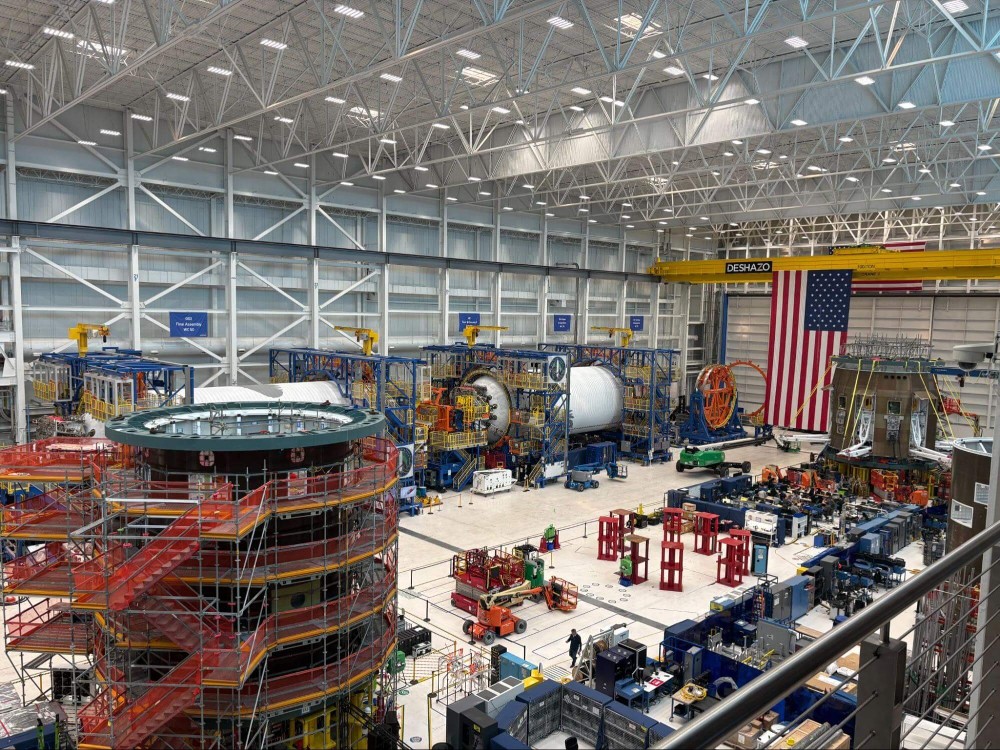
Pictured: The Blue Origin Factory Floor
This was just one of the stops on Secretary of War Pete Hegseth’s nationwide “Arsenal of Freedom” tour.
Walking the floor with Hegseth, the focus stayed on what matters…
How many units can move through at once, how quickly they can be assembled and how reliably that output can be sustained.
The Pentagon continues to make it very clear that they are looking to prioritize companies that can produce, test and deploy capabilities at pace. Commercial space firms like Blue Origin are now part of the core defense industrial base and they are being evaluated accordingly.

Pictured: Buck with Secretary of War Pete Hegseth
The dominance that the Secretary of War emphasized comes from building rockets, engines and landers at scale and at speed. Sustained access to orbit depends on manufacturing capacity that can support replacement, expansion and long-term operations.
Credit is due to President Donald Trump for pressing to increase defense spending while setting expectations for how that spending is used.
“I don’t mind people making lots and lots of money,” Hegseth said during the visit. “But if you’re going to do so, deliver for the American people and the taxpayers the capabilities you said you would deliver.”
Commercial space companies such as Blue Origin are positioned to compete more directly under this approach. And standing inside the facility, you can see this working in real-time.
This is an America-first argument delivered in an American factory, centered on American workers building the systems that underpin national defense.
The visit connected directly to the administration’s plans for space-based missile defense, including the proposed Golden Dome architecture. That system relies on persistent sensors and space-based interceptors, which in turn rely on rockets, engines and production lines capable of supporting them over time. Manufacturing capacity becomes strategy at that level.
Blue Origin is being treated as part of the nation’s defense infrastructure. Expectations are aligned with that role. Performance, speed and scale are now central to how the company is viewed inside the Pentagon.
“We have to dominate the space domain,” Hegseth told workers at the factory. “That means we’ll ensure that we keep building rockets and engines and landers that you make here at scale and at speed.”
At the end of the day, space is just a different kind of terrain. And the work happening inside facilities like this one is how that terrain is held.
Why Space Matters Now
Last week, we wrote about the Discombobulator and the way modern warfare is increasingly decided by systems rather than single platforms.
Software. Integration. Speed.
The ability to connect sensors, shooters and decision-makers into a single operating picture has become the decisive advantage.
That logic doesn’t stop at the edge of the atmosphere… it extends upward.
Space now sits on top of the same doctrine — it connects everything beneath it.
Satellite constellations support daily operations and strategic deterrence. Their disruption carries immediate consequences for communications, navigation, intelligence and missile defense.
The reason this matters so much is that space is a contested domain.
Over the past decade, Beijing has launched more than a thousand satellites, building dense constellations designed to support surveillance, communications and precision targeting.
That expansion concentrates on the Indo-Pacific, where space-based systems extend China’s ability to monitor U.S. and allied forces, coordinate long-range strike capabilities and shape the operational environment before conflict begins. Chinese military doctrine emphasizes information dominance as a prerequisite for success, and space systems sit at the center of that strategy.
Allied military leaders now speak openly about the erosion of norms that once governed behavior in orbit. One senior NATO official recently summarized the shift plainly, saying the rule-based order in space is nearly over. Space has entered the same competitive environment as every other strategic domain.
Global governments now allocate more funding to space defense and security than to civil space programs. A significant portion of that spending remains classified, which just shows how central space capabilities have become to national defense planning.
For the United States, this shift carries direct implications. Space systems underpin missile warning, command and control, precision targeting and strategic communications. Maintaining advantage requires the ability to launch, replace and protect those assets continuously. That capability rests on domestic industry.
America-first defense policy treats space as critical terrain that must be held with American systems built by American companies.
Walking away from the Blue Origin visit, that throughline felt consistent. The Discombobulator, integrated missile defense, networked warfare and space dominance all follow the same logic.
Systems matter more than platforms. Speed matters more than process. Industrial strength determines staying power.
Space sits at the top of that stack, shaping what the United States can see, decide and do. Holding that high ground remains a national priority, and the work to secure it is already underway.
Why Blue Origin Fits the Long Game
Blue Origin fits into the long game because its mission aligns with permanence.
The company is organized around building infrastructure that lasts, scales and supports sustained presence beyond Earth. New Glenn, Blue Origin’s rocket, is built to move large payloads reliably and their lunar lander, Blue Moon, is designed to support sustained lunar operations.
These programs are meant to create capacity that can be used again and again.
This is how national power is built.
Space systems require the ability to launch, service and replenish assets over long periods. Blue Origin’s work supports that requirement by concentrating on the foundational pieces that make continuous operations possible.
A permanent American presence on the Moon (which Jeff Bezos is targeting) serves as a proving ground for deeper space activity and a platform for industrial expansion beyond Earth. Lunar infrastructure extends American reach without depending on fragile supply chains.
Walking through the Blue Origin facility, I saw firsthand that the systems under construction are sized for sustained output. The timelines reflect long-term commitments.
At the end of the day, the long game in space is not won by who arrives first. It is won by who remains.
NASA’s New Role
What became clear over the course of the visit is that NASA no longer sees itself as the only builder in the room.
The agency is operating as a coordinator now, setting direction and anchoring long-term goals while American companies take on the work of building and scaling the systems that make those goals real.
NASA Administrator Jared Isaacman spoke about the mission and framed it around how the United States maintains presence in space without starting over every time a political cycle turns or a program sunsets.

Pictured: Jared Isaacman and Buck Sexton outside the Northrop F-5 military jet
You can see that approach in NASA’s relationship with Blue Origin.
The Artemis V lunar lander contract is not about planting a flag and going home. Rather, it focuses on landing systems that can be used again and surface operations that can be sustained.
Think infrastructure that assumes the United States plans to stay.
The same thinking applies to the VIPER rover mission, which sends Blue Origin to the Moon’s south pole to help map resources that matter for long-duration operations.
NASA is placing long-term bets on American companies that can build, replace and expand systems over time. The agency provides stability and intent, while industry provides production and scale.
That division of labor explains why this moment feels different from past space efforts.
The goal is not a single achievement that fades into history. We’re not dealing with systems that vanish when the ribbon is cut.
Maintaining the High Ground
What these visits drove home is that space now sits in the same category as sea lanes, airspace and energy grids. It shapes outcomes long before anyone sees a battlefield.
Walking through these facilities, the America-first logic showed up in where the money is going, how expectations are being set and how openly performance is being demanded.
The roles inside that strategy are coming into focus. SpaceX sets the pace with speed and operational cadence. Blue Origin builds depth with systems designed to endure. The Pentagon applies pressure and decides who earns continued access.
What struck me most is how little of this felt theoretical. The timelines feel real, finally.
There were conversations about throughput, replacement and staying power. About what happens if something fails and about how quickly it can be rebuilt.
With American power back in motion, what matters now is holding the high ground when it counts.

Comments: