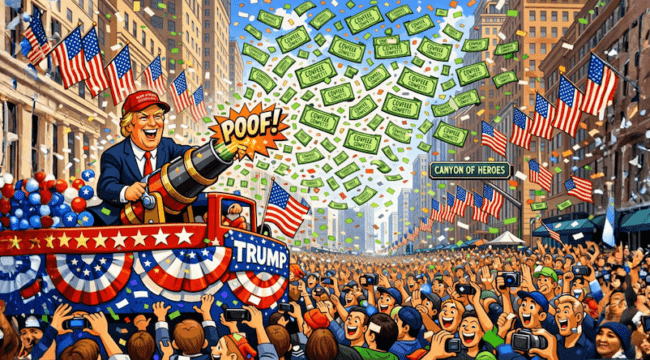

Covfefe Confetti
Did you believe Jim Rickards when he coined the phrase “Mar-a-Lago Accord”?
Did you believe Stephan Miran when he actually wrote the Mar-a-Lago Accord?
If you did, you’re way ahead of Wall Street. And lightyears ahead of Main Street.
No one really believed until two days ago. Not Wall Street. Not the City of London. Not Tokyo, Hong Kong, or Singapore.
That’s when The Donald told the world the dollar was doing “just fine.” And for the President, it is. For the U.S. government, it’s more than just doing fine. It’s a godsend. But for you, American citizen, it’s about to become an ever-shrinking nightmare in your wallet.
We’re no longer moving slowly, softly toward inflation infinity. We’ve made the calculations, are sure there are no asteroids in our path, and are jumping to lightspeed.
What Stephen Miran Wrote
Let’s start with what Miran actually put on paper, because this is where the blueprint lives (bolds mine):
The desire to reform the global trading system and put American industry on fairer ground vis-à-vis the rest of the world has been a consistent theme for President Trump for decades. We may be on the cusp of generational change in the international trade and financial systems.
The root of the economic imbalances lies in persistent dollar overvaluation that prevents the balancing of international trade, and this overvaluation is driven by inelastic demand for reserve assets. As global GDP grows, it becomes increasingly burdensome for the United States to finance the provision of reserve assets and the defense umbrella, as the manufacturing and tradeable sectors bear the brunt of the costs.
Translation: The dollar is too strong. It’s killing American manufacturing. And the government is deliberately weakening it to fix the trade imbalance.
This isn’t a conspiracy theory anymore. Not even academic theory. This is a stated government policy.
BlackRock Will Run The Fed
Rick Rieder, BlackRock’s CIO of Global Fixed Income, is now the odds-on favorite to become the next Fed Chairman. And if you want to know what that means for your money, listen to what he told CNBC.
Rieder thinks this is “the best investing environment ever.” Not for Main Street, necessarily. But for people who understand what’s coming? Absolutely!
He’s not worried about the Fed cutting rates aggressively. In fact, he’s arguing they should drop the funds rate by 100 basis points. His reasoning? The interest rate tool no longer really controls inflation, and he may have a point.
But you know what high rates do hurt? Housing. Low-income borrowers. And most importantly to Rieder: “The cost to the government. We have too much debt in this country.”
There it is. Remember “fiscal dominance?” He just said the quiet part out loud.
Rieder admits that keeping rates high charges the government “an extra 100 basis points” on its ludicrous $38.7 trillion debt load. And he doesn’t think it’s “worth it.” He wants rates down to make the government’s debt cheaper to service, regardless of what it does to inflation.
When the CNBC host pointed out that “if the White House is listening to what you’re saying right now, they’re all standing up yelling yes, yes, this is the story we’ve been trying to tell,” Rieder didn’t disagree. He doubled down, claiming inflation volatility is “incredibly low” and productivity gains will keep prices in check even as rates plummet. Pray he’s correct.
Rieder is likely to chair the Federal Reserve. Someone who thinks we should cut rates to help the government finance its spending, even if it means your grocery bill keeps climbing.
But that’s not all. Check out what happened in the markets this week.
Don’t Call Us…
My colleague and Paradigm Press options market expert Nick Riso posted this gem on our editorial board. On Monday, January 26, 2026, the MIAX Options Exchange did something remarkable. They made a dozen series of iShares Silver Trust (SLV) call options “non-tradable.”
Look at what they shut down:
- February strikes at $160, $165, $170, $175, $180, and $185
- Late February strikes at the same levels
I hasten to remind you silver is trading at $119 as I write this at 6:13 ET this morning.
These options aren’t lottery tickets. These are high-strike calls that would pay off handsomely if silver surged in a dollar-devaluation scenario. The kind of scenario that Stephen Miran literally wrote into official policy.
You can’t buy insurance if the insurance company won’t sell it to you. And right now, the options market is pulling the ladder up behind the smart money. If you wanted to position for a massive silver spike as the dollar weakens, those high-strike calls would be exactly how you’d do it.
Now you can’t.
The timing is not coincidental. The Mar-a-Lago Accord is moving from pipe dream into practice. A BlackRock executive who prioritizes government debt costs over price stability prepares to run the central bank. And now, the exchanges are welding the escape hatches shut.
No, This Time Isn’t Different
Every currency debasement in history rhymes. The government states it’s managing a “strategic adjustment.” Their apparatchiks, bureaucrats, and university minions explain why “this time the consequences will be contained.” And regular people holding cash watch their purchasing power evaporate.
Rieder’s pitch is seductive: technology’s productivity gains will offset the inflationary pressure from rate cuts. The powers that be can strategically weaken the dollar without causing runaway inflation. The government can service its debt more cheaply without crushing savers.
It’s all been said before, and recently, too. In Argentina. In Turkey.
The pattern never changes. The government prioritizes its own financing needs. The central bank accommodates. The currency weakens. And the people holding that currency pay the price.
Stephen Miran wrote the playbook for deliberate dollar devaluation. Rick Rieder is arguing the Fed should cut rates to reduce the government’s debt servicing costs. And the options exchanges are making sure you can’t easily hedge against the obvious outcome. And the President smiles from ear to ear.
Wrap Up
You were supposed to think the Mar-a-Lago Accord was a conspiracy theory. Once again, Jim Rickards called it. Stephan Miran put it in writing. The dollar was “overvalued” and needs to come down to help American manufacturing.
You were supposed to think the Fed operates independently. After Arthur Burns, we should’ve known better. Now, BlackRock’s Rick Rieder is openly lobbying for rate cuts to reduce government borrowing costs. He auditioned well on CNBC and may have talked himself into becoming the next Fed Chairman.
You were supposed to have access to hedges. But the options exchanges just made it impossible to buy high-strike silver calls before genuine dollar devaluation hits.
The pieces are all in place. The policy is documented. The personnel are selected. The exits are blocked.
When the President says the dollar is doing “just fine,” he’s not lying. For his government’s ability to finance its spending, a weakening dollar is better than fine. It’s perfect.
But by the time Main Street figures this out, it’ll be too late to do anything about it. They’ll have Covfefe Confetti in their wallets.

Comments: