
Trump’s 3 Choices in Ukraine (A Win-Win-Win for Russia)
With the War in Ukraine now approaching its fifth year and possibly reaching a climatic stage, it’s timely to offer an overview of the situation.
This overview has three vectors – the situation on the battlefield, the corruption scandal rocking Kyiv, and the prospects for the success of the Trump peace plan. The thread that connects these three vectors is the role of the Russian Federation and specter of Vladimir Putin. Let’s look at these vectors separately and then unify them in the end.
On The Ground
The situation on the battlefield is straightforward. Russia is winning the war decisively and is now poised to take all Ukrainian territory east of the Dnipro River, the main waterway that divides east and west Ukraine.
The Donbas consists of two Russian-speaking provinces in eastern Ukraine called Donetsk and Luhansk. Russia has formally annexed the Donbas into the Russian Federation, although the Armed Forces of Ukraine (AFU) continue to fight to retain them. Russia has scored a series of key victories in Mariupol (2022), Bakhmut (2023) and Avdiivka (2024). A major AFU counteroffensive in 2024 failed totally.
U.S. and NATO weapons have been of no benefit to Ukraine. Armored vehicles including Abrams, Challenger and Leopard tanks and Bradley Fighting Vehicles have been left burning on the battlefield. Precision artillery has been made useless by the Russian ability to jam the GPS guidance systems. Ukraine’s initial advantage in drones has been crushed by Russia’s war mobilization and ability to produce thousands of drones per month.
F-16 fighter jets are shot down with ease by advanced Russian anti-aircraft systems. Patriot anti-missile systems are being blown-up by Russian hypersonic missiles that the west does not even possess. Ukraine has managed some attacks on Russian energy infrastructure inside Russia, but these have been no more than pinpricks and have been easily repaired. Meanwhile, the entire Ukrainian power grid has been severely degraded by Russian drones and missiles as bitter cold winter weather approaches.
Now, Russia has taken Pokrovsk, a medium-sized city in the Eastern Donbas closer to the Dnipro River. The significance of Pokrovsk is not its size, but its role as a major logistics hub for rail and road transportation. Pokrovsk is the distribution center for almost all AFU military operations in the Donbas region. Now, pockets of Ukrainian resistance in other cities such as Kramatorsk, Slovyansk and Lyman are without supplies of food and ammunition and are gradually being surrounded.
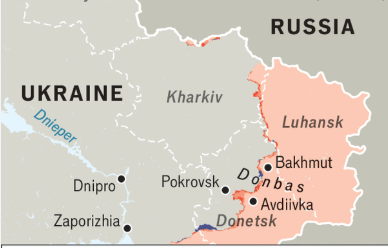
A Prelude to Victory. Pokrovsk is considered the gateway to Donbas and the key to allowing Russia to capture the rest of the region. When it was taken, it now gives Russia a new “jumping off” point into other major cities in the Donbas.
At the same time, the Russians have surrounded another major city in the north called Kup’yansk at the head of the Oskil River, not far from the provincial capital city of Kharkiv. Once Kup’yansk falls, the way will be open to surround Kharkiv. The Ukrainians have already stated to evacuate civilians from that city. These encirclement maneuvers are in addition to a major pincer movement in central Donbas focused on Kostyantynivka, Yablunivka and Toretsk.
The result is that the Russians are making major offensive moves in the north, central and southern areas of the Donbas and AFU positions are crumbling due to lack of food, ammunition and manpower. By this winter, there will be little standing in the way of a full-on Russian race to the Dnipro.
Beyond that, the Russians would look to the eventual taking of Kharkiv, Odessa and the portion of Kherson on the western bank of the Dnipro. Russian control of Donetsk, Luhansk, Zaporizhzhia, Kherson and the entire Black Sea coast of Ukraine would be complete. There would be nothing left of Ukraine except a landlocked rump state and the cities of Kyiv and Lviv.
Russian never wanted to conquer all of Ukraine. It wanted to secure the Russian-speaking areas and strategic points along the Dnipro River and the Black Sea Coast. With a much larger population, larger economy, better technology, full war mobilization, gold reserves, and the complete failure of Western economic sanctions, it is close to achieving those goals.
A Corrupt Kyiv
While Russia advances, Kyiv collapses politically. A major corruption scandal has emerged, implicating many of the top political leaders around the Ukrainian military dictator Zelensky. The accusations involve kickbacks and bribes from major Ukrainian energy companies.
This is the same racket that Hunter Biden and the Biden Crime Family conducted from 2014 to 2022, but on a larger scale. One key figure close to Zelensky has already fled to Israel (which has no extradition treaties). Zelensky’s top aide Andrii Yermak has recently resigned. All signs point to Zelensky himself being implicated in this scandal.
The only real scandal is why this current scandal wasn’t revealed earlier. This corruption has been going on in Ukraine for over thirty years. A lot of the corrupt money was being funneled back to the Democratic Party, which is why the U.S. never pursued the matter under Obama or Biden. When Trump tried raising the issue in 2019, he was impeached for just discussing it on the phone.
The implication is that the U.S. is now allowing the investigation to move forward because it’s time for Zelensky to move to one of his mansions in Miami, Dubai or Spain. The anti-corruption commission in Ukraine is controlled by U.S. appointees and funded with U.S. money. The message to Zelensky is to sign the Trump peace treaty or run for your life – perhaps both.
Three Choices for Trump
This brings us to the peace process currently underway. Top White House negotiator Steve Witkoff, aided by Jared Kushner and Secretary of State Marco Rubio, have just met with Putin in Moscow after discussions with Zelensky and NATO allies including the UK, France and Germany.
The Trump peace plan began a few weeks ago with 28-points. These points were narrowed down to 19-points after discussions with Zelensky. The exact text of this plan has never been revealed to the public and it is a work in progress.
In the main, we know it would cede the Donbas, Zaporizhzhia and Kherson to Russia up to the Dnipro River. Russia would give up a small patch of Ukrainian territory in the Sumy region, which was never on Russia’s list of goals. Russia would also give up its designs on Odessa. Ukraine would agree never to join NATO and maintain a kind of neutrality between east and west.
Russia’s list of demands to end the war has scarcely changed since before the war. It includes demilitarization, de-Nazification, neutrality, no NATO membership and protections for the Russian-speaking population. As Zelensky attacked the Russian Orthodox Church in Ukraine, Russia’s list expanded to include protections for the Church.
The biggest change in the Russian position has involved the annexation of Ukraine territory into the Russian Federation. Russia began the war with Crimea and quickly expanded its territory to include the Donbass. The longer the war lasts, the more territory Russia gains. There should be no expectation that Russia will return any of this land except Sumy. Today, Russia claims Ukrainian territory up to the Dnipro River that is has not yet occupied but expects to in the ongoing offensive.
The Russian position is very close to the original Trump 28-point plan – close enough to get a deal done. The problem is that NATO and Zelensky have changed the Trump deal in the last two weeks of negotiations. These changes include “boots on the ground” in the form of a peacekeeping force comprised of NATO troops and security guarantees that would oblige NATO members to come to the aid of Ukraine in the event the Russians engaged in future military action. Of course, Russian military action could easily be provoked by Ukrainian covert operations or drone attacks.
In short, the Ukrainian additions to the original peace plan amount to NATO status without formal NATO membership and lay the foundation for a new war. It would be the same package of lies the west has served up to Moscow in the Minsk I and Minsk II agreements, not to mention the Maidan “color revolution” in 2014 orchestrated by CIA, MI6 and Ukrainian Nazis.
Trump’s Choices. While the outcome is uncertain in the war, the timing is not. We’ll know within a week or two which way this is going. Russia wins in every scenario.
The Trump team is between a rock and a hard place. If they push the modified peace plan with the Ukrainian changes, Russia will say no. If they agree to the Russian position with slight concessions by Moscow, then Ukraine, France, Germany and the UK will say no.
Trump has three choices: The first is to stick with the modified plan, in which the case the war will drag on. The second is to agree to the Russian position and force Zelensky out of office in favor of a new leader who will agree. In that event, the war will end quickly. Western Europe doesn’t really matter in this scenario – they’re vassal states. The third is just to walk away; something Trump should have done last February when it was still Biden’s war. It’s not too late to do that, although Trump will be branded as a Putin Puppet by the DC warmongers.
My estimate is that the first scenario will play out. But Trump has enormous capacity to surprise the world, so one cannot discard the second scenario. The third scenario seems unlikely because it’s a no-win for Trump politically, even though it would be the cleanest course militarily.
While the outcome is uncertain, the timing is not. We’ll know within a week or two which way this is going. Russia wins in every scenario. The only variables are the size and speed of the victory.

Comments: