The Next Big Emerging Markets?
When countries get grouped together for economic or political purposes, an acronym or other shorthand device is soon to follow. OPEC, EU and G7 are a few of the old standards, while G20, PIIGS (European nations with dangerously large sovereign debt burdens), and of course BRICs are newer examples.
Now The Economist is getting into the game with “CIVETS”: Colombia, Indonesia, Vietnam, Egypt, Turkey and South Africa – six countries that could be the next wave of emerging markets stardom.
The Economist’s basic case: these six have large and young populations, diversified economies, relative political stability and decent financial systems. In addition, they are for the most part unhampered by high inflation, trade imbalances or sovereign debt bombs.

We didn’t think up the acronym, but we have liked the long-term prospects for most of these countries for quite a while. Here are some of our thoughts and observations.
Start with Colombia, which has had a hard time getting people to forget about its narcoterrorism past and look at its promising pro-business government policies.
I met with former President Alvaro Uribe and it was fascinating to observe his policies for social stability and job creation. Five years ago, he changed the rules and began to encourage companies to come in and help develop their oil resources. He has taken those petrodollars created and reinvested them back in the country’s infrastructure and created jobs.
That is in complete contrast to what Hugo Chavez is doing in Venezuela, or even Mexico and its energy policy. Both of those countries are watching their reserves deplete, but there’s no policy to bring in intellectual capital like you’re seeing in Colombia.
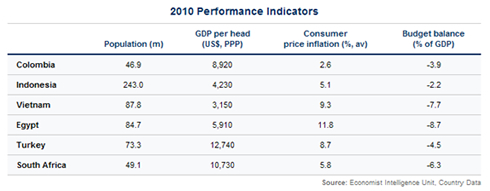
Turkey’s economy is dynamic and currently supported by strong underlying trends that point to long-term growth ahead. Its economy is the sixth largest in Europe and in the top 20 worldwide with a 2009 GDP of $615 billion. Turkey’s per capita GDP of just over $8,700 is greater than any of the BRICs. Industrial output leaped by 21 percent in the 12 months ending March 2010, inflation fell to 6.1 percent last year from double-digit levels a year before, and public debt is less than 40 percent of GDP.
And while Europe still makes up more than half of Turkey’s exports, the current government has taken steps to increase exports to Middle East trading partners – Saudi Arabia, Iraq and Egypt – as a hedge against economic volatility in Europe.
Indonesia’s demographics, natural resources and relatively stable politics have set up the country for what could be a very strong decade of growth. Its economy doubled in the past five years and in greater Jakarta – the world’s second-largest urban area with roughly 23 million people – per-capita GDP grew by 11 percent each year from 2006 through 2009.

More importantly, this growth was driven by the private sector, not by government spending – the private sector accounts for roughly 90 percent of the country’s GDP. Over the past five years, the average income has doubled to $2,350 a year and Deutsche Bank thinks that figure can rise another 50 percent by the end of next year.
Despite this income growth, Indonesia still has the lowest unit labor costs in the Asia-Pacific region, according to JP Morgan. This has attracted manufacturing activities from China. Employment growth is key because half of Indonesia’s population is 25 years old or younger, so the workforce as a portion of total population will rise over the next 20 years. This should increase the country’s consumption levels and fuel further economic growth.
Vietnam has seen rapid economic growth in recent years. It too has picked up some manufacturing base that was formerly in China. The country’s per-capita income of $1,050 last year was nearly fivefold higher than it was in the mid 1990s, and in Hanoi, the income level is closing in on $2,000 per person, according to government figures.
That new wealth is showing up in gold purchases. Net retail gold investment in Vietnam exceeded 500,000 ounces during the first quarter of 2010, up 36 percent year-over-year, the World Gold Council says. Add to that a 20 percent increase in gold jewelry demand.
Beyond the CIVETS, we see some potential in other places. Malaysia’s economy, for instance, grew more than 10 percent in the first quarter of 2010, and the country has plans to slash its budget deficit and at the same time invest more heavily in infrastructure. And in Chile, despite February’s earthquake, public debt is just 7 percent of GDP and the economy is expected to see 5.5 percent growth this year and 6.5 percent in 2011 as resource exports to emerging markets in Asia accelerate.
We see the global growth story – led by key emerging market countries like the BRICs, the CIVETS and others – as the most powerful long-term investment opportunity.

For more on this theme, I invite you to read through the Emerging Markets archives on the “Frank Talk” blog and to look at our interactive “What’s Driving Emerging Markets” presentation.
Regards,
Frank Holmes,
for The Daily Reckoning
[Note: Advanced G-20 economies references members of the G-20 whose economies are considered by the IMF to be developed. This includes Canada, United States, Austria, Belgium, France, Greece, Ireland, Italy, Netherlands, Norway, Portugal, Spain, Sweden, Switzerland, United Kingdom, Australia, Japan and Korea. Emerging G-20 economies references members of the G-20 whose economies are considered by the IMF to be emerging. This includes Brazil, India, Indonesia, Hungary, Russia and Saudi Arabia. BRIC refers to the emerging market countries Brazil, Russia, India and China.]

Comments: