The Ghosts of Bubbles Past

Global Crossing. Remember that name?
It was a darling of the dotcom bubble.
Founded in March of 1997, fairly late, the company quickly became a star. It IPO’d just 18 months later. That is unbelievably fast for a public offering.
Investors really wanted a piece of this one. And the vision was powerful. Bring fast internet to the world with a huge network of fiber-optic cable.
The investment pitch was tantalizing: we’re building the telecom infrastructure of the future.
Investors viewed the company as a toll booth on the internet.
Global Crossing’s fiber network soon spanned 27 countries and more than 200 cities. They were indeed connecting the world. Upgrading the people from dial-up to high-speed internet.
In 2001, Global Crossing raised another $1 billion and declared its network was “fully funded”.
Just 221 days later, the company declared bankruptcy.
The infrastructure Global Crossing built survived, and much is still in use today.
The company’s founder, Gary Winnick, managed to sell $700 million worth of stock before the collapse.
Bagholders got $0.
The Breakthrough That Broke Fiber
At the time Global Crossing was founded, each strand of fiber-optic cable could transmit about 2.5 gigabits of data per second (gps).
By 2000, a breakthrough called DWDM (dense wavelength-division multiplexing) made each cable able to transmit 100 gps.
A 40x increase in fiber throughput capacity. So even though the internet was still growing fast, they built way too much new telecom infrastructure. There was a glut of fiber.
The DWDM efficiency breakthrough played a big role in the dotcom bust.
Could something similar happen today? Of course.
And I believe there will be major breakthroughs which make AI far more efficient, and cheaper. Right now, around the world, there are probably 100,000 of the world’s smartest engineers working to hone efficiency and performance on hundreds of AI models.
With so much brain power focused on the problem, I don’t think AI will stay as expensive as it is today for long. We’re already beginning to see this with the newest Chinese open source AI models, which are perhaps 95% as good as the best American models, but cost 1/10th the price.
Depending on how it shakes out, such a breakthrough could cripple infrastructure companies much like DWDM did to the fiber plays.
And of course, there are also other factors to consider which could threaten the AI boom.
Data Center Stocks Crack
AI stocks stumbled again today. Hardest hit were data center stocks.
Coreweave (CRWV) is down 9.84% around midday. IREN is down 8.8%. Nebius (NBIS) is down 7.8%. Oracle (ORCL) is down about 4%.
The same concerns we saw in the dotcom are returning to haunt investors.
Too much debt. Not enough revenue.
A week ago Jim Rickards warned readers about data center stocks in the Paradigm Press App (available for Android and iPhone).
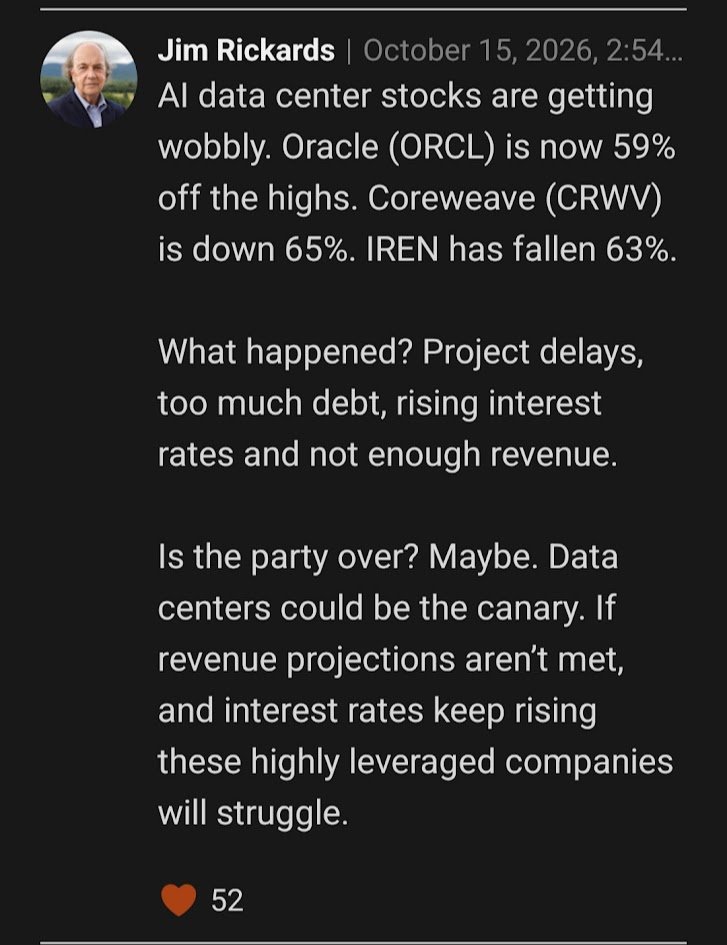
Source: Paradigm Press App
Coreweave is indeed the possible canary here. It’s the most heavily-indebted and leveraged among the “neocloud” data center stocks. It essentially buys Nvidia GPUs and rents them out. This is a very popular business model right now, and one that’s about to get a ton of new competition over the next year with new facilities going up nationwide.
And that last point Jim raised is important. Rising interest rates.
This is yet another similarity between the dotcom and AI booms. Between June 1999 and May of 2000, Greenspan’s Fed raised interest rates 6 times, from 4.75% to 6.5%. He was trying to slow the bubble down, but it just collapsed.
Today we are once again facing rising interest rates and yields. And it could get ugly considering the sheer amount of debt being used to fuel this bubble.
Leveraged to the Hilt
The AI boom is fueled by debt. Lots of it.
Morgan Stanley says in 2026 alone, companies have raised $466 billion in debt to power the AI buildout.
And there’s at least $1.4 trillion in future spending commitments (for example: you build the data center and we’ll guarantee a certain amount of rent for 5 years).
There’s debt and leverage at every level of the sector. The hyperscalers (like Amazon), the neoclouds (like Coreweave), the landlords, etc.
When something goes wrong, debt amplifies that wrongness. The key risks I see are:
- Interest rates keep rising
- A major efficiency breakthrough lowers AI costs significantly
- A flood of new data centers lowers prices and breaks the economics
- Chinese open-source models continue to improve and gain market share
Of course, it’s possible that we’re a year or more away from the bubble popping. You never really know with these things. Stocks can often climb the wall of worry longer than a rational person would expect.
But “neoclouds” and AI data center stocks sure do look risky here. With mountains of debt and locked-in future obligations, these puppies could implode unless everything goes perfectly.
With higher interest rates, not enough electricity, and rising inflation, it’s going to be a bumpy road for debt-laden darlings.
Meanwhile, parallels to the dotcom era are becoming unavoidable. We’ll continue to seek out investments which will survive and thrive during the bust and beyond.