Thank God for Capitalism

As Thanksgiving rolls around, it’s the perfect time to reflect on the abundance we take for granted. And I’m not talking about turkey, stuffing, and pumpkin pie.
I’m talking about the small daily miracles capitalism delivers: the products and services that make our lives better, easier, and more enjoyable.
Amazingly, we live in a world where people complain about “too much choice.” Numbnuts, they are.
Let’s take a moment to appreciate some of these underappreciated free-market marvels.
Decaffeinated Coffee
Decaffeinated coffee is the perfect example of capitalism solving a “non-problem” in the best way possible.
Coffee’s primary charm is its caffeine kick. It’s the main reason we can stay awake for so long and work so hard.
Yet someone thought, “What if people just want the taste, not the insomnia?” Boom! An entire industry sprouted up to cater to them.
Thanks to market forces, decaf coffee isn’t just an option; it’s a good one. Roasters and suppliers compete to provide the smoothest, richest decaf blends possible. It’s a minor miracle that you can enjoy a cup of Joe at midnight without worrying about staying up until sunrise.
Zero Alcohol Beer
A few decades ago, zero-alcohol beer was a tasteless joke. Remember O’Doul’s? Awful stuff.
But capitalism doesn’t rest.
Thanks to relentless competition and the new zero alcohol movement, breweries now offer non-alcoholic beers that taste shockingly close to the real thing. Whether it’s Heineken 0.0 or Lagunitas IPNA, the market identified a demand from health-conscious drinkers and designated drivers, and answered it beautifully.
It’s freedom in a glass.
Sparkling Water
There was a time when sparkling water was considered a luxury. Now, thanks to capitalism, you can walk into any grocery store and be overwhelmed by the variety: lemon, lime, berry, peach, cucumber mint… there’s a flavor for everyone.
While I was in NYC, I tried Hal’s New York Black Cherry Seltzer—the greatest thing since sliced bread, and with zero calories, too!
Companies like Perrier, San Pellegrino, and even private-label brands compete for your attention and dollars, driving innovation and lowering costs. Sparkling water embodies the beauty of competition. It’s not a necessity, but an indulgence made affordable for millions.
And it keeps you off diabetes-inducing Coca-Cola!
IKEA Furniture
Flat-pack furniture might not seem glamorous, but IKEA is a testament to capitalism’s genius.
Affordable, functional, and (sometimes) stylish, IKEA’s products let a 20-something furnish their entire apartment for the price of a single designer chair.
By optimizing supply chains, logistics, and even customer participation (you build it yourself!), IKEA democratizes design by removing the labor costs of assembling the furniture.
Sure, building that bookshelf will test your patience - and your marriage - but where else can you get Swedish meatballs with your sofa?
The Affordable Fountain Pen
Fountain pens were once the tools of aristocrats and intellectuals, costing a small fortune. Enter the free market, and now you can own a quality fountain pen for less than $20.
Brands like Lamy, Pilot, and Kaweco have turned what was once a luxury into an affordable everyday indulgence. Since it fits in my front pocket, I don’t leave home without my Kaweco Sport Fountain Pen. Every writer should own one. (I use my Lamys at home.)
A $1,000 Montblanc Meisterstück? Tell me you got a promotion without telling me you got a promotion.
Writing by hand with a fountain pen becomes a joy, almost romantic. That’s the magic of capitalism: it takes what was exclusive and makes it accessible and pleasurable.
PCs and Macs
Remember when a personal computer was the stuff of sci-fi? Today, whether you’re on Team PC or Team Mac, the choices are endless and affordable.
The new Mac Mini is now five inches by five inches. Ridiculous. Two years ago, I bought a Microsoft Surface Laptop Studio 2 so I can teach by drawing on my screen sometimes and model in Excel other times.
Competition among giants like Apple, Microsoft, Dell, and countless others has driven down costs while boosting innovation. Your laptop may be your tool, but it’s also a symbol of the relentless progress capitalism makes possible.
Amazon
Love it or loathe it, Amazon is Peak Capitalism.
Amazon’s vast marketplace lets you buy nearly anything and have it delivered to your door, sometimes within hours, even in the foothills of the Italian Alps.
Jeff Bezos didn’t invent online shopping, but he perfected it. Amazon's beauty isn’t just convenience; it empowers millions of small businesses to reach customers worldwide.
It’s capitalism’s algorithm wrapped in a cardboard box.
FedEx, UPS, and DHL
Logistics might not sound sexy, but imagine modern life without FedEx and UPS.
Even worse, imagine the damn USPS trying to satisfy the impulse buying of over 340 million people. Fuhgeddaboudit!
These companies revolutionized shipping, making next-day delivery a reality and global commerce seamless. Whether you’re sending a birthday gift across the country or running an e-commerce business, these private carriers prove that when capitalism competes, we all win.
Wrap Up
These examples prove capitalism’s brilliance. And they’re convenient choices.
Genuine, crony-free capitalism is a system where competition and innovation create an abundance of choices that make our lives better in ways we often overlook.
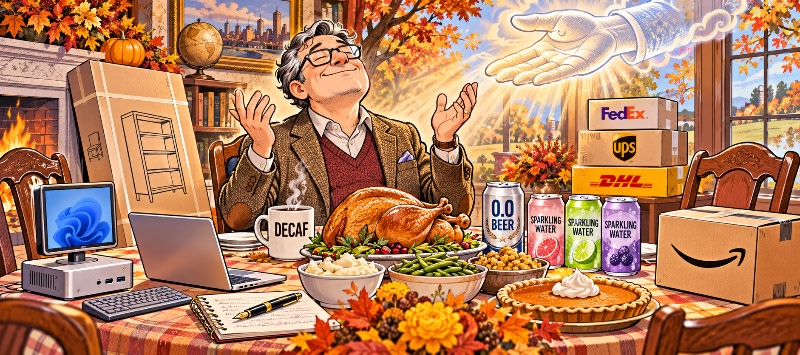
So, this Thanksgiving, take a moment to thank the Invisible Hand as you sip your sparkling water, jot notes with your fountain pen, or order a flat-pack table from IKEA. It’s working harder than ever to deliver the miracles we enjoy every day.
Happy Thanksgiving!