Harvard’s Gold and the Lost Art of Reading Rocks

This is the Ram’s Horn, an example of what’s called “wire gold,” part of the vast collection at Harvard’s Mineralogical Museum.
It’s an inch thick at the base, just over four inches long, and tips the scale at 263 grams (about 8.4 oz.). You could calculate its raw metal value, but this specimen is unique to the point of pricelessness.
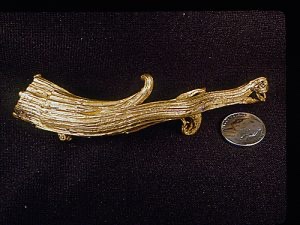
Ram’s Horn Gold. Credit Harvard University.
Ram’s Horn formed deep in the earth and in 1893 was pulled from the long-closed Ground Hog Mine at Battle Mountain, in Eagle County, Colorado (namesake for the new and innovative Battle Bank, by the way).
Gold rarely grows as a nearly single crystal, in one direction, but as the photo shows, this one resembles a bundle of thick yellow wires ending in curly terminations. A few years ago, Harvard sent Ram’s Horn to Los Alamos National Laboratory, where physicists bombarded it with radiation (it wasn’t damaged). The Horn is up to 30% silver; unsurprising given the geochemistry of Colorado’s gold belt.
I mention this because I recently visited Harvard (my alma mater) to see a new exhibit, “The Origins of Gold,” curated by the effervescent Professor/Curatrix of Collections Raquel Alonso-Perez.
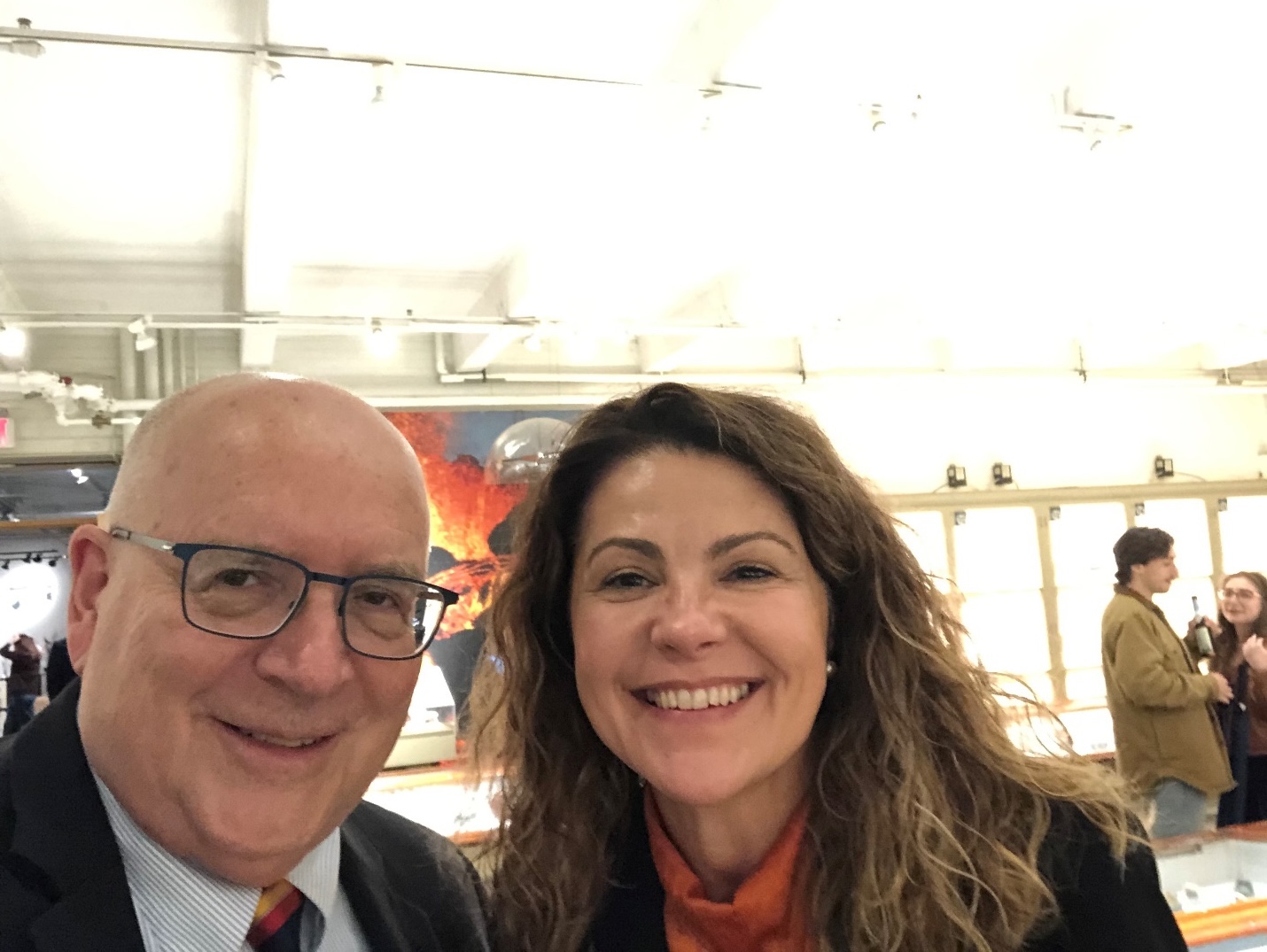
Your editor and Harvard’s Curatrix of Minerals, Raquel Alonso-Perez. BWK photo.
We looked at a slew of astonishing minerals, and discussed mineralogy which may seem dry, but is fundamental to keeping modern society running.
So, let’s look at gold and discuss minerals.
Gold, From the Ground Up
Walking into the museum, I had an odd sensation of time folding back on itself. I first saw some of those specimen cases long ago, as a wide-eyed student, learning the difference between something shiny and pretty, versus an object that tells you something.
Now I was back as an Old Guy who spent decades “kicking rocks” everywhere from Alaska to South Africa, Chile to Kyrgyzstan. And some of those Harvard cases had not changed much (full credit to superb curation by Prof. Alonso-Perez); but I sure had.
Gold is the star of the show because it always shines. It’s been pulled from riverbeds and hard rock deposits for perhaps 40,000 years, and a gleaming specimen still stops people in their tracks.
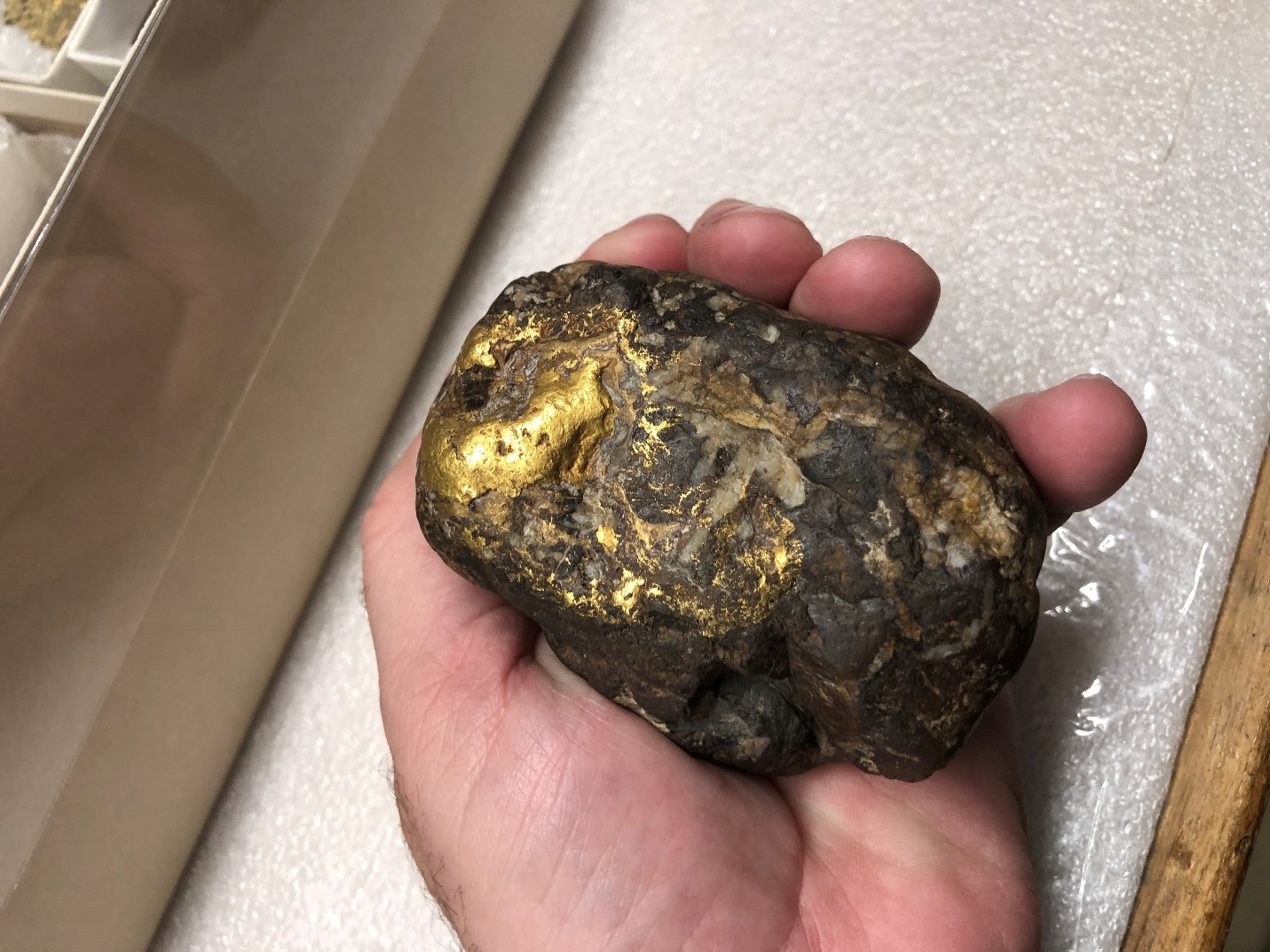
A fistful of Alaska gold. BWK photo.
What struck me was the question in the title of the Harvard exhibit. Not “Where is gold?” or “What is gold worth?” but where did it come from, and why is it here? That question separates the casual visitor from a geologist.
I had a long talk with Professor Alonso-Perez, whose enthusiasm for mineralogy is contagious. She understands that a specimen is never “just” a specimen. A nugget of gold or a crystal cluster is a record of ancient fluids moving through rock, of heat, pressure and chemistry that favored one element over another across spans of time we can barely imagine.
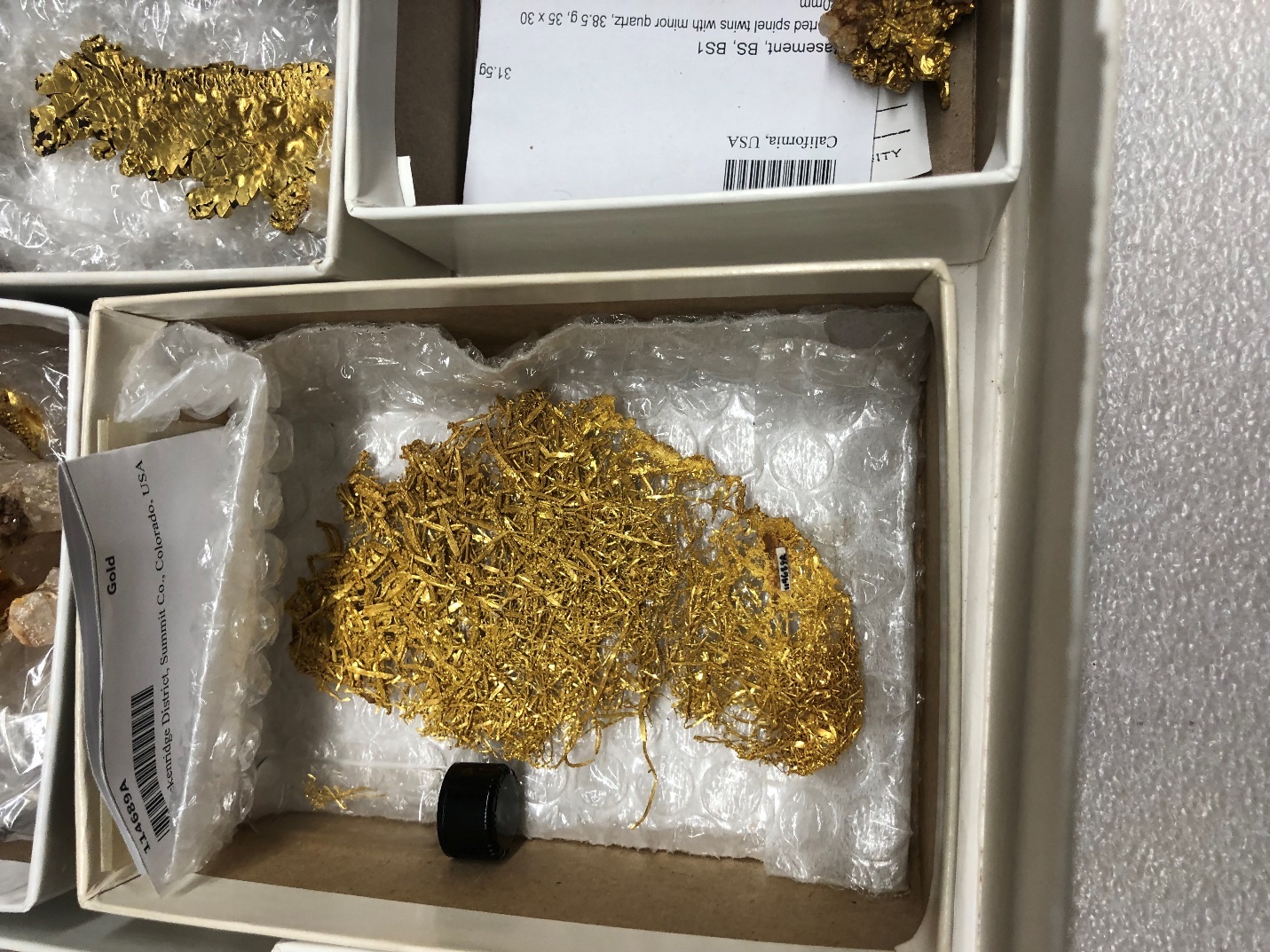
Gold crystals from Breckenridge, Colorado. BWK photo.
A geologist learns to read that record; or not. Without that skill, you’re standing in a library full of books written in a language you don’t know. Which brings me to a particular fear for the future.
That is, I’m concerned that across American academe, industry and within Big Government Science, our system produces too many people who cannot read the language of rocks; namely, we’re not teaching mineralogy and crystallography.
The Quiet Collapse of Mineral Education
Let’s follow the numbers. A 2024 review of roughly 50 US university-level geoscience programs, published in GSA Today (Note: GSA = Geological Society of America) found that only about half require a rigorous course in mineralogy. And petrology, which is the study of rocks, is required by just 56% of programs. So, a student can graduate with a so-called “geology” degree, yet the true study of what rocks are actually made of is optional at half the schools.
A recent survey by the Mineralogical Society of America documented falling enrollments in mineralogy and petrology. The fact is the many geoscience departments are squeezed for credit hours and faculty, and have folded distinct courses in mineralogy, optical mineralogy and petrology into a single survey called “Earth Materials.”
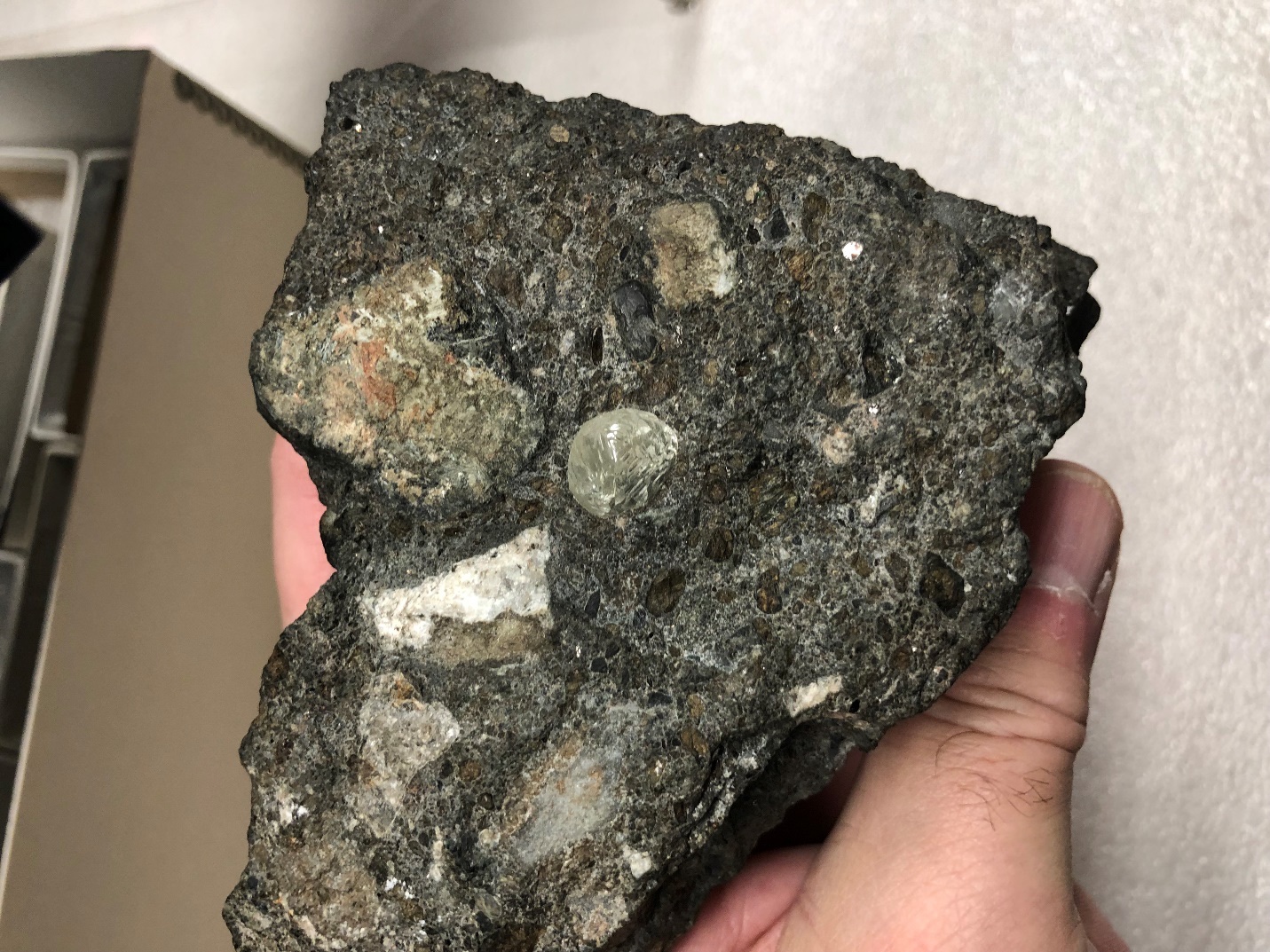
South African kimberlite with raw diamond. BWK photo.
Optical mineralogy – identifying minerals in thin section under a polarizing microscope – has been especially hard hit, while crystallography now survives mostly as a few lectures inside other classes; or perhaps in chemistry or material science programs.
Okay, yes; I understand the pressure of falling enrollments, rising costs, and how degrees must fit inside a set number of credits. And classical subjects like minerals and crystals must compete against newer fields like big data, AI, climate, GIS and planetary science. They all clamor for space; all are worthy.
But something has been crowded out; it’s a missing body of knowledge that is foundational to geology, earth science, climate, planetary science, and even metallurgy and materials science.
Minerals, Doctors and Anatomy
Over many years of kicking rocks, I’ve detected a dangerous assumption: namely, that a working geologist does not need deep knowledge of rock-forming or economic minerals, because “the software” or “the instruments” will do it. Just send samples to the lab and wait for the numbers.
That’s like saying a doctor doesn’t need to study anatomy because we have MRI machines and CAT scans. Noooo!
That is, the machine gives you a picture, but someone has to know what they’re looking at. Minerals are, in essence, the organs and tissues of the planet’s crust, and if you don’t understand the parts, you can’t tell when the instruments are wrong.
Mineralogy is the foundation of petrology, geochemistry, economic geology, exploration, mining and energy. When I look at a prospect, whether gold, copper, rare earths, tungsten, antimony and more, my first questions are mineralogical: What phases are present? How did they form? How will this ore behave in a mill? Get those wrong and you can spend hundreds of millions of dollars proving up a big mistake.
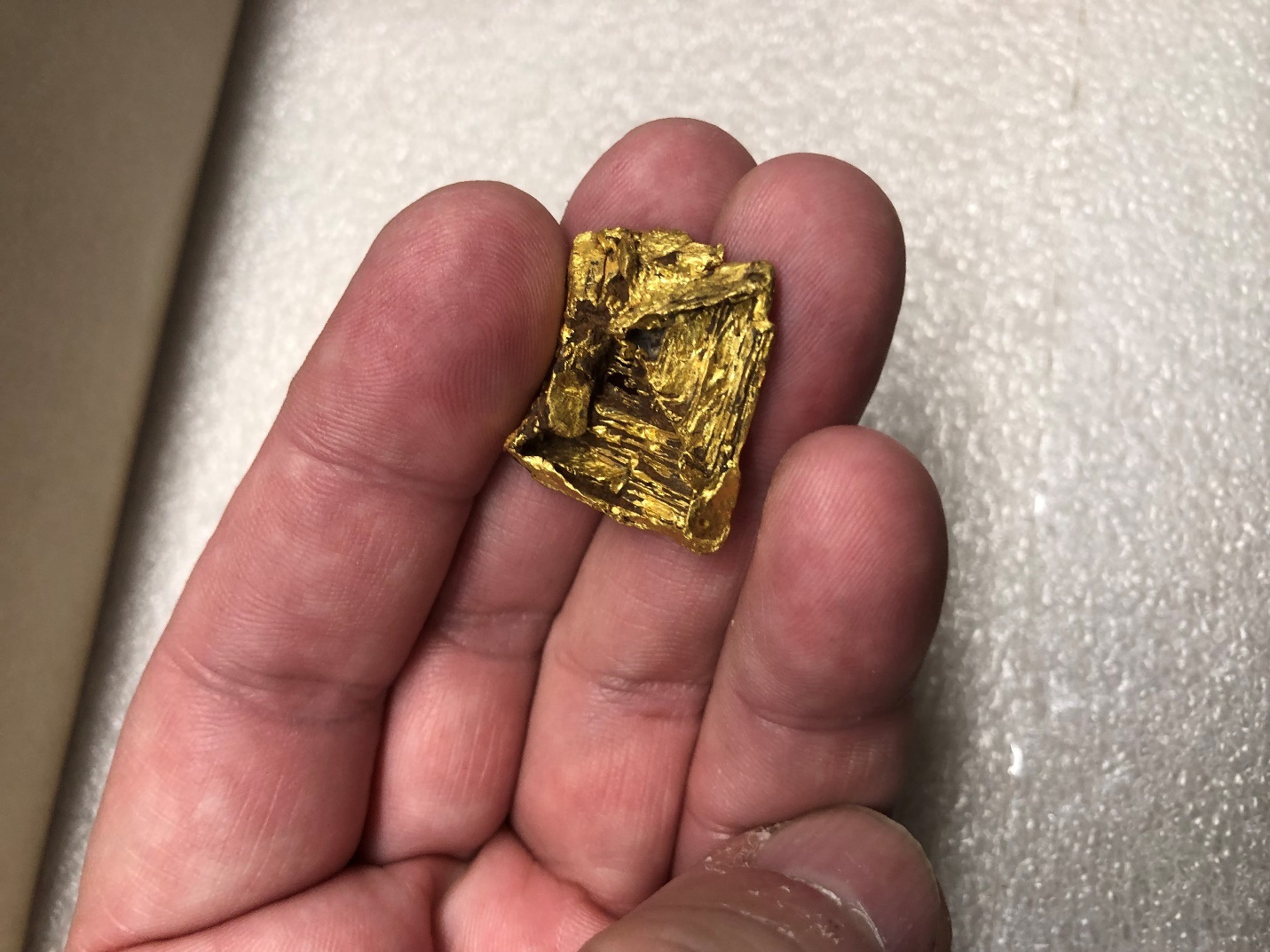
Cubic crystalline gold from Colorado. BWK photo.
That’s what I do in my work with Paradigm Press: look for where and why economic concentrations of minerals or energy can form, and whether anyone can make money from them.
The Electrons In Control
Mineralogy rests on chemistry, which is controlled by electrons. In native gold (or silver, copper, many other metals), loosely bound valence electrons are shared across the whole structure in metallic bonding, a “sea” of electrons found around positive ion cores. That’s why some metals conduct electricity, are malleable, and shine.
Crystalline gold from Colorado. BWK photo.
To get a little bit geeky, in most minerals the bonds range from ionic to covalent. Transition metals such as iron, copper and chromium carry partly filled “d”- and/or “f”-orbitals that channel energy, govern color, magnetism, phosphorescence and more. It’s why ruby is red and emerald is green, though both owe their color to chromium. Or it’s why rare earth elements have such exotic properties in high tech applications.
The same logic explains why certain metals concentrate in certain minerals, and why some move through weathering while others – like gold! – stay put.
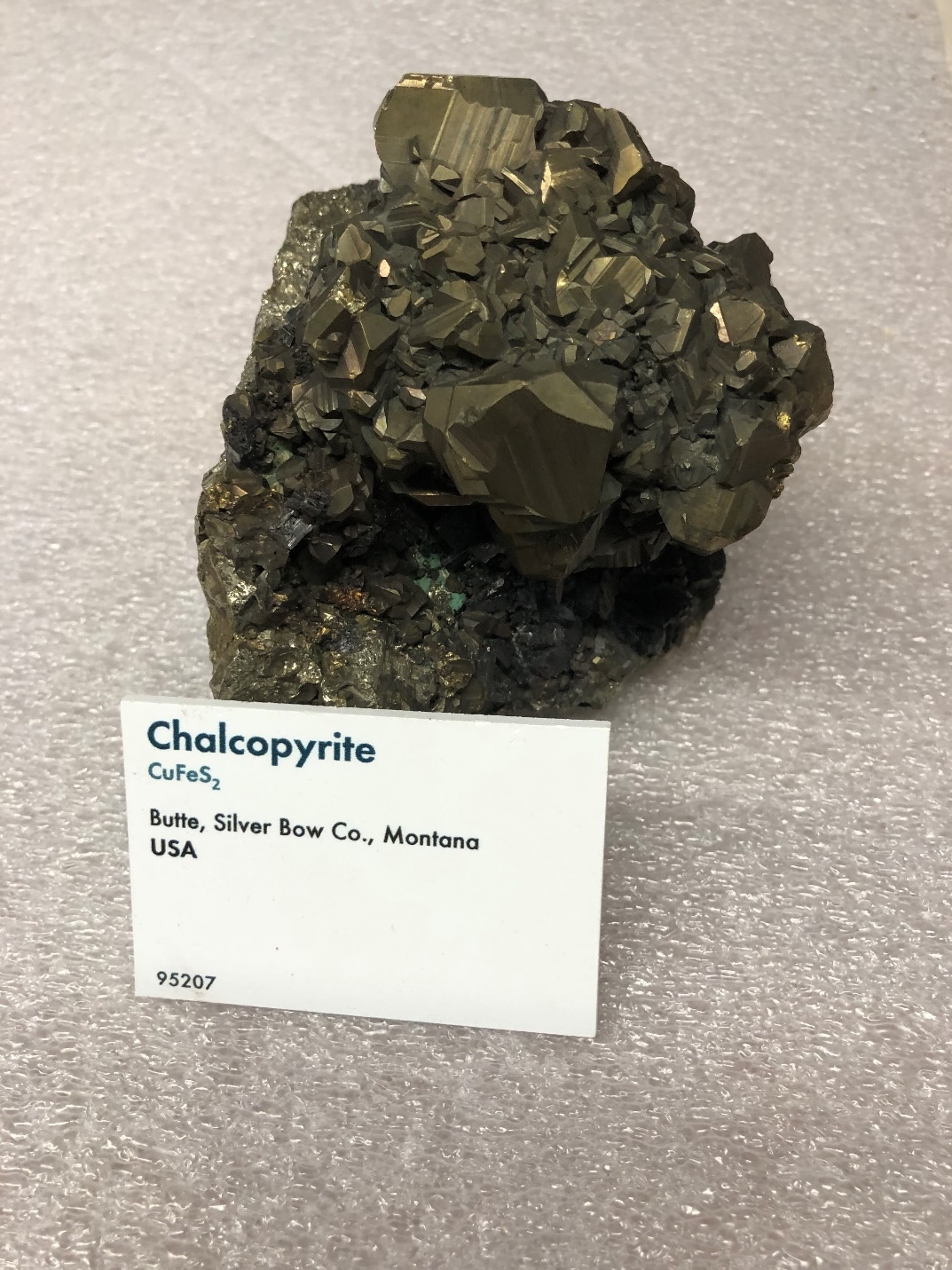
Chalcopyrite from Montana. BWK photo.
Know this, and a mineral is no longer just a name and formula on a label. It’s a set of rules that explain why metals partition into one phase and not another; miners and metallurgists definitely must know this. And this is also the same basic chemistry that materials scientists use to design batteries, magnets, catalysts and semiconductors.
In other words, minerals are nature’s prototypes. The electron bonds and structures that make a good magnet or a good battery cathode often have a natural cousin in the mineral kingdom.
The Education Pipeline Gap
Now, let’s consider American industry. The U.S. mining engineering pipeline has shrunk from about 25 university programs in the early 1980s to 14 today, graduating perhaps 150 to 200 mining engineers a year, many of them foreign students. Meanwhile, about half the domestic mining workforce is nearing retirement.
Economic geologists with real ore-deposit training are scarce; while people who understand mineral processing and metallurgy – the bridge between a rock and a “specification-grade” material – are thin on the ground. Across the mining industry, people tell me they struggle to find young grads who can dissect and assess the chemical and economic potential of a complex mineral assemblage.
Now look overseas. One estimate puts China at more than 3,000 mining engineers in a recent year, against fewer than 200 in the US. That is, Beijing treats critical minerals as national strategy, and its universities integrate mineralogy, processing and metallurgy with industry.
Russia also has a deep tradition of minerals and crystallography; Germany and Scandinavia link it all back into chemistry and materials science; and to their credit, Australia and Canada sustain hands-on economic geology programs.
The U.S. still does superb research, and a handful of schools remain world class. But in building a broad pipeline, we are far behind our competitors, and they know it.
Why does this matter? Because we’re in a global race for resources. The world wants lithium, cobalt, nickel, copper, rare earths, antimony, tungsten and – yes! – gold on a scale never seen before. Finding ore takes geologists who know minerals; development takes engineers who understand ore; processing takes metallurgists who can handle mineral structures. Every link depends on mineralogical literacy.
You can mine a mountain inside-out, and still lose if you can’t convert ores and concentrates into something a battery maker will buy. And much of that midstream skill is no longer resident in the U.S.; we’re becoming a nation that can’t read its own rocks.
Back to Those Mineral Cases
I’m still grateful for what I learned at Harvard long ago, and truth be told it wasn’t easy. Mineralogy demands a good eye, patience and a willingness to master math, physics and chemistry that seem arcane but repay you for life. (Ask me how I know.)
The remedy is not mysterious. Geology and earth science programs – and chemistry and physics departments too – must get back to teaching mineralogy and crystallography.
Bring back optical mineralogy! Rebuild economic geology and mineral processing! Make Rocks Great Again!
Basically, universities must reconnect with miners and mines, and break the news to young people that holes in the ground are not dead ends; indeed, mines are the entry point to the most strategic resources of the 21st century.
The gold exhibit at Harvard’s Mineralogical Museum reminds even casual visitors of the importance of materials that come from the ground. At the end of the day, people must understand minerals because those doggone rocks are not going to explain themselves.
That’s all for now. Thank you for subscribing and reading.