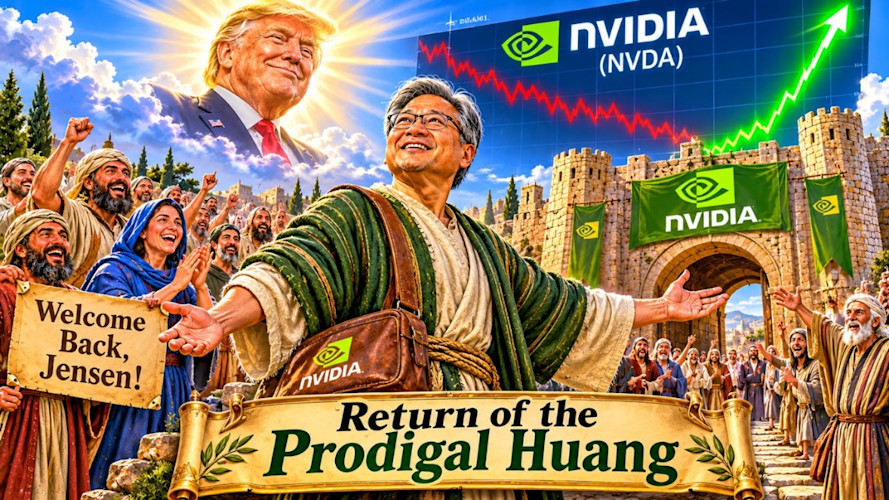
Return of the Prodigal Huang

What a story! A man cast out and now returned. Less than two weeks ago Jensen Huang “resigned” (ha!) as chief executive of Nvidia (NVDA), the company he co-founded in 1993. This Monday the board voted unanimously to bring him back, effective immediately.
It’s the parable of the Prodigal Son, with one difference: the father didn’t run down the road to meet him. The White House did.
Indeed, just six days before this reversal of fortune, board chairman Harvey Jones told investors the board didn’t intend to reinstate Huang. But then, President Trump spoke to the board “directly and indirectly,” per news accounts. And Nvidia announced it had “received input from senior levels of the United States government,” to the effect that Huang’s return “poses no national security risk.”
And hey, whaddaya know? Nvidia’s stock, down roughly 25% since the resignation, jumped about 30% in early trading. Draw your own conclusions. Was the cure meant for Huang, the company or the market?
But don’t be distracted by theatrics. The real story is in Beijing.
Spheres of Influence
Last week in Shenzhen, China, Donald Trump sat down with Xi Jinping and Vladimir Putin. Some observers called it Yalta 2.0, referring to a 1945 conference in which the U.S., Soviet Union and Britain carved up the postwar world.
Perhaps it really was Yalta Redux; but one item definitely on the agenda was computing power. For two years Washington powerbrokers argued over whether to sell China the H200, a powerful AI chip made by Nvidia.
Then on November 17, Nvidia announced it would no longer ship high-end chips to China. Naturally, the D.C. intelligentsia asked, “who lost the Chinese market?”
And that’s the wrong question! Because whomever sits in Nvidia’s corner office – Jensen Huang or Joe Blow – one rock-solid principle of China’s internal security apparatus is that their nation will never depend on American-controlled technology, least of all chips and AI.
In fact, Beijing never meant to hand anyone that valuable internal market; it meant to take it. Which brings us back to Shenzhen, and a world sorting itself into spheres of influence:
- America keeps the Western Hemisphere and sea lanes.
- Russia keeps its near abroad. And…
- China keeps Asia’s landward and coastal approaches, with a total lock on tech within that sphere.
But a sphere of influence is only as good as its internal industries of production: the energy, mines, mills, factories, shipyards, munitions, and now the computers that run modern war. A great power that rents its machinery from a rival doesn’t have a sphere; it has a lease, and Beijing understands this in its bones.
Long ago, Mao Zedong preached “self-reliance” while Chinese cities went hungry. Then Deng Xiaoping counseled China to “hide its brightness and bide its time,” which reflected patience, not modesty.
More recently, Xi Jinping put it all on paper in a mandate called “Made in China 2025,” which feeds the current and future Five-Year Plans. In other words, China views any significant dependence on outsiders as unacceptable vulnerability.
Learn, Copy, Replace
With singular focus, China pursues its own self-interest, one industry after another. China opens the door and invites foreign capital. The price of admission is a joint venture, a local partner, and technology transfer. The visitor brings the tech, China studies it, and in a few years there’s a Chinese version for sale; first at home, then to the world.
Look at high-speed rail. In the 2000s Japanese, German, and French firms sold trains and know-how into China. Beijing rebuilt the designs, called the result Chinese, and now exports rail, competing with its teachers.
Look at nuclear power. China cut its teeth on Russian reactors, then added Westinghouse’s AP1000 design. The Chinese studied it all, built their own units, and now fields a domestic design.
Look at shipbuilding. Korean and Japanese yards led the world until Chinese state-backed yards absorbed their methods. Today China builds most of the world’s commercial tonnage.
Or autos. Whether it was GM, Mercedes, Volkswagen or others, the rule was always a joint venture with a state-owned partner. Then, Chinese firms learned the factory, the supply chain and the logistics, and passed their teachers on the road.
None of this is a conspiracy theory; it’s Chinese industrial policy. Foreign investors show up with dreams of the so-called “China Market.” Over time, they wind up competing globally against knockoffs of their own products and ideas.
China’s Army-Companies
Now add the People’s Liberation Army (PLA) which does not buy from a market the way the Pentagon does. China runs a policy called military-civil fusion: the state wants civilian technology to serve the army, and military research feeds the economy.
China’s big state defense groups, aerospace giants, shipbuilders, nuclear and electronics conglomerates and more all sit at the center of a web of subsidiaries, institutes, and universities. Almost all are related to various military organizations.
In China, the line between “private” and “military” is a distinction without a difference. A Chinese company can be a genuine private enterprise yet still answer to a Party committee and hold state contracts, all subject to a national-security law that obliges it to help the state’s intelligence work.
One example is Huawei, nominally private but also a national champion that works closely with the Party and PLA. Indeed, the PLA has a name for the goal: “intelligentized warfare,” meaning war run on AI, sensors, and data at speed. Which brings us back to foreign tech, because you can’t run your own military on someone else’s computer chips.
For China, a PLA-adjacent company like Huawei gives the military a supplier that speaks its language, takes its orders, and shares its secrets. It also gives the PLA a window into civilian tech breakthroughs.
For example, when a Chinese cloud firm trains a better AI model, PLA reps are just down the hall. When a chemical plant masters a new process for, say, rocket motor propellants or structural composites, PLA missile makers are first in line.
You’ll find the same approach in other sectors: commercial and naval shipbuilding, nuclear power, space launch and satellites, jet engines, machine tools, chemicals, software and much more.
A Chinese planner looks at AI compute and sees the next ship, reactor, or rocket, but NOT with any dependence on foreigners. Self-sufficiency in high tech is the foundation for larger goals, if not global industrial dominance. A country that can build every link in the chain can’t be blockaded, sanctioned, or switched off.
What the Nvidia Fight Was Really About
Okay, back to Nvidia: strip away the lobbying and personalities, and the national-security case against Nvidia’s China sales was simple. It was never about Chinese gamers buying graphics cards. It was about moving frontier computing to a country whose engineers copy what they’re given. Every advanced chipset, software library, reference design and cluster blueprint gives Chinese teams something to study, reverse, and rebuild.
The evidence that the military wants this equipment is wide open. Not long ago, a congressional commission reported that the Chinese military remains fixated on Nvidia’s H200 for “intelligentized warfare,” because homegrown parts such as Huawei’s Ascend still trail what’s in the West.
Nvidia argued that if America refused permission to sell, Huawei would invent its own versions and grow stronger. Well, yes. But Beijing will favor Huawei in either case, because the whole idea is that China never relies on American-controlled technology, least of all for AI. The argument about whether to sell chips to China was about timing, not destination.
Beijing Says “No, Thank You”
Now we reach a part of this saga that much of Washington has missed: the main obstacle to Nvidia selling high-end chips to China has long been Beijing. For example, Chinese customs forbade import of most Nvidia chips. And Chinese regulators told big firms to slow down or pause orders, and to justify why domestic parts wouldn’t do.
When some Nvidia chips finally arrived, Beijing ordered Chinese firms to keep their allotment outside the mainland so Huawei wouldn’t lose sales. In other words, this isn’t China begging for chips; it’s government management of internal demand to encourage a domestic industry.
Meanwhile, every American restriction teaches Beijing the same lesson it learned from rail, reactors, and ships: don’t depend on the same people who can cut you off. In this respect, Nvidia’s share of chips installed in Chinese data centers has gone from double digits to a rounding error, and China’s planners count that as progress.
Again, going back to Trump’s trip to China last week, the American side floated U.S.-China cooperation on agriculture, energy, and even superintelligence. Well, sort of… Washington wants sales, tariffs, and a calmer relationship, while Beijing wants time, access, and permission to keep building and to close its technology gaps with the West.
In terms of Great Powers and global influence, the real question for China, the U.S. and Russia are who supplies the machinery inside each new sphere of influence. A China that runs on Huawei silicon, Chinese reactors, Chinese cars and ships, and basically “Chinese everything” has an enduring future.
But a China that depends on American chips from Nvidia has a sphere of influence and power with a kill switch; entirely unacceptable in Beijing.
Three Takeaways
When it comes to China, don’t process Nvidia news like it’s political news from Washington. These are two different worldviews:
- China’s self-sufficiency drive is a national strategy, not a moneymaking trade. Foreign investment is a classroom, and the assignment is to learn, copy, and replace.
- The PLA and Chinese industry are not separate worlds. Captive firms in aerospace, chemicals, electronics, and AI make the “private sector” a part of China’s national defense complex.
- The Nvidia dispute was about technology transfer, but rest assured that China won’t accept dependence on American-controlled AI; the only question is how fast it can build what it needs.
What This Means for America
The lesson for Washington is plain. If China is building a sphere of influence with its own energy and industry, America needs the same on its side of the ocean. America should keep its best chips and tools out of the hands of a rival’s military, enforce the rules it writes, and stop pretending that revenue and security always point the same way.
Meanwhile, the Prodigal Huang is home, the fatted calf is roasting, and Wall Street is cheering. Fine, although I suspect that not even the Mighty Huang can save markets from a selloff and correction that is both inevitable and overdue.
But note also that Beijing isn’t at this American feast. No, China is in the workshop, building its own chips, and it doesn’t much care about this latest U.S. corporate soap opera. Because Beijing won’t buy what it can build.
That’s all for now. Thank you for subscribing and reading.