

Helium to the Moon!
Back in 2022, I briefly worked for a tiny junior company exploring for a rare gas in Alberta. The company found an old natural gas field that eventually played out.
It didn’t run out of natural gas. It just had so much other stuff in it that the gas wasn’t economic. Natural gas is cheap. So, the wells need to produce a lot of it for them to make money.
But that wasn’t happening.
For every molecule of methane (natural gas), the wells produced too much carbon dioxide. And each well they drilled got steadily worse. But they also produced a little helium. And the further north the field went, the more helium the wells contained.
My brief time with the company got me very interested in niche commodities like helium.
We really only see them in small ways, like party balloons filled with helium. But behind the scenes, this gas is a critical commodity.
It’s the only one whose molecules are so small that they can escape gravity and leave our atmosphere. That makes it a scarce resource. And it’s incredibly useful in industries, particularly semiconductor manufacturing. And it was way too cheap for its utility.
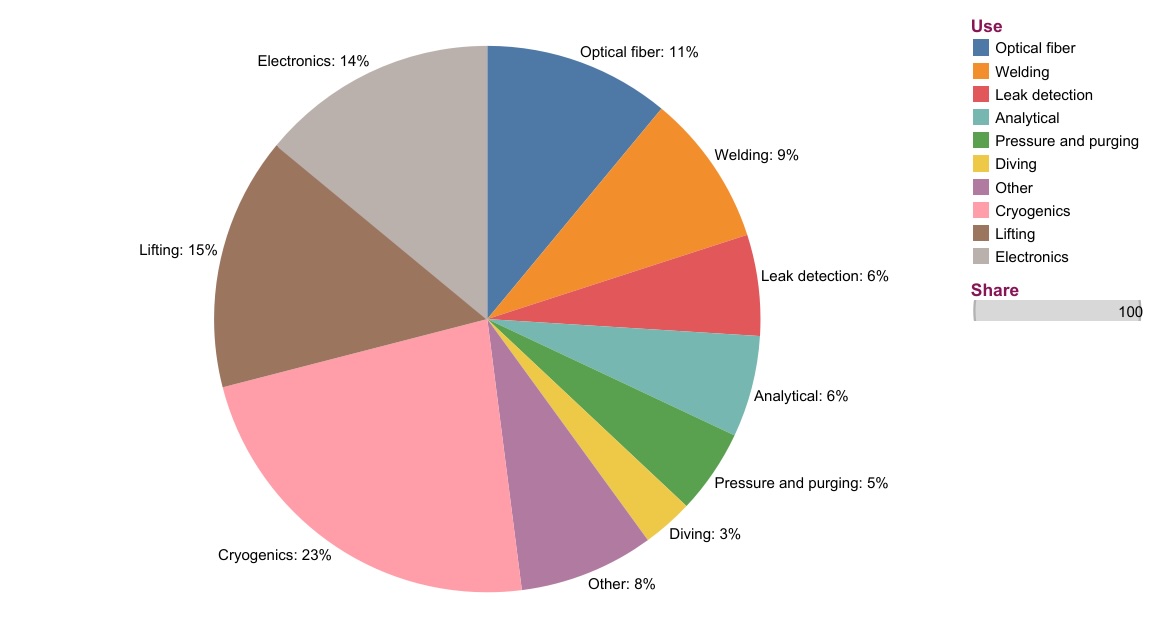
It’s inert, so it doesn’t react with any other elements. It can be used to flush out other reactive gases, to protect sensitive microchips. Semiconductor manufacturers use about 17% of all the helium supplied. The other major uses are controlled atmospheres for fiber optics and semiconductors (17%), MRI imaging (15%), and aerospace (9%).
This chart from the Canada Energy Regulator shows the global share of helium use (from 2022):
The market is relatively small. For example, the U.S. produced about 81 million cubic meters of helium in 2025. It produced 1.1 billion cubic meters of argon in comparison.
The entire global helium market was just $3.36 billion in 2025. However, it is critical to those industries. The gas comes in several grades:
- Crude helium (60% to 80% pure)
- Gaseous helium (98%+ pure)
- Grade A (99.997% pure)
There are only four plants in the U.S. that can refine the first two grades into the Grade A.
The problem is that the war in Iran cut off 20% the world’s helium supply so far. And it could have a much larger impact as the war escalates. The giant South Pars field in between Qatar and Iran produces roughly 33% of the world’s helium.
The other major suppliers are the U.S., (42.6%), Russia (9.5%), and Algeria (5.8%).
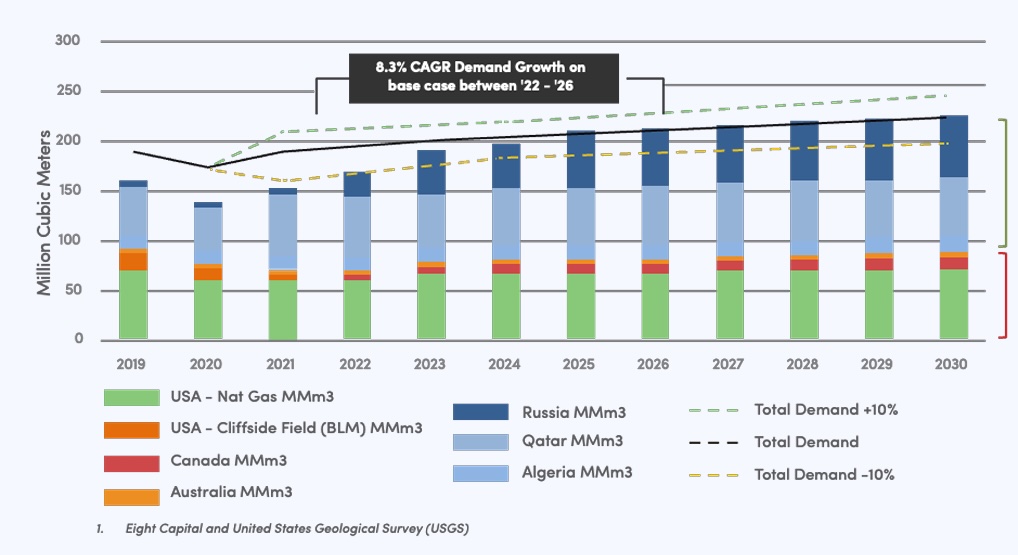
As we can see in the chart above, the U.S. suppliers should make out well from this. Air Products (NYSE: APD), Linde (Nasdaq: LIN), and ExxonMobil (NYSE: XOM) are major suppliers. DCP Midstream, a subsidiary of Phillips 66 (NYSE: PSX), runs the primary helium hub that feeds crude helium to adjacent purification plants.
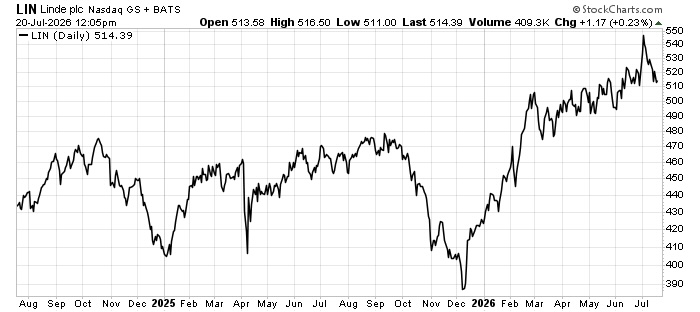
Helium is such a small market that most of it comes from either major oil and gas producers like ExxonMobil or gas makers like Linde.
There are some exploration companies out there, but buyers beware. Few of them have production. If their website is mostly about helium facts…run away. The way to play helium is through the big companies like Linde and Air Products.
And here’s the thing. The helium price accounts for less than 1% of the cost of a chip. But the industry consumes nearly 25% of all the helium. That means, in a shortage, the price can go up. Because these chip makers must have it. And they will pay the higher prices to get it.
That means helium sales should give the big companies’ earnings a boost in 2026.

Comments: